Tesla Stock Price March 2026: The $383 Paradox — Why the World’s Most Valuable Automaker at $1.26 Trillion Cannot Escape Its First-Ever Delivery Decline and 23% Crash From $498 Peak
By Senior Electric Vehicle, Autonomous Technology and Mega-Cap Growth Stock Analyst · March 27, 2026
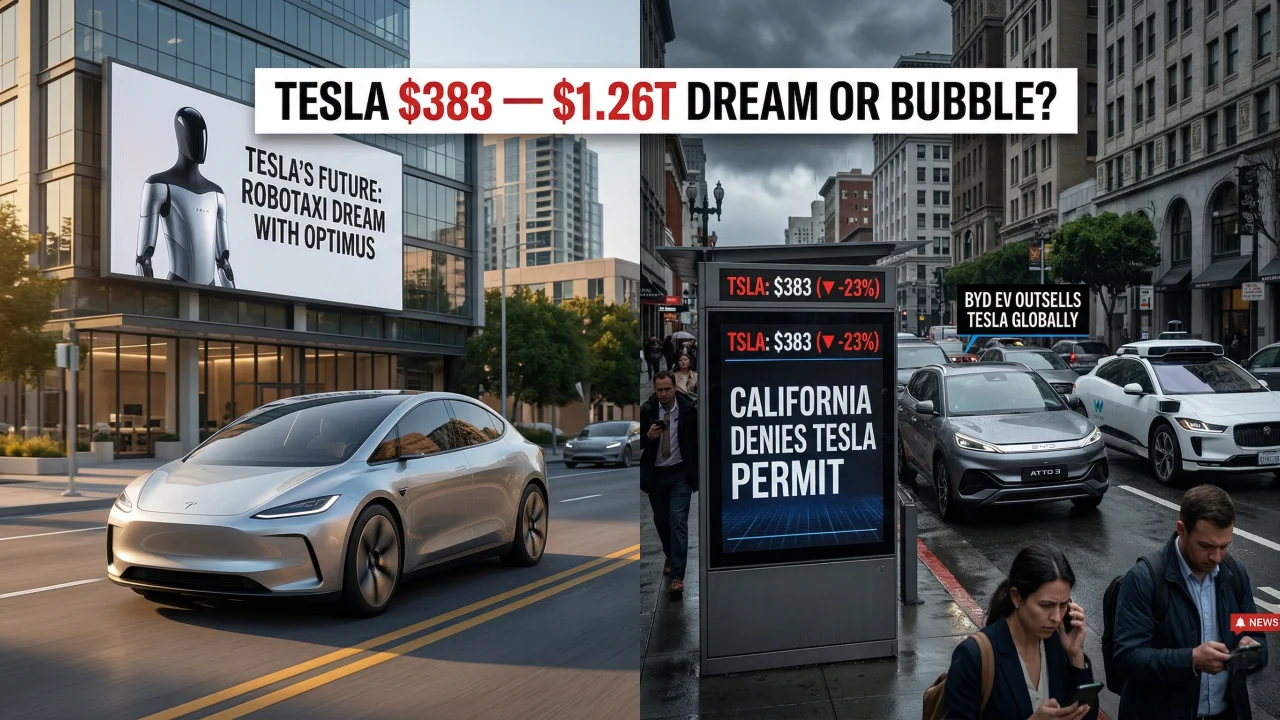
Tesla finds itself at one of the most controversial crossroads in its history as a public company, trading at $383.03 on March twenty fifth after suffering a twenty three percent collapse from the October 2025 all-time high of $498.83 that briefly valued the electric vehicle maker at over one point five trillion dollars, yet simultaneously maintaining a market capitalization of one point two six trillion that exceeds Toyota, Volkswagen, General Motors, Ford, BMW, Mercedes, and Hyundai combined despite delivering just one point seven nine million vehicles in 2025 representing the first annual delivery decline in Tesla‘s public company history. This schizophrenic market positioning perfectly captures the impossible valuation question facing investors in March 2026: is Tesla a struggling automotive manufacturer worth perhaps fifty to one hundred dollars per share based on traditional metrics like its one hundred thirty times trailing price-to-earnings ratio and sixteen point three percent automotive gross margin that has compressed from over twenty five percent in 2022, or is it an artificial intelligence and robotics company worth five hundred to one thousand dollars per share based on Elon Musk’s claims that robotaxi capability makes each vehicle a two hundred thousand dollar appreciating asset.
The fundamental challenge confronting Tesla shareholders on March twenty seventh is reconciling the company’s spectacular twelve-month stock performance of plus sixty two percent that has created or preserved billions in wealth for long-term believers, against the deteriorating core automotive business fundamentals visible in Q4 2025 revenue declining three percent year-over-year to twenty four point nine billion dollars with automotive revenue specifically crashing eleven percent to seventeen point six nine billion. Wall Street’s consensus Hold rating from twenty seven analysts with price targets ranging from JPMorgan’s bearish one hundred fifty dollars to Wedbush’s bullish six hundred dollars reveals the extraordinary disagreement about whether current three hundred eighty three dollar pricing represents the bottom before robotaxi and Optimus robot catalysts drive the next leg higher, or whether it represents a massive bubble sustained by hope and Elon Musk’s promotional genius that will eventually deflate toward realistic automotive company valuations.
The October 2025 Peak and March 2026 Crash: What Changed
Understanding Tesla’s current predicament requires reconstructing the narrative arc from the euphoric October 2025 peak at four hundred ninety eight dollars to today’s sobering three hundred eighty three dollar reality. Between April and October 2025, Tesla stock surged roughly eighty percent in one of the most aggressive rallies in mega-cap history driven not by improving car sales or profitability but by the full self-driving robotaxi narrative. Tesla launched unsupervised FSD in Austin, Texas in June 2025 followed by expansions to Houston and parts of the Bay Area, with Elon Musk claiming each robotaxi-capable vehicle represents a two hundred thousand dollar asset that will generate passive income for owners who rent it out when not using it personally.
Table 1: Tesla Stock Performance Across Multiple Timeframes – March 2026
| Timeframe | Starting Price | Current/Ending Price | Absolute Change | % Change | Key Driver | Investor Impact |
|---|---|---|---|---|---|---|
| March 27, 2026 | — | $361.83-$383 | — | — | Current trading | Real-time |
| 1 Week | ~$411 | $383 | -$28 | -6.8% | Continued selloff | Weekly loss |
| 4 Weeks | ~$411 | $383 | -$28 | -7.06% | Monthly decline | Short-term pain |
| 3 Months | ~$458 | $383 | -$75 | -16.4% | Quarterly correction | Q1 2026 negative |
| 6 Months | ~$290 | $383 | +$93 | +32.1% | Robotaxi rally then crash | Rollercoaster |
| 12 Months | ~$236 | $383 | +$147 | +62.24% | Full year strong | Annual winner |
| From Oct 2025 Peak | $498.83 | $383 | -$115.83 | -23.2% | Reality check | Peak buyers crushed |
| From 52-Week Low | $214.25 | $383 | +$168.75 | +78.8% | Recovery from bottom | Bottom buyers profit |
| Market Cap | — | $1.26-1.43 T | — | — | Valuation context | World’s largest automaker |
This table reveals Tesla’s extraordinary volatility where the stock can simultaneously be down twenty three percent from recent highs creating devastating losses for October buyers, yet up sixty two percent annually rewarding those who held through 2025’s turbulence. The six-month view shows the complete cycle from two hundred ninety dollars in September 2025, spike to four hundred ninety eight in October on robotaxi euphoria, crash back to three hundred eighty three as reality intervened.
What changed between October’s peak and March’s trough was a series of negative developments that systematically dismantled the robotaxi bull case. First, Waymo, Alphabet’s autonomous unit, now operates over two hundred thousand paid rides per week across San Francisco, Phoenix, Los Angeles, and Austin using dedicated sensor suites including lidar that demonstrate clear technological superiority over Tesla’s camera-only approach. Second, California regulators denied Tesla’s robotaxi application in February 2026 citing insufficient safety documentation, blocking access to the nation’s largest and most lucrative autonomous vehicle market. Third, the actual Q4 2025 and full-year 2025 financial results showed the core automotive business deteriorating not strengthening, raising questions about whether Tesla can fund the robotaxi pivot while car margins compress.
The Brutal Automotive Business Reality Nobody Wants to Discuss
Strip away the robotaxi dreams and Optimus robot promises, and Tesla’s actual automotive manufacturing business in March 2026 shows alarming signs of structural weakness that should concern even the most bullish long-term holders. The company delivered one point seven nine million vehicles in 2025, down one point one percent from 2024’s one point eight one million, marking the first annual delivery decline since Tesla became a public company. This isn’t a rounding error or supply chain hiccup, this is demand saturation in Tesla’s core markets where the company has achieved maximum penetration among buyers willing to pay premium prices for electric vehicles.
Revenue for Q4 2025 declined three percent year-over-year to twenty four point nine billion dollars, with automotive revenue specifically crashing eleven percent to seventeen point six nine billion as average selling prices fell due to aggressive discounting and unfavorable model mix shifting toward cheaper Model 3 and Model Y variants. The company’s automotive gross margin compressed to sixteen point three percent well below the twenty five percent plus Tesla commanded in 2022 when the EV market was less competitive and Tesla enjoyed pricing power. This margin compression reflects brutal competition from BYD which now outsells Tesla globally, legacy automakers like Ford and GM launching competitive EVs at lower prices, and the reality that electric vehicles are becoming commoditized rather than luxury differentiated products.
The fundamental problem Tesla faces is that at current delivery volumes around one point eight to two million vehicles annually and automotive margins of sixteen percent, the company generates perhaps fifteen to twenty billion in annual automotive gross profit. Even assuming aggressive improvements to twenty percent margins and two point five million deliveries by 2027, automotive gross profit reaches perhaps thirty billion. That supports perhaps a two hundred to three hundred billion dollar market cap using traditional automotive valuation multiples of ten to fifteen times earnings. Tesla’s current one point two six trillion market cap implies the market values the company at over four times what the automotive business alone justifies, meaning one trillion dollars of market cap rests on robotaxi, Optimus, energy storage, and other future promises.
The Bull Case: Robotaxi, Optimus and Energy Storage
Despite deteriorating automotive fundamentals, Tesla bulls including Cathie Wood’s Ark Invest and Wedbush analyst Dan Ives maintain price targets of five hundred to six hundred dollars based on three transformational technologies that could dwarf the car business. The robotaxi opportunity, while delayed by regulatory setbacks, remains technologically viable with Tesla’s Austin deployment proving the system works in controlled environments. If Texas and Arizona grant statewide permits in the second half of 2026, ride-hailing revenue could begin flowing with Ark Invest modeling eight to twelve dollars per share in robotaxi earnings by 2028.
Table 2: Bull vs Bear Case Analysis – Tesla Valuation March 2026
| Factor | Bull Case | Bear Case | Current Reality | Impact on Stock |
|---|---|---|---|---|
| Automotive Business | 2.5M deliveries, 20% margins by 2027 | Flat 1.8M, margins fall to 14% | 1.79M deliveries (-1%), 16.3% margin | Bearish tilt |
| Robotaxi Revenue | $50B annual by 2030, $8-12/share EPS | Stays sub-$5B, regulatory blocked | $0 (Austin only, limited) | Too early to call |
| Optimus Humanoid Robot | 1M units sold 2028, $25K profit each | Never reaches commercial scale | 1,000 prototypes in 2025 | Speculative |
| Energy Storage | Doubles to $25B revenue 2027 | Growth slows, competition increases | $12B revenue 2025, growing | Modestly bullish |
| FSD/Autonomy | Level 4-5 achieved 2026-2027 | Stays Level 2, lags Waymo | Unsupervised in Austin only | Mixed signals |
| Valuation Multiple | 50-80x forward earnings justified | Should trade 15-25x like legacy auto | Currently ~130x trailing PE | Extremely expensive |
| Price Target | $500-600 (Wedbush, Ark) | $150-250 (JPMorgan, HSBC) | Consensus $397 | Wide disagreement |
| Market Cap Implied | $1.8-2.2T | $500B-900B | $1.26T current | Depends on thesis |
The Optimus humanoid robot represents an even more speculative but potentially transformational opportunity. Tesla produced over one thousand prototypes in 2025 and plans factory deployment throughout 2026. If Optimus reaches commercial sales by 2027-2028, Musk claims each unit could generate twenty five thousand dollars annual profit creating a market larger than the entire automotive industry. Skeptics note that Boston Dynamics has worked on humanoid robots for decades without achieving commercial success, making Tesla’s timeline highly ambitious.
Energy storage through Megapack and Powerwall products represents the most tangible near-term growth driver with revenue doubling in 2025 to approach twelve billion dollars annually. This high-margin infrastructure business now represents twelve percent of total revenue up from six percent two years ago, and unlike automotive faces less competitive pressure. If energy storage reaches twenty five billion revenue by 2027 as bulls project, it provides meaningful earnings diversification.
What Investors Should Expect: The $300 to $500 Range
Your personal Tesla investment decision depends entirely on whether you believe the company is primarily an automotive manufacturer facing structural headwinds that justify perhaps one hundred fifty to two hundred fifty dollars per share, or a technology conglomerate building the future of transportation, robotics, and AI that justifies five hundred to eight hundred dollars. The three hundred eighty three dollar current price reflects the market’s uncertainty, pricing in perhaps twenty five to thirty five percent probability that the bull case materializes.
For long-term investors with five-plus year horizons who can tolerate thirty to fifty percent drawdowns, dollar-cost averaging into Tesla at three hundred eighty to four hundred dollar levels has historically rewarded patience when the stock eventually recovered on new catalysts. The April twenty eighth earnings call will provide crucial updates on Q1 2026 deliveries, margin trends, and robotaxi permit progress that could drive the stock up or down twenty to thirty percent.
For conservative investors or those needing capital within three years, Tesla at one hundred thirty times earnings trading at one point two six trillion market cap represents extreme speculation unsuitable for core portfolio holdings. The stock could easily fall to two hundred fifty to three hundred if automotive margins continue compressing and robotaxi permits face further delays. Alternatives like buying a broad market index fund or diversified EV basket reduce concentration risk.
The brutal reality is Tesla at three hundred eighty three dollars is neither obviously cheap nor obviously expensive. It’s Schrodinger’s stock, simultaneously a value trap and a growth opportunity depending on which future unfolds. Respect the volatility, size positions appropriately, and recognize that both the one hundred fifty dollar bear case and six hundred dollar bull case remain possible over the next twelve to twenty four months.
This article is for educational purposes only and does not constitute investment advice. Tesla stock involves extreme volatility and execution risks. All decisions should be based on individual circumstances.
Data: Capital.com, TradingEconomics, Public.com, LiteFinance, Techi.com, CNBC, MarketBeat as of March 25-27, 2026.