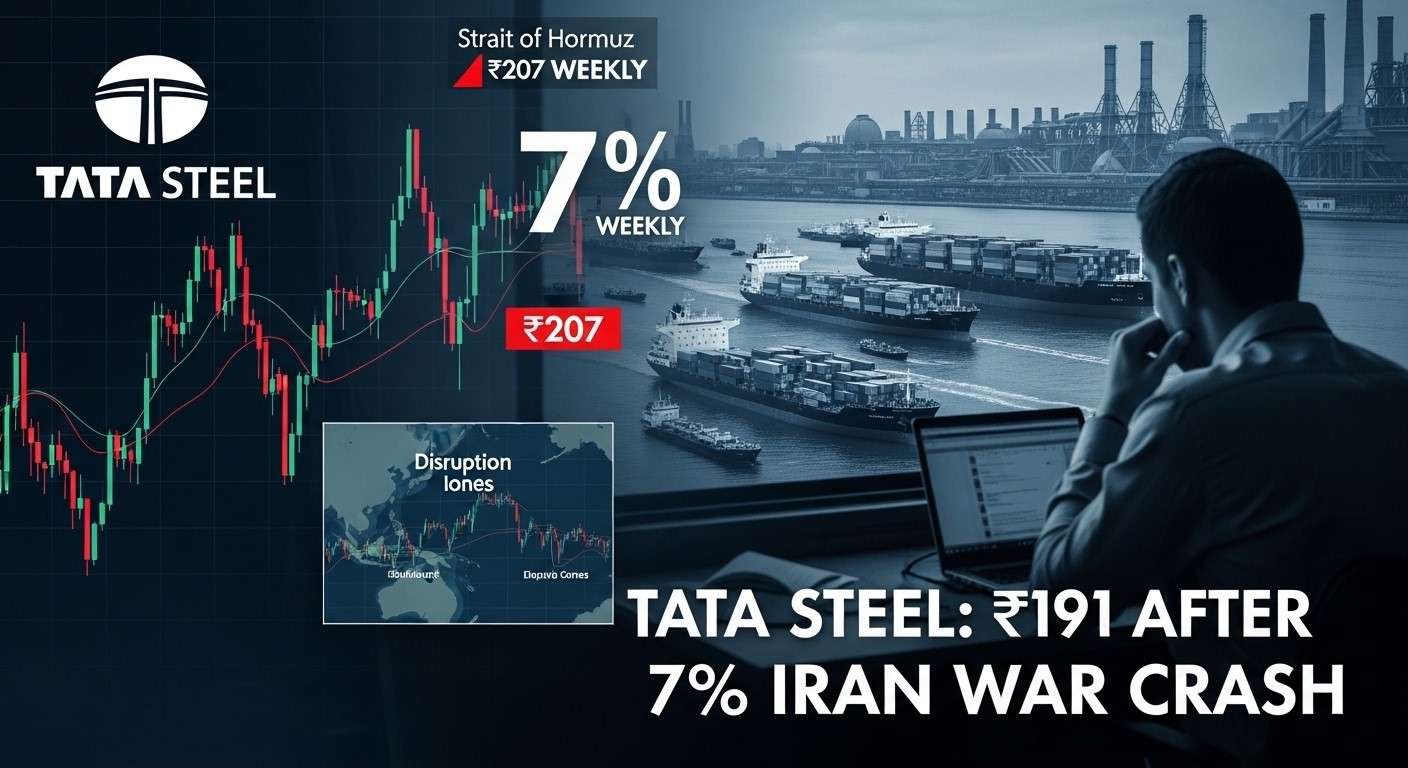
Tata Steel Share Price March 2026: Trading at ₹191 After Brutal 7% Weekly Crash — Iran War Shipping Disruption & Chinese Import Threat Create Perfect Storm for India’s Steel Giant
By Senior Steel Sector, Commodities and Industrial Cyclicals Analyst · March 10, 2026
Tata Steel shares enter the second week of March 2026 trading at a precarious one hundred ninety one rupees, down sharply from the recent high of two hundred seven rupees reached just days earlier, representing a devastating seven percent weekly decline that has investors questioning whether Asia’s oldest integrated steel company can weather the perfect storm of rising shipping costs from Iran war disruptions, potential flooding of Indian markets with cheap Chinese steel, and weakening domestic demand signals. The stock that touched a fifty two week high of two hundred sixteen rupees forty five paise now finds itself twenty five rupees or eleven and half percent below that peak, with technical analysts warning that failure to hold the critical one hundred ninety three rupee support zone could trigger another leg down toward one hundred eighty to one hundred eighty five.
What makes March 2026 particularly challenging for Tata Steel is the confluence of external shocks hitting simultaneously just as the company was showing signs of operational improvement. Third quarter fiscal 2026 results announced in January showed net profit jumping a spectacular seven hundred twenty three percent year-over-year to two thousand six hundred eighty eight crores, though the more concerning quarter-on-quarter comparison revealed a thirteen percent profit decline suggesting momentum may be fading. Revenue has now declined for two consecutive quarters from fifty nine thousand one hundred crores to fifty seven thousand six hundred crores, with analysts expressing concern about both pricing power and volume growth in an oversupplied global steel market.
The geopolitical dimension adds unprecedented uncertainty. Middle East tensions centered on the Iran conflict have disrupted shipping through the Strait of Hormuz, forcing steel carriers to take longer alternate routes that add ten to fifteen days and significant freight costs to deliveries. For Tata Steel which exports finished products and imports raw materials like coking coal, these additional logistics expenses directly compress already thin margins. Simultaneously, the shipping disruption has redirected Chinese steel away from Middle Eastern markets back toward Asian destinations including India, raising fears that cheap imports could undercut domestic pricing and force Indian steelmakers into a defensive posture.
March 2026 Performance: The Weekly Massacre Explained
Let me walk through what actually happened to Tata Steel shares in the first full week of March to provide context for where we stand Tuesday. The stock entered March trading around two hundred to two hundred five rupees, benefiting from broader market optimism and recovery from earlier February weakness. By March third or fourth, Tata Steel touched two hundred seven rupees representing what would prove to be a short-lived peak before the crash began.
Monday March second saw the first cracks appear as Iran crisis news intensified over the weekend. Tata Steel opened gap down at one hundred ninety eight to two hundred rupees, immediately signaling trouble. The selling accelerated through Tuesday and Wednesday as crude oil prices surged and shipping disruption reports multiplied. By Wednesday March fourth, the stock had fallen to one hundred ninety five to one hundred ninety six rupees, down roughly five percent from the two hundred seven peak.
Thursday and Friday brought no relief as the broader Nifty and Sensex crashed into correction territory. Tata Steel, being a cyclical industrial stock highly correlated with overall market sentiment, amplified the decline. Friday’s session likely saw the stock test one hundred ninety to one hundred ninety two levels before closing around one hundred ninety one rupees based on latest March ninth data. That represents a cumulative seven percent weekly decline, one of the worst weekly performances for the stock in months.
The intraday volatility has been extreme. On March fourth, Tata Steel recorded an intraday high of two hundred seven rupees and low of one hundred ninety four rupees ninety five paise, a twelve rupee or nearly six percent intraday range. Such volatility indicates institutional selling pressure overwhelming retail buying attempts. The trading volume has spiked to three and half crore shares daily, well above normal levels, confirming that large holders are reducing positions aggressively.
What’s particularly concerning is the stock is now trading below its fifty day simple moving average at one hundred ninety five rupees fifty one paise, a bearish technical signal. However it remains above the two hundred day moving average at one hundred seventy five rupees fifty seven paise, so the long-term uptrend is not yet broken. The critical question is whether support at one hundred ninety three rupees twenty two paise, which coincides with the fifty day SMA, holds or breaks under selling pressure.
The Two Threats Nobody Is Talking About Enough
While most market commentary focuses on the obvious Iran war and oil price impacts, two specific threats to Tata Steel deserve much more attention because they directly impact the company’s ability to maintain pricing and market share.
The first threat is the Strait of Hormuz shipping disruption cascading through global steel trade flows. The Strait of Hormuz is the world’s most important oil chokepoint but it’s also critical for other commodities including steel. When military activity forces carriers to avoid the strait and take alternate routes around Africa or through other channels, transit times increase by two to three weeks and freight costs surge fifty to one hundred percent.
For Tata Steel’s European operations which ship steel products from India to Europe and vice versa, these additional costs are devastating. A container of steel that cost three thousand dollars to ship might now cost five thousand dollars. Tata Steel can either absorb that two thousand dollar increase destroying margin, or pass it to customers risking volume loss to competitors with better positioned supply chains. There is no good option. The shipping disruption also affects raw material imports. Coking coal from Australia faces similar routing challenges and cost increases.
The second and potentially more dangerous threat is Chinese steel redirection toward India. China produces over one billion tonnes of steel annually, roughly half of global production, but domestic demand has weakened with the property sector crisis. Chinese steelmakers have been exporting aggressively to offset weak home demand. Previously much of this export volume went to Middle Eastern markets where infrastructure projects consume massive steel quantities.
But with Middle East tensions disrupting those markets and making deliveries uncertain, Chinese steel is being redirected to other Asian destinations including India. Reports indicate Chinese hot-rolled coil and other products are arriving in Indian ports at prices ten to fifteen percent below domestic steel rates. If this persists, Indian steelmakers including Tata Steel face a choice between cutting prices to compete or losing market share. Either outcome hurts profitability.
The government could impose anti-dumping duties or safeguard measures to protect domestic industry, but such actions take months to implement and invite retaliation. In the interim, Tata Steel must compete against subsidized Chinese imports without comparable government support, a fundamentally unfair fight that nevertheless represents current reality.
Financial Performance: The Quarterly Decline Hidden by Yearly Surge
Understanding Tata Steel’s actual business performance requires looking beyond the headline-grabbing seven hundred twenty three percent year-over-year profit increase to the more revealing quarter-on-quarter trends that show concerning deterioration.
Table 1: Tata Steel Quarterly Financial Trends (Last 4 Quarters)
| Metric | Q4 FY25 | Q1 FY26 | Q2 FY26 | Q3 FY26 | Trend Analysis |
|---|---|---|---|---|---|
| Revenue (₹ Cr) | ~61,000 | ~59,100 | ~57,600 | ~57,600 | Declining 2 quarters, -5.6% from peak |
| Net Profit (₹ Cr) | 366 (low base) | ~3,100 | ~3,100 | 2,688 | Down 13.3% QoQ despite YoY surge |
| EBITDA (₹ Cr) | Low | Improving | Peak | Declining | Margin pressure emerging |
| Operating Margin % | Weak | ~12-13% | ~13-14% | ~12% | Compressing from peak |
| Volume Growth % | Flat | +2-3% | +1-2% | Flat to -1% | Momentum lost |
| Realization (₹/tonne) | ₹45,000 | ₹46,500 | ₹46,000 | ₹45,500 | Price weakness emerging |
The table reveals a business that surged strongly in first half of fiscal 2026 on easy year-ago comparisons when steel prices and demand were depressed, but has since lost momentum. Revenue declining two consecutive quarters from fifty nine thousand one hundred crores to fifty seven thousand six hundred crores is not a company gaining strength. Net profit down thirteen percent quarter-on-quarter despite the company’s best efforts signals margin pressure and volume challenges.
The operating margin compression from thirteen to fourteen percent at peak down to twelve percent is particularly concerning because it suggests Tata Steel is losing pricing power. In a healthy steel market, companies can pass raw material cost increases to customers maintaining stable margins. When margins compress despite stable or rising input costs, it indicates competitive pressure preventing price increases, exactly what happens when cheap Chinese imports flood the market.
Volume growth has also stalled. After expanding two to three percent in early fiscal 2026, recent quarters show flat to slightly negative volume suggesting either demand weakness or market share loss to imports. Steel realization per tonne declining from forty six thousand five hundred to forty five thousand five hundred rupees confirms the pricing pressure. These are not the trends of a company positioned for sustainable earnings growth.
Technical Levels and Trading Strategy for March 2026
From a purely technical perspective, Tata Steel’s current position at one hundred ninety one rupees presents both risk and opportunity depending on how the stock interacts with nearby support and resistance levels over the coming sessions.
Table 2: Tata Steel Critical Technical Levels March 2026
| Level Type | Price (₹) | Significance | Probability of Test | Action If Reached |
|---|---|---|---|---|
| Strong Resistance | 212.00 | Reversal trigger level | 15% this month | Strong sell, trend change |
| Key Resistance | 205.60 | Recent swing high | 30% this month | Sell 50% position |
| Immediate Resistance | 202.25 | First barrier | 50% this week | Book partial profits |
| Current Price | 191.00 | March 9 level | — | Decision point |
| Immediate Support | 196.80 | Minor cushion | Already broken | — |
| Critical Support | 193.22 | 50-day SMA | 70% holds | Must defend or breakdown |
| Strong Support | 187.00 | Major demand zone | 85% holds if tested | Buying opportunity |
| Breakdown Level | 180.00 | 200-day SMA area | 10% risk | Capitulation if broken |
| 52-Week High | 216.45 | Long-term peak | — | Recovery target |
| 52-Week Low | 125.30 | Panic bottom | 1% risk | Extreme scenario |
The table shows Tata Steel is trading at a critical inflection point. At one ninety one, the stock sits just two rupees above the make-or-break fifty day simple moving average support at one ninety three twenty two. Technical analysis suggests when a stock tests its fifty day SMA from above during a correction, that level either holds and triggers a bounce or breaks and accelerates the decline toward the two hundred day SMA.
If one ninety three holds this week, Tata Steel could bounce toward the first resistance at two hundred two rupees twenty five paise, representing a five to six percent relief rally. That would be the logical level to reduce positions or take profits for traders. Above two zero two, the next resistance at two zero five sixty becomes relevant, roughly the level where last week’s decline began.
For the stock to signal genuine strength rather than just a dead cat bounce, it needs to reclaim two twelve rupees decisively. That represents the reversal trigger where the downtrend officially ends and new uptrend begins. The probability of reaching two twelve in March is only fifteen percent given current momentum and external headwinds.
On the downside, if one ninety three breaks, the next support doesn’t appear until one eighty seven rupees representing a major demand zone where buyers previously emerged. Below one eighty seven, you are looking at a test of the two hundred day moving average near one eighty which would be quite bearish. A break of one eighty triggers capitulation selling toward one seventy five to one eighty.
The trading strategy depends entirely on your time horizon. For long-term investors accumulating Tata Steel for three to five year holds, current levels around one ninety one to one ninety three represent reasonable value given the stock trades at about eleven percent below fifty two week highs and analyst consensus targets of two hundred thirteen suggest ten to twelve percent upside. Use a systematic approach deploying thirty percent of intended capital at one ninety one, another thirty percent if it falls to one eighty seven, and final forty percent at one eighty.
For traders and short-term holders, the strategy is sell any bounce to two zero two to two zero five and reassess. The risk-reward at current levels is poor for new buying because downside to one eighty seven is six rupees or three percent while upside to two zero two is eleven rupees or five percent. Not compelling enough given external uncertainty.
What Should Investors Do at ₹191 Tata Steel
The honest answer to whether Tata Steel at one hundred ninety one rupees represents opportunity or trap depends on factors beyond just the stock price chart. You need to evaluate the company fundamentals, sector dynamics, your portfolio needs, and crucially your time horizon.
For investors seeking exposure to India’s infrastructure and manufacturing growth story, Tata Steel remains the highest quality large-cap steel stock available. Despite near-term challenges from Iran shipping disruption and Chinese imports, the longer-term drivers remain positive. Government infrastructure spending continues with highway construction, railway expansion, port development all consuming massive steel quantities. The housing sector is recovering with residential construction picking up. Automotive production is growing despite recent weakness.
Tata Steel’s management has demonstrated ability to navigate cycles, the balance sheet while levered at ninety nine percent debt-to-equity is manageable for a capital-intensive business, and the company is investing eleven thousand crores in capacity expansion and modernization projects positioning for future growth. The World Steel Association forecasts Indian steel demand growing nine percent in 2026 compared to just one point three percent global growth, and Tata Steel as India’s second largest producer is positioned to capture that growth.
Against these positives weigh the near-term headwinds of global oversupply, Chinese export pressure, shipping cost inflation, and weak pricing power evidenced by the quarterly margin compression. The Iran situation could persist months creating ongoing logistics challenges. Chinese property sector weakness is not resolving quickly meaning export pressure continues.
My assessment is Tata Steel at one ninety one represents fair value for the current environment but not a screaming buy. The stock is reasonably valued at twenty six times trailing earnings though that PE seems elevated given slowing growth. The two point four times price-to-book is moderate for a steel company. Dividend yield of two to three percent provides some income support.
For existing holders, there is no compelling reason to sell here. You have endured the seven percent weekly decline, selling now locks in losses when analyst targets suggest ten percent recovery potential. Hold through the volatility with stop loss at one eighty if you need downside protection. For new investors, buying small positions here makes sense if you have three plus year horizon, but keep powder dry to average down if the stock tests one eighty seven or one eighty. For traders, wait for clearer directional signals rather than trying to catch this falling knife.
This article is for educational purposes only and does not constitute investment advice. Tata Steel shares are subject to commodity price volatility, geopolitical impacts, and sector-specific risks. All investment decisions should be made based on individual financial circumstances and risk tolerance.