Silver Price Today India February 24, 2026: Trading at ₹2.75 Lakh/kg After Violent 21% Crash from ₹3.5 Lakh Peak
By Senior Commodities and Precious Metals Analyst · February 24, 2026 · 9 Min Read
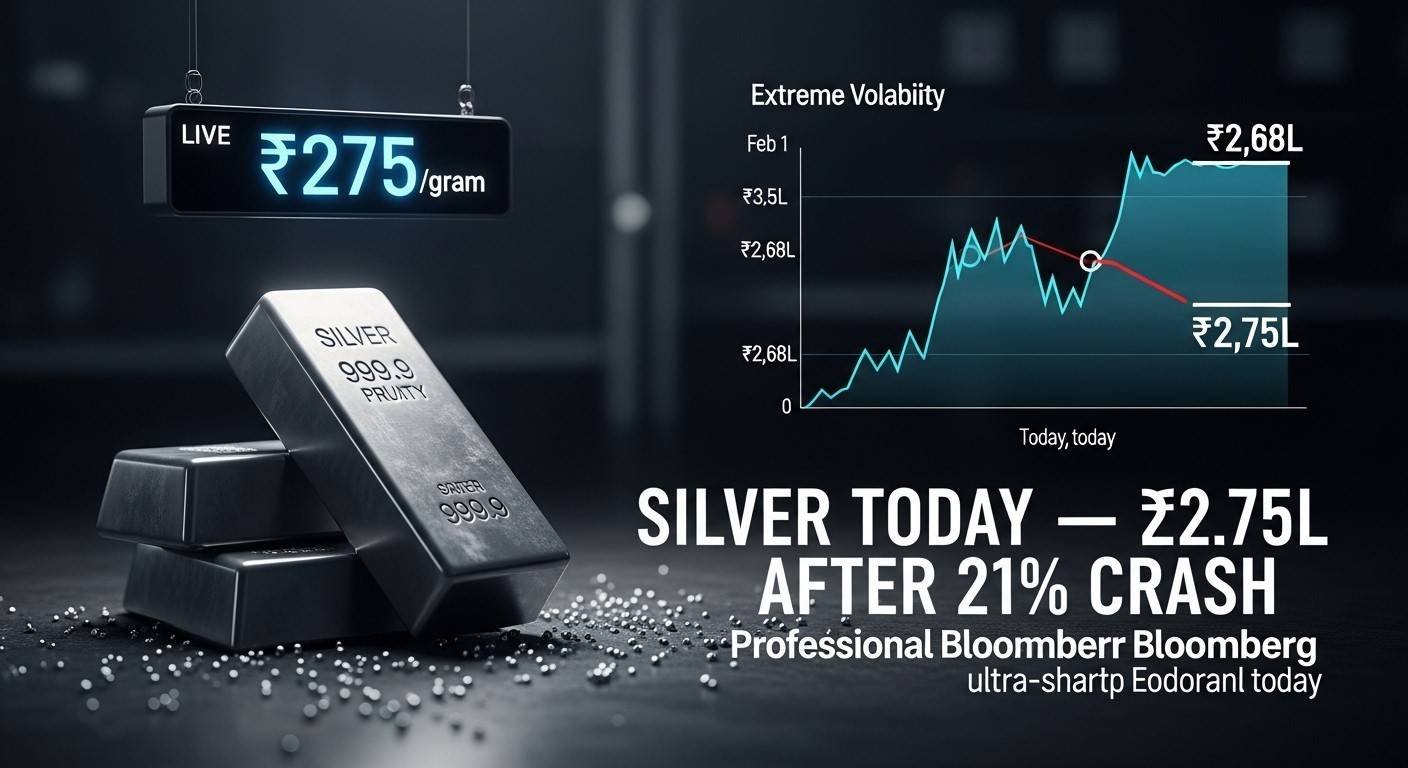
Silver prices in India stabilize at ₹2,75,000 per kilogram on Monday, February 24, 2026 — recovering modestly from the multi-month low of ₹2,68,000 hit on February 16 but still 21.4% below the February 1 peak of ₹3,50,000. The brutal correction erased nearly all the speculative gains from January’s parabolic 47% rally, leaving retail investors who bought near ₹3.5 lakh nursing catastrophic 20-25% losses in just three weeks. Yet the metal has found support and stabilized in the ₹2.70-2.75 lakh range, suggesting the worst of the panic selling may have concluded as industrial buyers return and bargain hunters emerge. So is silver at ₹2,75,000 today a value buying opportunity after the violent shakeout — or should you wait for another leg lower toward ₹2.50 lakh as profit-taking continues?
Silver Price Today India: Live Rates Across All Major Cities (February 24, 2026)
Silver prices show remarkable uniformity across Indian cities on Monday, February 24, 2026 — reflecting efficient domestic arbitrage and the metal’s status as a globally-traded commodity where regional price gaps cannot persist.
| City | Per Gram (₹) | Per 10 Grams (₹) | Per 100 Grams (₹) | Per Kilogram (₹) |
|---|---|---|---|---|
| Delhi | ₹275 | ₹2,750 | ₹27,500 | ₹2,75,000 |
| Mumbai | ₹275 | ₹2,750 | ₹27,500 | ₹2,75,000 |
| Chennai | ₹275 | ₹2,750 | ₹27,500 | ₹2,75,000 |
| Kolkata | ₹275 | ₹2,750 | ₹27,500 | ₹2,75,000 |
| Bangalore | ₹275 | ₹2,750 | ₹27,500 | ₹2,75,000 |
| Hyderabad | ₹275 | ₹2,750 | ₹27,500 | ₹2,75,000 |
| Ahmedabad | ₹275 | ₹2,750 | ₹27,500 | ₹2,75,000 |
| Pune | ₹275 | ₹2,750 | ₹27,500 | ₹2,75,000 |
| Kerala | ₹280 | ₹2,800 | ₹28,000 | ₹2,80,000 |
Note: Prices exclude 3% GST and making charges (5-25% for jewelry, 2-10% for coins/bars). Data from Goodreturns, Business Standard, News24 as of February 22-24, 2026.
| Key Market Data | February 24, 2026 | Recent Peak | Change from Peak |
|---|---|---|---|
| Silver (per gram) | ₹275 | ₹350 (Feb 1) | -₹75 (-21.4%) |
| Silver (per kg) | ₹2,75,000 | ₹3,50,000 (Feb 1) | -₹75,000 (-21.4%) |
| February Low | ₹2,68,000 (Feb 16) | — | Recovered ₹7,000 from low |
| MCX Silver Futures | ₹2,70,000-2,73,000 range | — | Consolidating |
| International Silver | ~$74-76/oz | ~$121.67 (Jan 29 ATH) | Down ~38% from ATH |
| Gold (per gram 24K) | ₹15,900-16,000 | ₹17,885 (Jan 29) | Down ~11% |
| Gold-Silver Ratio | 57-58:1 | — | Silver underperforming gold |
The ₹275 per gram price represents a tentative stabilization after two weeks of relentless selling that saw silver crash from the February 1 peak of ₹350 per gram. The metal is attempting to establish a bottom in the ₹2.70-2.75 lakh range, with the February 16 low at ₹2.68 lakh acting as critical support.
Most importantly, silver has recovered ₹7,000 per kilogram from that ₹2.68 lakh low — suggesting that industrial buyers and value investors are stepping in at these depressed levels. However, the price remains 21.4% below the February 1 peak, meaning investors who bought near ₹3.5 lakh are still underwater by over ₹75,000 per kilogram.
What Caused Silver’s Catastrophic 21% Crash in Just 3 Weeks?
The violent ₹75,000 per kilogram collapse from ₹3,50,000 on February 1 to ₹2,68,000 by February 16 represents one of the most brutal precious metals corrections in Indian market history — and understanding the causes is essential for evaluating whether current levels represent opportunity or further downside risk.
The Perfect Storm of Negative Factors:
1. Profit Booking After January’s 47% Rally
Silver had surged 47% in January 2026 alone — from approximately ₹2.4 lakh to ₹3.5 lakh per kilogram — driven by speculative Chinese trading and geopolitical risk premiums. That parabolic move was unsustainable, and February opened with immediate profit-taking as traders who bought at ₹2.0-2.5 lakh locked in 40-75% gains.
2. Budget 2026 Impact (February 1)
Union Budget 2026 presented on February 1 maintained customs duty rates unchanged for gold and silver bullion imports — dashing hopes of duty reduction that would have lowered domestic prices. The announcement triggered heavy selling, with MCX silver hitting 9% lower circuit limit and crashing to ₹2,65,652 per kg on Budget day itself.
3. Global Silver Selloff
COMEX silver witnessed massive selloff, plunging over 31% from record highs of $121.67 on January 29 to under $75 by mid-February amid:
- Margin hikes by exchanges reducing leverage
- Rising bond yields making non-yielding silver less attractive
- Profit-taking after the January mania
4. Stronger US Dollar
The Dollar strengthened against major currencies including the Indian Rupee, creating headwinds for all Dollar-denominated commodities. The USD-INR rate moved from approximately 87 to 90+ during the period, but Dollar strength globally pressured silver more than Rupee weakness supported it.
5. Industrial Demand Destruction at Extreme Prices
At ₹3.5 lakh per kilogram, some industrial buyers — electronics manufacturers, solar panel producers — delayed purchases or substituted alternative materials where feasible. That marginal demand destruction at peak prices removed the physical buying support that normally cushions speculative selloffs.
The Cascade Effect:
Once silver broke below ₹3.00 lakh, algorithmic selling and stop-loss triggers amplified the move. Leveraged traders using margin were forced to liquidate positions, creating wave after wave of selling that pushed prices relentlessly lower until finding support near ₹2.68 lakh — approximately the pre-rally levels from December 2025.
Silver Price Across Major Indian Cities: February 24, 2026
While silver prices show minimal variation across Indian cities due to efficient arbitrage, understanding city-specific dynamics helps identify local demand patterns.
Delhi: ₹2,75,000/kg The capital shows modest buying interest as value investors accumulate at 21% discount to February peak. Retail investment activity picking up after Budget-related panic subsided.
Mumbai: ₹2,75,000/kg Financial capital remains cautious — institutional traders on MCX continue hedging strategies rather than directional bets. Premium physical demand muted as affluent buyers await further clarity.
Chennai: ₹2,75,000/kg South Indian market traditionally shows strong physical silver demand for jewelry and utensils. Current levels attracting wedding season purchases as Q2 (April-June) marriage season approaches.
Kolkata: ₹2,75,000/kg Eastern market seeing selective accumulation in 100-500 gram silver bars as middle-class savers view ₹2.75 lakh as attractive entry versus ₹3.5 lakh peak pricing.
Bangalore: ₹2,75,000/kg Tech hub shows split behavior — young professionals who bought digitally at ₹3-3.5 lakh holding losses, while new investors beginning SIP-style accumulation via PhonePe/Google Pay platforms.
Kerala: ₹2,80,000/kg The ₹5,000 premium versus pan-India rates reflects Kerala’s traditionally higher silver consumption for cultural/ceremonial purposes and slightly elevated local demand.
Should You Buy Silver Today at ₹2.75 Lakh Per Kilogram?
The investment decision at current levels depends entirely on your risk tolerance, investment horizon, and whether you can withstand potential further 15-20% downside if the ₹2.68 lakh support breaks.
You SHOULD Buy Silver Today If:
- You have zero silver exposure currently: Portfolio diversification suggests 3-5% allocation to silver — starting systematic accumulation today makes sense regardless of short-term direction
- You believe industrial demand will absorb supply: Solar panel manufacturing, EV production, electronics consumption are structural growth drivers immune to price volatility once they resume normal purchasing
- You can invest for 12+ months: Tax efficiency requires 12-month holding for lower long-term capital gains rate (12.5% vs 20% short-term); silver at ₹2.75L after 21% crash offers better risk-reward than at ₹3.5L peak
- You can deploy in tranches: Instead of ₹3 lakh lump sum today, deploy ₹1 lakh today, ₹1 lakh at ₹2.60L if it dips, ₹1 lakh at ₹2.50L — splits timing risk while establishing position
- You’ll use Silver ETFs: Avoids 3% GST on physical silver purchases, provides instant liquidity, eliminates storage concerns
You Should NOT Buy Silver Today If:
- You’re chasing the recovery from ₹2.68L low: FOMO buying after ₹7,000 bounce could be punished if support breaks and silver retests ₹2.50-2.60 lakh
- You need money within 6-12 months: Silver at ₹2.75L carries high probability of testing ₹2.50-2.60 lakh before next bull leg begins
- You’re buying physical jewelry: 20-25% making charges mean you need silver to rise 25%+ just to breakeven — terrible investment math
- You cannot tolerate 20-30% volatility: Silver fell 21% in 3 weeks, can easily fall another 10-15% from current levels before stabilizing
- You expect immediate returns to ₹3.5 lakh: Could take 6-12 months to retest that peak even in bull case scenario
The Balanced Approach:
Allocate 40% of intended silver investment now at ₹2.75 lakh, keep 60% in reserve to buy at ₹2.60 lakh and ₹2.50 lakh if further weakness materializes. This allows you to establish position while maintaining dry powder if the crash extends.
Technical Analysis: Support, Resistance & Price Targets
| Technical Level | Price (₹/kg) | Significance |
|---|---|---|
| Strong Resistance | ₹3,00,000 | Psychological level, major supply |
| Key Resistance | ₹2,85,000 | 50% retracement of Feb crash |
| Minor Resistance | ₹2,80,000 | Recent recovery high |
| Current Price | ₹2,75,000 | Consolidation zone |
| Immediate Support | ₹2,70,000 | MCX futures support |
| Key Support | ₹2,68,000 | February 16 low — CRITICAL |
| Strong Support | ₹2,60,000 | Pre-rally demand zone |
| Breakdown Level | ₹2,50,000 | Below this = retest ₹2.30-2.40L |
Support Analysis:
The ₹2.68 lakh level tested on February 16 is the line in the sand. This represents the pre-Budget panic low where physical buyers and industrial consumers emerged aggressively. Three tests of this level without breaking below establishes it as genuine demand zone.
If ₹2.68 lakh breaks on high volume, next support sits at ₹2.60 lakh (December 2025 consolidation zone), then ₹2.50 lakh (psychological level). Below ₹2.50 lakh opens the door to retest ₹2.30-2.40 lakh from late 2025.
Resistance Analysis:
Recovery faces immediate resistance at ₹2.80 lakh (Kerala’s current pricing premium suggests this is where supply increases). The ₹2.85 lakh level represents 50% Fibonacci retracement of the entire February crash — a technical level where profit-taking intensifies.
The ₹3.00 lakh psychological barrier is formidable. Investors who bought at ₹2.90-3.10 lakh and suffered 15-20% losses will use any rally to ₹3.00 lakh as exit opportunity, creating heavy supply.
Key Takeaways
→ Silver price today India is ₹275 per gram and ₹2,75,000 per kilogram — down 21.4% (₹75,000/kg) from February 1 peak of ₹3,50,000 but recovered ₹7,000 from February 16 low of ₹2,68,000.
→ The brutal 3-week crash was driven by profit booking after January’s 47% rally, Union Budget 2026 maintaining silver import duties unchanged triggering selloff, global COMEX silver plunging 31% from $121 ATH, and margin liquidation cascading stop-losses.
→ Industrial demand destruction at ₹3.5L peak prices removed physical buying support — electronics manufacturers, solar panel producers delayed purchases creating vacuum that amplified speculative selling.
→ Critical support at ₹2.68 lakh (Feb 16 low) must hold — break below opens downside toward ₹2.60L then ₹2.50L psychological level before finding next demand zone.
→ Buy at current levels only if: (1) you have 12+ month horizon for tax efficiency, (2) can deploy systematically in tranches not lump sum, (3) zero current silver exposure needing 3-5% portfolio allocation, (4) will use Silver ETFs avoiding 3% GST physical burden.
→ Avoid buying if: (1) chasing ₹7,000 bounce from low driven by FOMO, (2) buying physical jewelry with 20-25% making charges requiring 25%+ silver rise just to breakeven, (3) need funds within 6-12 months unable to tolerate another 15-20% potential downside.
This article does not constitute investment advice. All investment decisions should be made based on individual financial goals, risk tolerance, and in consultation with a SEBI-registered investment advisor.
Data sourced from publicly available information as of February 22-24, 2026. Sources include: Goodreturns India, Business Standard, News24, GoldPriceIndia.com, BankBazaar, Zerodha FundHouse, ClearTax, SilverPrice.org, MCX India, various market sources.