Silver Price Monday March 9, 2026: Why Silver Remains Stuck at ₹2.85 Lakh Per Kilogram While Gold Rallies Three Percent During the Iran War Crisis
By Senior Commodities, Precious Metals and Industrial Demand Analyst · March 9, 2026
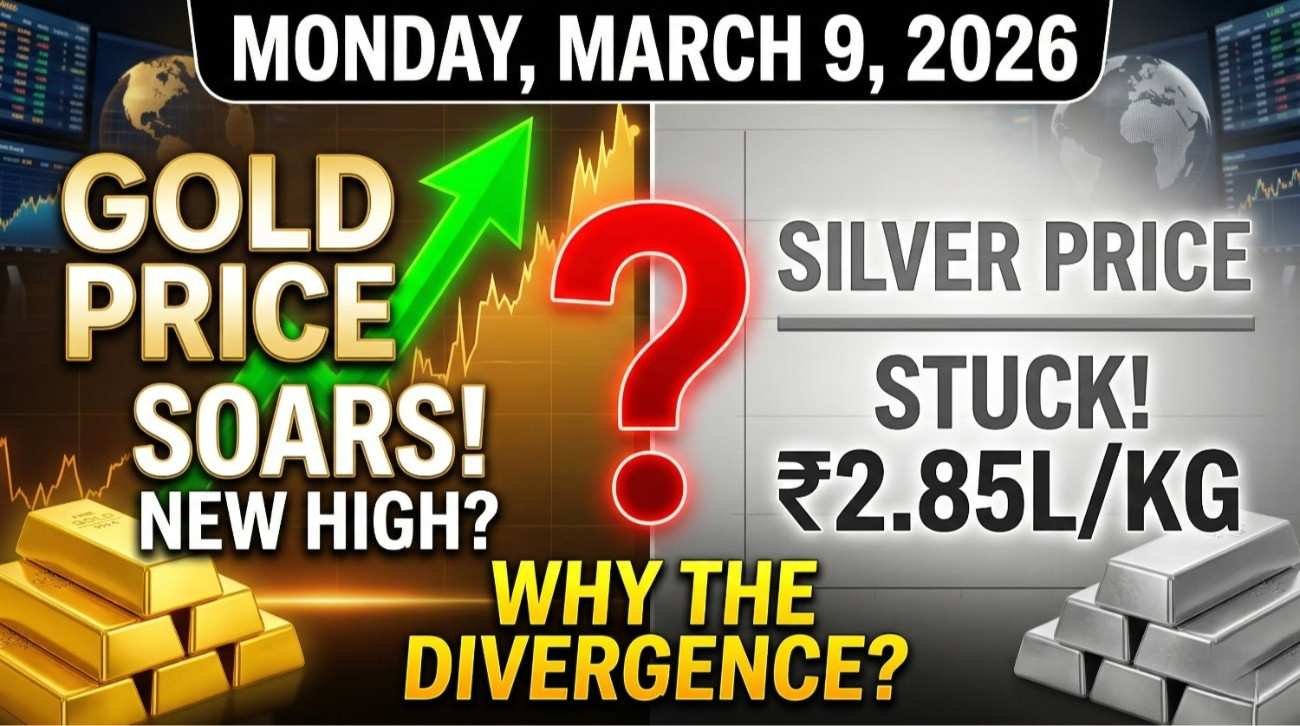
Silver presents one of the most puzzling stories in commodity markets as we head into Monday March 9, 2026, trading at essentially unchanged levels around two hundred eighty five rupees per gram or two lakh eighty five thousand rupees per kilogram despite a geopolitical crisis that has sent gold surging three percent and equity markets crashing five to six percent over the past week. This divergence between gold’s spectacular safe haven rally and silver’s stubborn consolidation reveals something fundamental about how these two precious metals behave differently during crisis periods, and understanding this divergence is crucial for investors trying to decide whether silver at current levels represents opportunity or trap.
Saturday’s closing price of two hundred eighty five rupees per gram with some cities like Delhi showing two hundred ninety rupees sets up Monday for what will likely be another frustrating session of sideways price action in the two hundred eighty to two hundred ninety five rupee range. While gold investors have watched their holdings appreciate from fifteen thousand nine hundred to sixteen thousand five hundred rupees per gram, silver holders have endured seven consecutive days of essentially zero movement, creating the kind of opportunity cost that makes investors question whether they are in the right asset during this crisis.
The central question facing silver investors Monday morning is whether this consolidation represents healthy digestion of earlier gains before the next leg higher toward three lakh rupees per kilogram, or whether silver’s failure to rally alongside gold during peak geopolitical fear signals fundamental weakness that could lead to a breakdown back toward two lakh seventy thousand or even two lakh sixty thousand. To answer that question requires understanding the unique dynamics that make silver behave so differently from gold despite both being classified as precious metals.
The Brutal Reality: Silver Unchanged While Markets Burn
Let me start by laying out the actual price action that has silver investors frustrated and confused. On Friday March sixth, silver closed at two hundred eighty five rupees per gram across most major Indian cities. Saturday March eighth saw the exact same closing price of two hundred eighty five rupees per gram. That represents zero change, zero movement, zero momentum during a forty eight hour period when gold rallied another fifty to seventy rupees per gram and equity markets crashed another one to two percent.
Zoom out to the full week and the picture is equally disappointing from a momentum perspective. Monday March second, when the Iran crisis erupted with news of the Supreme Leader’s assassination, silver opened at two hundred ninety to two hundred ninety five rupees per gram in many cities. By Wednesday March fourth it had pulled back to two hundred eighty five to two hundred ninety. Thursday and Friday saw continued consolidation at two hundred eighty five. That means silver is actually down five to ten rupees per gram for the week, roughly two to three percent, during a period when safe haven demand should theoretically be driving it higher.
Compare that to gold which opened the week around sixteen thousand to sixteen thousand one hundred and closed Saturday at sixteen thousand three hundred sixty four, a gain of two hundred sixty to three hundred sixty rupees or approximately two to three percent. Even more stark is the comparison to international markets where gold in dollar terms rallied from five thousand one hundred to five thousand three hundred dollars per ounce while silver in dollars actually declined slightly from ninety three dollars fifty to ninety three dollars forty one cents per ounce.
This divergence creates cognitive dissonance for investors who think of gold and silver as interchangeable safe haven assets. They are not. Gold is purely an investment and monetary metal with minimal industrial use. Silver is a hybrid with roughly fifty percent of demand coming from industrial applications like electronics manufacturing, solar panels, batteries and medical equipment, and only fifty percent from investment and jewelry demand. During geopolitical crises, that industrial component of silver demand becomes a liability rather than asset.
Why Industrial Demand Weakness is Killing Silver’s Rally
The fundamental reason silver cannot rally alongside gold despite the Iran war creating perfect safe haven conditions comes down to what is happening in the global industrial economy. Let me walk through the transmission mechanism that is suppressing silver prices even as geopolitical fear peaks.
The Iran conflict has driven crude oil from around seventy dollars per barrel to seventy five and potentially heading toward eighty dollars. Higher oil prices feed directly into manufacturing costs for every industrial product that uses energy-intensive production processes. Electronics manufacturing, which consumes roughly thirty percent of annual silver production for components like circuit boards, semiconductors and electrical contacts, faces margin pressure when energy costs spike. Solar panel manufacturers, another major silver consumer using roughly ten percent of annual production for photovoltaic cells, see project economics deteriorate when oil pushes other energy costs higher.
When industrial consumers face rising input costs, their first response is to reduce or delay purchases of commodities like silver. Electronics manufacturers who were planning to buy fifty tonnes of silver for inventory might cut that order to thirty tonnes and operate with leaner inventories. Solar panel producers who had contracts to purchase twenty tonnes might renegotiate for fifteen tonnes hoping prices fall further. This industrial demand destruction happens immediately, within days of oil price spikes, and shows up in futures markets as reduced buying interest from commercial hedgers.
The equity market crash compounds this industrial demand problem. When stock markets fall five to six percent in a week, that reflects investor expectations of slower economic growth ahead. Slower growth means reduced consumer demand for electronics like smartphones, laptops, televisions and appliances, all of which contain silver components. Reduced auto sales mean fewer vehicles with silver-containing electrical systems. Slower construction activity means less demand for solar panel installations. Every equity market percentage point decline translates to reduced industrial silver consumption estimates.
So while the safe haven investment demand for silver increases during the crisis as some investors rotate from stocks to precious metals, that increase is more than offset by the collapse in industrial demand expectations. The net result is flat to slightly declining silver prices even as gold, which has almost no industrial demand component, rallies sharply on pure safe haven flows.
City-Wise Silver Pricing: Where the Metal Trades Monday
Understanding regional price variations helps identify the best purchase points and reveals which markets show stronger physical demand. The table below presents Saturday’s closing prices and Monday’s expected opening ranges across major Indian cities:
Silver Price Comparison: Major Cities (March 8-9, 2026)
| City | Saturday Close (₹/gram) | Saturday Close (₹/kg) | Monday Expected Open (₹/gram) | Monday Expected (₹/kg) | Premium vs National Average | Key Demand Drivers |
|---|---|---|---|---|---|---|
| National Average | ₹285 | ₹2,85,000 | ₹285-290 | ₹2,85,000-2,90,000 | Base | MCX benchmark |
| Delhi | ₹290 | ₹2,90,000 | ₹288-295 | ₹2,88,000-2,95,000 | +₹3,000-10,000 | Capital city premium |
| Mumbai | ₹285 | ₹2,85,000 | ₹285-290 | ₹2,85,000-2,90,000 | At par to +₹5,000 | Financial hub volume |
| Chennai | ₹286-288 | ₹2,86,000-2,88,000 | ₹288-293 | ₹2,88,000-2,93,000 | +₹3,000-8,000 | South India wedding demand |
| Hyderabad | ₹310 (spike) | ₹3,10,000 | ₹295-305 | ₹2,95,000-3,05,000 | +₹10,000-20,000 | Extraordinary single-day jump |
| Bangalore | ₹285-287 | ₹2,85,000-2,87,000 | ₹286-292 | ₹2,86,000-2,92,000 | +₹1,000-7,000 | Tech sector buying |
| Kolkata | ₹285 | ₹2,85,000 | ₹285-290 | ₹2,85,000-2,90,000 | At par to +₹5,000 | Traditional market |
| Ahmedabad | ₹283-285 | ₹2,83,000-2,85,000 | ₹284-289 | ₹2,84,000-2,89,000 | -₹1,000 to +₹4,000 | Competitive trading hub |
The most striking anomaly in this table is Hyderabad showing three lakh ten thousand rupees per kilogram, a stunning twenty five thousand rupee premium over the national average. Reports indicate this resulted from a single-day surge driven by local demand dynamics, possibly related to a large wedding order or industrial purchase that temporarily exhausted local supply. This kind of extreme regional premium is unsustainable and should normalize within days as arbitrage brings silver from other markets.
Chennai’s modest three to eight thousand rupee premium reflects the ongoing South Indian wedding season where silver jewelry, utensils and gifts remain culturally important purchases despite elevated prices. Ahmedabad showing a slight discount to the national average demonstrates how competitive high-volume trading markets keep prices efficient through arbitrage.
For investors looking to buy physical silver Monday, Mumbai and Ahmedabad likely offer the best pricing due to deep markets and competition among dealers. Bangalore and Chennai command small premiums but remain reasonable. Delhi’s premium seems unjustified given it should have similar competitive dynamics to Mumbai. Hyderabad should absolutely be avoided until the premium collapses back toward national averages.
The Hidden Costs That Make ₹285 Silver Actually Cost ₹330
Just as with gold, the spot price you see quoted for silver bears little resemblance to what you actually pay when buying physical metal once all taxes, charges and premiums are applied. Understanding this cost structure is essential for rational investment decisions.
Start with the base spot price of two hundred eighty five rupees per gram for purchases totaling one kilogram or two lakh eighty five thousand rupees. Immediately add three percent goods and services tax which equals eight thousand five hundred fifty rupees, bringing the subtotal to two lakh ninety three thousand five hundred fifty.
If you purchase silver jewelry rather than plain coins or bars, making charges apply. For silver these are typically lower percentages than gold but still material, ranging from five to fifteen percent depending on design complexity. Assume eight percent making charges on the base metal value of two lakh eighty five thousand, adding twenty two thousand eight hundred rupees. Your subtotal now stands at three lakh sixteen thousand three hundred fifty rupees.
Many dealers add a premium during periods of elevated demand, typically one to three percent. At two percent that adds another five thousand seven hundred ten rupees for a subtotal of three lakh twenty two thousand sixty. Include small charges for hallmarking, wastage allowances, and the reality is your all-in cost approaches three hundred twenty to three hundred thirty rupees per gram for jewelry purchases versus the two hundred eighty five rupee spot price.
This means silver must appreciate from two hundred eighty five to three hundred thirty rupees per gram, a gain of sixteen percent, simply for you to break even on a jewelry purchase made Monday. That is the hidden tax on physical silver buying that most retail investors do not calculate before making purchase decisions. And it explains why silver investors who bought at two hundred seventy rupees just two weeks ago are not actually profitable even though spot prices rose to two hundred eighty five. Their all-in cost was probably three hundred ten to three hundred twenty rupees, meaning they remain underwater.
🖼️ SECTION IMAGE PROMPT: “Professional editorial cost breakdown infographic for silver purchase – horizontal stacked bar chart showing base silver ₹285/gm taking 86% of bar in metallic silver color, then segments for +3% GST (₹8.55) in blue, +8% making charges (₹22.80) in orange, +2% dealer premium (₹5.70) in red, final total ₹322/gm marked, large text ‘13% HIDDEN COSTS’, silver coins and rupee symbols, calculator showing breakeven calculation requiring 13% price appreciation, professional Bloomberg financial literacy infographic aesthetic with clean visualization, 16:9 landscape format”
Smart Ways to Buy Silver Without Paying Sixteen Percent Premiums
For investors who believe silver will eventually break out of its current consolidation and rally toward three lakh to three lakh twenty five thousand per kilogram, there are significantly more cost-efficient ways to gain exposure than buying physical jewelry that destroys returns before you start.
Silver exchange traded funds offer the most accessible low-cost option for most investors. These schemes invest in physical silver and trade on stock exchanges just like stocks. The expense ratios typically range from point seven to one point two percent annually. There is no goods and services tax on ETF unit purchases or sales. No making charges, no dealer premiums, no wastage allowances. You buy at essentially spot price and sell at spot minus small expense ratio and brokerage.
Investing two lakh eighty five thousand in a silver ETF at two hundred eighty five rupees per gram equivalent costs that base amount plus perhaps three thousand to five thousand in annual fees. When silver reaches three hundred rupees per gram, your holding is worth three lakh. After minimal selling costs you net approximately two lakh ninety five thousand, producing a ten thousand rupee profit. Meanwhile the jewelry buyer who paid three lakh twenty two thousand remains far underwater needing silver at three hundred seventy rupees for breakeven.
Digital silver platforms offered by apps like Google Pay, PhonePe, and dedicated platforms like Augmont or SafeGold allow fractional purchases starting from one rupee. The advantage is accessibility for small investors who cannot afford kilogram quantities. The downside is three percent goods and services tax applies plus small transaction fees. Still far better than jewelry but not as efficient as ETFs for larger amounts.
MCX silver futures are for sophisticated traders only. The leverage is attractive, controlling large positions with small margins, but that leverage magnifies losses as much as gains. Unless you understand derivative mechanics, expiry management, and can stomach extreme volatility, futures trading silver is inappropriate during crisis periods when prices can gap violently on geopolitical headlines.
Physical silver coins and bars from reputable dealers like MMTC-PAMP or banks offer middle-ground economics. Making charges are typically three to eight percent rather than the eight to fifteen percent on jewelry. You pay the three percent goods and services tax but avoid design premiums. For investors who want tangible metal without jewelry markups, this represents reasonable compromise.
Why Silver Will Eventually Follow Gold Higher
Despite the frustrating consolidation and underperformance relative to gold over the past week, the fundamental case for silver appreciation over the medium term remains intact. Let me outline why patient investors should not panic out of silver positions or abandon plans to add exposure.
The first reason is mean reversion in the gold-to-silver ratio. Historically this ratio fluctuates between fifty and eighty, meaning one ounce of gold trades for fifty to eighty ounces of silver. Currently with gold at five thousand three hundred dollars and silver at ninety three dollars, the ratio stands at roughly fifty seven, near the low end of the historical range. When this ratio is low, it suggests silver is relatively expensive compared to gold and further mean reversion would require either gold falling, silver falling more, or silver rising faster than gold. Given gold’s strong uptrend, the most likely path for mean reversion is silver eventually playing catch-up with a sharp rally.
The second factor is that industrial demand weakness is a temporary phenomenon tied to the immediate shock of higher oil prices and growth concerns. If the Iran crisis resolves in coming weeks and oil retreats toward seventy dollars, industrial demand estimates will recover. Electronics manufacturers will resume normal purchasing. Solar installation projects will accelerate. That demand recovery combined with safe haven flows that are just beginning could drive silver sharply higher in catch-up mode.
The third element is that silver supply is relatively inelastic. Most silver comes as a byproduct of mining other metals like copper, lead and zinc. When silver prices fall, miners do not reduce silver output because they are primarily mining for the other metals. This means supply stays elevated even as price weakens, but it also means that when demand surges, supply cannot respond quickly creating sharp price spikes. Silver’s history includes episodes where prices doubled in months when investment demand overwhelmed available supply.
The fourth consideration is that silver at two hundred eighty five rupees per gram or two lakh eighty five thousand per kilogram is still nineteen percent below the February peak around three lakh fifty thousand. For investors who missed that peak, current levels offer a nineteen percent discount to recent highs. If geopolitical tensions persist and silver eventually rallies back toward previous highs, buying at two hundred eighty five provides substantial upside potential.
What Should You Do Monday Morning
Your Monday silver strategy depends entirely on your existing position, time horizon and conviction about the crisis duration and industrial demand trajectory.
If you currently have zero silver exposure and watched gold rally while wishing you owned precious metals, Monday represents a reasonable though not spectacular entry point. Silver has consolidated for seven days while gold rallied, suggesting some of the overheated momentum has cooled. Buy twenty to thirty percent of your intended allocation through ETFs or digital platforms at two hundred eighty five to two hundred ninety rupees per gram equivalent. Reserve the remaining seventy percent for potential dips to two hundred seventy to two hundred seventy five or for adding if silver breaks above three hundred confirming momentum.
If you hold silver purchased at two hundred fifty to two hundred seventy rupees last month and are sitting on small gains, the rational move is holding through current volatility. You are positioned correctly for eventual industrial demand recovery and safe haven flows. Set a target to sell thirty to forty percent of holdings if silver reaches three hundred ten to three hundred twenty and maintain a stop loss at two hundred sixty five to protect downside. This preserves upside participation while capping risk.
If you bought silver at three hundred to three hundred twenty during early February peaks and are currently underwater ten to fifteen percent, Monday is a day for patience not action. Selling at two hundred eighty five when you need three hundred ten to three hundred twenty for breakeven locks in permanent losses when time and industrial demand recovery could heal the position. Your strategy is waiting for silver’s eventual catch-up rally when gold peaks and money rotates to lagging precious metals.
If you are a trader rather than investor, Monday’s consolidation creates frustration not opportunity. Range-bound markets going sideways destroy traders through whipsaw losses and opportunity cost. Better to wait for a decisive breakout above two hundred ninety five or breakdown below two hundred seventy five before committing capital. Trading the middle of a consolidation range is low-probability trading that enriches only brokers.
The Honest Verdict on Silver at ₹285
Silver at two hundred eighty five rupees per gram on Monday March ninth represents fair value in a consolidation range, neither bargain nor bubble. The industrial demand headwinds from higher oil prices and growth concerns are real and explain why silver cannot rally alongside gold despite geopolitical chaos. But those headwinds are temporary and will reverse when the crisis resolves and oil retreats.
For portfolio diversification purposes, maintaining five to ten percent silver allocation makes sense even at current levels. For aggressive investors convinced industrial demand will recover and silver will catch up to gold’s rally, buying modest amounts at two hundred eighty five to two ninety represents reasonable positioning. For traders seeking momentum, silver is dead money currently and capital is better deployed elsewhere.
The key is recognizing that silver is not broken, just temporarily impaired by industrial demand concerns. When those concerns fade, silver’s catch-up rally could be violent given how far it has lagged gold. Patience will likely be rewarded, but timing is uncertain. Buy small now, keep powder dry for better levels, and recognize that silver at two eighty five is neither screaming buy nor avoid signal. It is fairly valued consolidation waiting for the next catalyst to break the range.
This article is for educational purposes only and does not constitute investment advice. Silver prices are subject to high volatility during geopolitical crises and industrial demand shifts. All investment decisions should be made based on individual financial circumstances and risk tolerance.