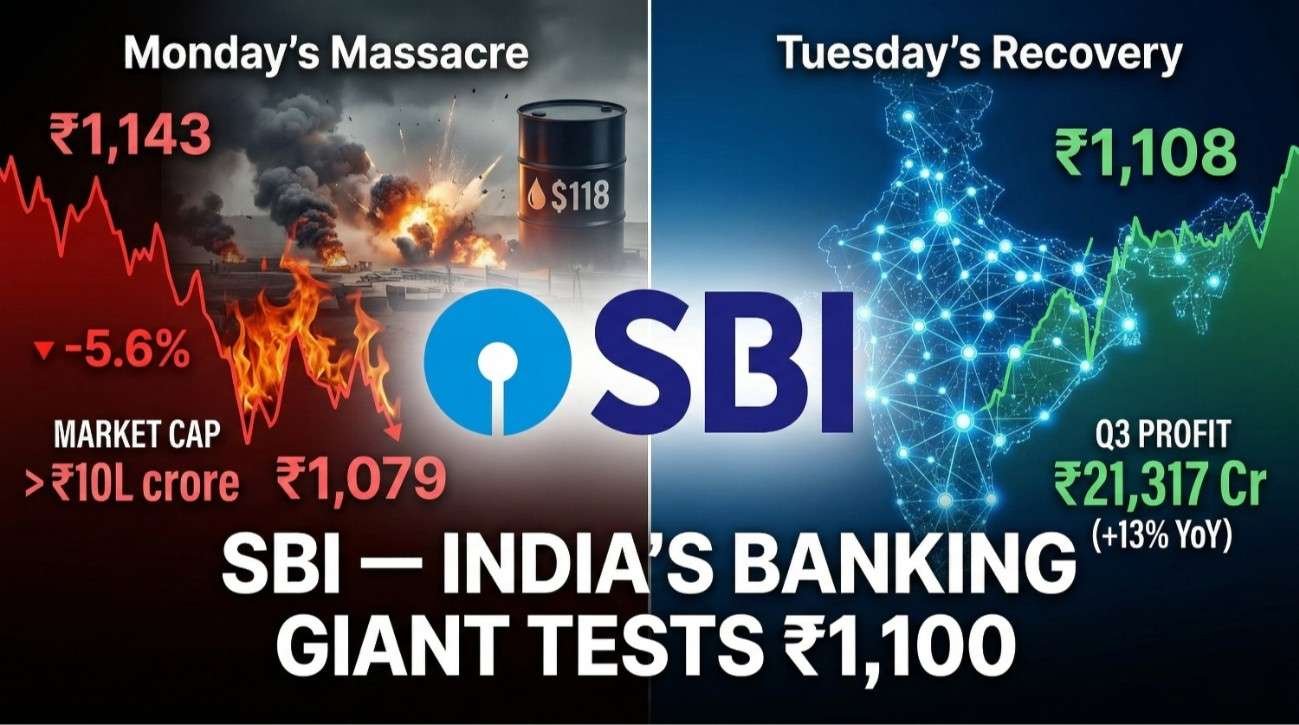
SBI Bank Share Price March 2026: The ₹1,108 Recovery After Monday’s ₹62,352 Crore Market Cap Wipeout — Why India’s Largest Bank Cannot Escape the Iran War Despite Stellar Q3 Profit Growth of 13%
By Senior Banking Sector, PSU Financial Institutions and Crisis Impact Analyst · March 10, 2026
State Bank of India, the nation’s largest lender and the only Indian bank on the Fortune Global 500 list, finds itself caught in the crossfire of March 2026’s geopolitical chaos, trading at ₹1,108.40 on Tuesday March 10 after surviving Monday’s catastrophic five point six percent crash to ₹1,079.40 that erased a staggering sixty two thousand three hundred fifty two crore rupees in market capitalization and dragged the banking behemoth’s valuation below the psychologically critical ten lakh crore rupee threshold for the first time in months. This violent two-day whipsaw perfectly captures the impossible situation facing India’s premier public sector bank in early 2026: fundamentally robust with third quarter fiscal 2026 net profit surging thirteen percent year-over-year to twenty one thousand three hundred seventeen crore rupees and digital banking platform YONO crossing nine crore registered users, yet technically vulnerable to the same geopolitical forces that are crushing the entire banking sector as crude oil prices that spiked to one hundred eighteen dollars per barrel Monday before retreating to eighty eight to ninety dollars Tuesday create impossible volatility.
The fundamental question facing the eight crore ninety one lakh shareholders of State Bank of India on Tuesday morning is whether Monday’s crash to ₹1,079 represents a generational buying opportunity in India’s most systemically important financial institution trading at just twelve point eight four times earnings despite consistent profitability, twenty two point five five percent deposit market share, and government backing that eliminates bankruptcy risk, or whether the stock’s inability to hold the ₹1,100 psychological support despite stellar quarterly results signals deeper problems in the Indian economy that will prevent SBI from sustaining its forty seven point eight one percent one-year return achieved before the Iran war erupted. Understanding which scenario is playing out requires analyzing both the operational excellence that drove SBI’s recent outperformance and the macro headwinds that are now overwhelming those positives.
The Monday Massacre: How SBI Lost ₹62,352 Crore in Six Hours
Let me start by reconstructing exactly what happened to State Bank of India shares during Monday March ninth’s trading session because the magnitude of destruction provides crucial context for understanding Tuesday’s partial recovery. Monday opened with SBI immediately gap-down from Friday’s close of ₹1,143.55 to an opening print of ₹1,111.10, representing a thirty two point four five rupee or two point eight four percent overnight loss that instantly vaporized thousands of crores in shareholder wealth before markets even officially began trading. This gap-down reflected Asian market weakness and crude oil’s Sunday night surge past one hundred dollars per barrel as Iran war tensions escalated without any diplomatic resolution emerging.
But the opening gap-down was just the beginning of Monday’s nightmare. Instead of finding buyers at these levels who viewed the dip as opportunity, selling accelerated throughout the morning session. By ten thirty AM, SBI had fallen below ₹1,100 to trade around ₹1,095. By eleven AM, the stock tested ₹1,085. The intraday low came around noon when SBI touched ₹1,064.25, representing a catastrophic seventy nine point three rupee decline from Friday’s close or six point nine percent intraday crash that ranks among the worst single-session performances for SBI in years outside of pandemic-level volatility.
The stock recovered modestly from that intraday low to close Monday at ₹1,079.40, still down a devastating sixty four point one five rupees or five point six percent for the session. This closing price had enormous psychological and financial implications. The five point six percent single-day decline translated to approximately sixty two thousand three hundred fifty two crore rupees in market capitalization destruction, dragging SBI’s total valuation from above ten lakh crore rupees to just nine lakh ninety three thousand crore rupees. Falling below the ten lakh crore mark matters because it removes SBI from an elite club of only a handful of Indian companies that maintain that valuation threshold.
The selling was completely indiscriminate across SBI’s shareholder base. Retail investors who had bought shares at ₹1,200 to ₹1,234 during January and February peaks now faced unrealized losses of eleven to fourteen percent. Foreign institutional investors holding ten point three percent of the bank’s equity sold aggressively, contributing to the six thousand crore rupee net FII outflow from Indian equities Monday. Domestic institutional investors tried to provide support but their buying could not stem the tide. Even the fifty five point five percent promoter holding, which is effectively the Government of India, provided no comfort as the market simply didn’t care about ownership structure when crude oil was touching one hundred eighteen dollars and geopolitical risk was spiking.
Tuesday’s Relief Rally: Dead Cat Bounce or Genuine Recovery
Tuesday March tenth brought dramatic reversal as crude oil prices collapsed from Monday’s peak of one hundred eighteen dollars per barrel to settle around eighty eight to ninety two dollars following President Trump’s social media post suggesting the Iran war may end soon. This thirty dollar or twenty five percent collapse in crude oil prices in less than twenty four hours completely changed the calculus for banking stocks including SBI. The market’s Tuesday opening reflected this sentiment shift immediately.
SBI gapped up significantly at the opening, though exact opening data varies across sources with some showing ₹1,111.10 opening which would be modest recovery and others suggesting stronger gap-up toward ₹1,120 to ₹1,130. By midday Tuesday, SBI was trading at ₹1,108.40, representing a gain of approximately twenty nine rupees or two point seven percent from Monday’s devastating close at ₹1,079.40. The intraday high Tuesday reached ₹1,119.90, briefly pushing the stock above ₹1,120 before profit-taking emerged and pushed prices back toward ₹1,108.
The critical question investors must answer Tuesday is whether this represents genuine bottoming and recovery or merely a classic dead cat bounce where markets briefly rally before resuming the downtrend toward deeper lows. Several factors suggest caution despite the relief rally. First, SBI at ₹1,108 remains dramatically below Friday’s close of ₹1,143, meaning the two-day move from Friday through Tuesday still shows a net loss of thirty five rupees or three percent. Second, the stock is trading well below its fifty two week high of ₹1,234.70 achieved as recently as early March, representing a ten point two five percent decline from recent peaks. Third, India VIX volatility index remains elevated above twenty three despite falling from Monday’s twenty four point four nine, indicating continued market uncertainty.
On the positive side, Tuesday’s recovery on massive volume suggests genuine buying interest rather than just short-covering. The broader BSE PSU Bank index also rallied strongly Tuesday, indicating sector-wide relief rather than SBI-specific factors. The stock held above ₹1,100 psychological support through Tuesday’s session, which would be encouraging if maintained through Wednesday and Thursday. The ultimate verdict on whether Tuesday marks a bottom or just a bounce will come from whether SBI can reclaim and hold ₹1,150 to ₹1,170 levels over the coming week.
The Fundamental Strength That Should Be Supporting Higher Prices
The disconnect between SBI’s stock price carnage and underlying business performance becomes even more puzzling when you examine the actual third quarter fiscal 2026 financial results announced in February that should theoretically be supporting ₹1,200 plus valuations rather than ₹1,108 crisis pricing. Let me walk through the quarterly numbers that make SBI’s current valuation look attractive despite near-term volatility.
Net profit for Q3 FY26 surged to twenty one thousand three hundred seventeen point one one crore rupees, representing thirteen point zero seven percent year-over-year growth from eighteen thousand eight hundred sixty nine crore in the same quarter last year. This profit growth is particularly impressive given the challenging operating environment for banks with rising provisioning requirements and competitive deposit market. For the nine months of fiscal 2026, cumulative net profit stands at approximately sixty thousand crore rupees, putting SBI on track for annual profit around eighty to eighty five thousand crore if the trajectory holds.
Net interest income, which represents the core banking business of taking deposits and making loans, grew nine point zero four percent year-over-year to forty five thousand one hundred ninety crore rupees. This steady NII growth demonstrates that despite competitive pressures, SBI maintains pricing power and is successfully growing its loan book. The net interest margin of three point one two percent for the December 2025 quarter compares to three point one five percent in the same period last year, representing just three basis point compression which is remarkably resilient given the intense competition for deposits from private banks and small finance banks.
Beyond the core banking numbers, SBI’s Q3 results included two significant one-time positives that boosted profitability. The bank received approximately two thousand two hundred crore rupees in dividend income from SBI Mutual Fund during the quarter, and treasury gains of roughly three thousand two hundred eighty crore contributed to other income. While these are non-recurring items that won’t repeat every quarter, they demonstrate the value of SBI’s diversified financial services ecosystem including mutual funds, insurance, and securities businesses that generate additional revenue streams beyond traditional lending.
On the asset quality front, SBI has maintained relatively stable metrics with gross non-performing assets and net NPAs both showing improvement or stability compared to previous periods. The bank’s provision coverage ratio remains robust above seventy percent, indicating conservative provisioning practices that protect against potential future stress. The capital adequacy ratio well above regulatory minimums provides buffer for continued loan growth without requiring fresh equity raises that would dilute existing shareholders.
The Digital Transformation Story Nobody Talks About
One of SBI’s most underappreciated strengths that should command premium valuations is the massive digital transformation underway through the YONO platform and associated digital banking initiatives. As of June 2025, YONO had nine point zero four crore registered users, making it one of India’s largest digital banking platforms and a genuine competitor to fintech apps like PhonePay, Google Pay, and Paytm that typically command much higher valuations per user.
More impressively, sixty six percent of all new savings accounts opened in Q1 FY26 came through the YONO digital channel rather than physical branches. This digital account acquisition is crucial because it dramatically lowers customer acquisition costs compared to the traditional branch model. A savings account opened through YONO costs SBI perhaps five hundred to one thousand rupees in marketing and onboarding costs, while a branch-opened account might cost three to five thousand rupees when you factor in branch staff time, real estate costs, and paperwork processing.
The YONO ecosystem extends far beyond just savings accounts. The platform facilitates personal loans, credit cards, insurance purchases, mutual fund investments, bill payments, merchant payments, and even e-commerce shopping. This creates a network effect where users who initially came to YONO for one service end up using multiple services, increasing their lifetime value to the bank. Industry analysts estimate that a highly engaged YONO user generates perhaps three to five times the revenue over their lifetime compared to a traditional passbook-only customer who only uses basic banking services.
The twenty two thousand four hundred five branches and sixty five thousand six hundred twenty seven ATMs remain relevant for high-value transactions and customer segments that prefer human interaction, but the digital channels now handle the majority of routine transactions. This hybrid model gives SBI competitive advantages that pure digital banks cannot match, combining nationwide physical presence for trust and convenience with digital efficiency for everyday banking.
Why Market Cap Below ₹10 Lakh Crore Makes No Sense
From a pure valuation perspective, State Bank of India trading at a market capitalization of nine point nine three lakh crore rupees below the ten lakh crore threshold following Monday’s crash represents a significant disconnect from intrinsic value based on virtually any reasonable valuation framework. Let me walk through the arithmetic that suggests SBI should trade materially higher than current levels.
At ₹1,108 per share, SBI trades at a price-to-earnings ratio of just twelve point eight four times trailing twelve months earnings. Compare this to private sector banking peers: HDFC Bank trades at eighteen to twenty times earnings, ICICI Bank at fifteen to seventeen times, Kotak Mahindra at sixteen to eighteen times. Even accounting for the typical PSU bank discount due to government ownership and perceived bureaucracy, a fifty percent discount to private banks seems excessive for an institution with SBI’s franchise strength, market share, and digital capabilities.
On a price-to-book basis, SBI at two point zero nine times book value also appears reasonably valued compared to historical ranges and peer comparisons. The bank’s return on equity has been improving steadily and now consistently exceeds fifteen percent, which mathematically justifies price-to-book ratios in the two to two point five range. If you believe SBI can sustain ROE above fifteen percent, current valuation offers reasonable value.
The dividend yield of one point three four to one point seven nine percent based on recent dividend payments provides some income support, though this is admittedly low compared to what investors could earn in fixed deposits or government bonds. However, the dividend represents only a fraction of earnings, with the bank retaining majority of profits to fund organic growth and meet capital adequacy requirements. As the loan book continues growing and profitability compounds, dividend per share should increase over time.
Perhaps most compellingly, SBI’s government backing eliminates bankruptcy risk entirely. Unlike private banks where there is theoretically some non-zero probability of failure, SBI cannot fail because the government would never allow it. This implicit guarantee should command premium valuations during times of financial stress or economic uncertainty, yet paradoxically SBI trades at discount to private banks. Rational investors should view SBI as having all the upside of banking sector growth with dramatically less downside risk than peers.
The Macro Headwinds That Are Destroying All Banks
Despite compelling fundamental and valuation arguments, State Bank of India stock cannot escape the macro headwinds that are crushing the entire banking sector during March 2026’s geopolitical crisis. Understanding these headwinds is crucial for calibrating expectations about near-term price action regardless of long-term value.
The most direct impact comes from crude oil prices that spiked to one hundred eighteen dollars Monday before falling to eighty eight to ninety dollars Tuesday. While Tuesday’s collapse provides relief, the damage from even brief crude oil spikes lingers through the economy for months. Higher fuel costs feed into inflation within four to six weeks, potentially forcing the Reserve Bank of India to delay interest rate cuts or even consider raising rates to combat inflation despite weak growth. Higher interest rates slow economic activity, reduce credit demand for both corporate and retail loans, and compress bank margins if deposit rates rise faster than loan yields.
The geopolitical uncertainty itself also drives bank stocks lower regardless of current earnings. When investors are uncertain about whether a regional war will escalate into broader conflict, they rotate capital away from economically sensitive sectors like banking toward defensive sectors like IT and pharma or safe haven assets like gold. This explains why Monday saw foreign institutional investors pull six thousand crore from Indian equities while domestic buyers struggled to absorb the selling. Until geopolitical clarity emerges, this rotation pressure continues.
The broader economic slowdown visible in recent GDP data showing growth decelerating to six point two percent from previous seven point eight percent also weighs on banking stocks. Slower GDP growth translates directly into slower credit growth as companies invest less in expansion and consumers borrow less for big-ticket purchases. For banks, lower credit growth means lower net interest income growth, which is the primary driver of profitability. The market is pricing in the possibility that fiscal 2027 could see materially slower loan growth than the fourteen to fifteen percent that banks have enjoyed recently.
Additionally, the competitive intensity in the deposit market has increased dramatically as banks compete for household savings to fund their loan books. This manifests in higher deposit rates being offered which compresses net interest margins as the cost of funds rises. SBI’s NIM compressing from three point one five to three point one two percent year-over-year reflects this pressure, and further compression toward three percent or below would materially impact profitability.
What Investors Should Actually Do With SBI Stock
Your personal State Bank of India investment decision Tuesday depends entirely on your time horizon, risk tolerance, existing position, and conviction about both the bank’s long-term prospects and geopolitical crisis resolution. Let me provide specific frameworks for different investor categories.
If you are a long-term investor with ten-plus year horizon and currently have zero SBI exposure, Tuesday presents a reasonable though not perfect entry point. The stock at ₹1,108 trades at attractive valuations on both PE and price-to-book metrics, the quarterly earnings show steady profit growth, and the government backing provides downside protection. A systematic approach would be deploying twenty to thirty percent of intended allocation at current levels around ₹1,100 to ₹1,110, reserving another thirty percent for deployment if the stock falls to ₹1,050 to ₹1,070 on any renewed war tensions, and keeping final forty percent in reserve for even lower levels below ₹1,000 or for adding if the stock breaks above ₹1,200 confirming recovery.
If you bought SBI at ₹1,150 to ₹1,234 during January and February and are now sitting on losses of four to eleven percent, Tuesday requires honest self-assessment about your conviction. If you genuinely believe in SBI’s long-term story and have three to five year holding horizon, averaging down at ₹1,100 to ₹1,110 makes sense to reduce your average cost. If you bought purely based on momentum without fundamental research, accept the loss and exit on any bounce to ₹1,150 to ₹1,170 rather than hoping for full recovery.
If you are fortunate enough to have bought SBI at ₹800 to ₹1,000 during 2024 and 2025 and are sitting on healthy gains of eleven to thirty eight percent, Tuesday is a day for portfolio rebalancing rather than panic or greed. Consider booking twenty to thirty percent of your position to lock in gains while maintaining core sixty to seventy percent exposure to the long-term growth story. Set a trailing stop loss at ₹1,050 to protect remaining position from catastrophic decline below ₹1,000.
For traders rather than investors, SBI’s volatility creates opportunity but demands discipline. The ₹1,060 to ₹1,200 range appears to be establishing as the trading band for March. Buy near ₹1,060 to ₹1,080 with stop below ₹1,050, target ₹1,150 to ₹1,180. Sell near ₹1,180 to ₹1,200 with stop above ₹1,210, target ₹1,100 to ₹1,120. This requires perfect execution and most traders will get whipsawed, so only attempt if highly skilled at range-bound trading.
The bottom line is State Bank of India at ₹1,108 represents a fundamentally strong bank trading at reasonable valuations temporarily depressed by geopolitical chaos. For patient investors willing to endure near-term volatility, current levels should generate acceptable returns over three to five years. For those needing stability or lacking conviction, better to wait for clearer signals that the war crisis is resolving and banking sector recovery is confirmed before committing capital.
This article is for educational purposes only and does not constitute investment advice. Banking stocks remain volatile during geopolitical crises. All investment decisions should be made based on individual financial circumstances