RVNL Share Price March 2026: The 44% Crash From ₹448 to ₹252 — Why Rail Vikas Nigam’s ₹1,201 Crore Ganga Bridge Project and Merger Buzz Cannot Save This Overvalued Railway Infrastructure Stock
By Senior Railway Infrastructure, PSU Stocks and Government Construction Projects Analyst · March 24, 2026
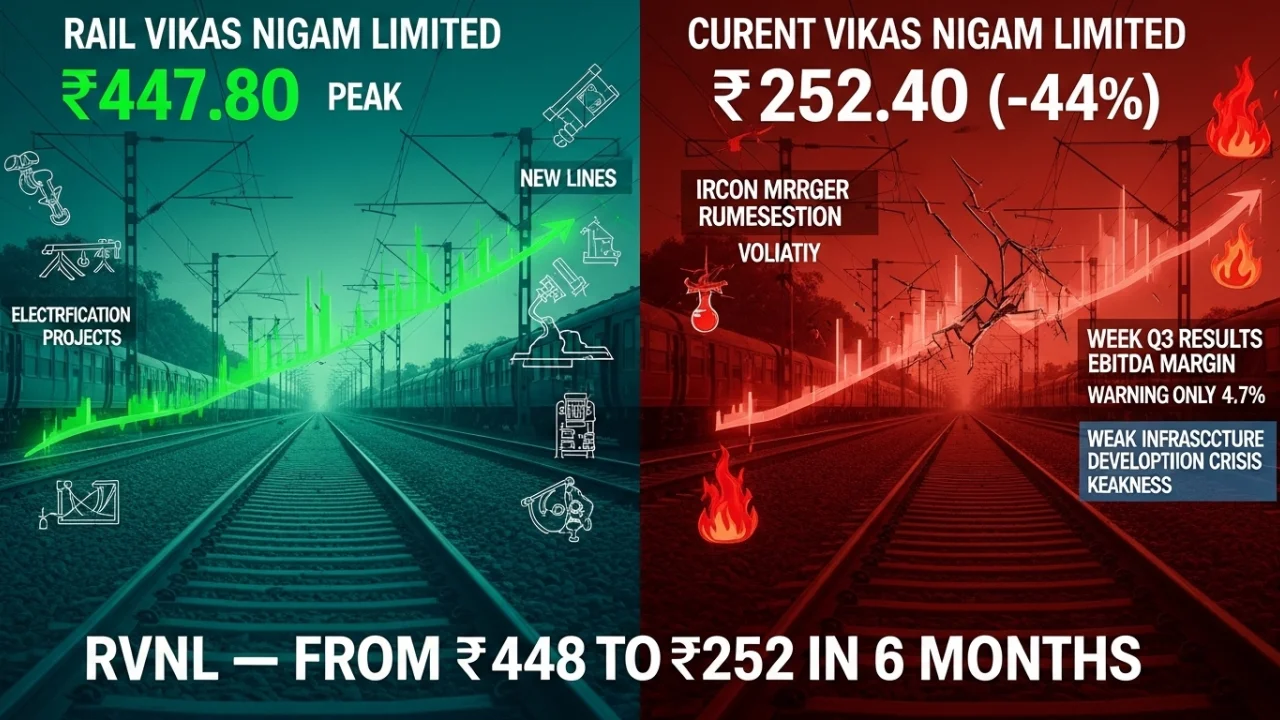
Rail Vikas Nigam Limited finds itself trapped in one of the most brutal corrections in the railway public sector enterprise space during March 2026, trading at just ₹252.40 on March twenty third after touching a fresh fifty two week low of ₹251.20 the same day, representing a catastrophic forty four percent collapse from the ₹447.80 fifty two week high achieved in recent months and leaving the government-owned railway infrastructure specialist with a diminished market capitalization of fifty five thousand one hundred fifty nine crore rupees as investors question whether the company’s expensive fifty seven times price-to-earnings valuation can possibly be justified by quarterly revenue growth of just two point one percent year-over-year and EBITDA margins compressed to a razor-thin four point seven percent. This dramatic fall from grace comes despite what should be positive catalysts including a massive one thousand two hundred one point three five crore rupee letter of award for designing and constructing a new rail-cum-road bridge over the Ganga river near Varanasi, brief twelve percent surge on March sixth following NDTV Profit reports of a potential merger with fellow railway PSU IRCON International that RVNL subsequently denied, and interim dividend approval of one rupee per share representing zero point six six percent yield that provides almost no income support at current depressed prices.
The fundamental mystery confronting Rail Vikas Nigam’s retail and institutional shareholders on March twenty fourth is how a company with seventy eight point two percent government ownership through the Ministry of Railways, CARE AAA credit rating signaling zero default risk, and robust order book including recent wins worth ninety five point three crore from NMDC for track refurbishment in Chhattisgarh and seven hundred ninety six point eight crore for residential tower construction at Bacheli can simultaneously be one of the worst-performing stocks in the entire BSE 500 index with six month losses of twenty nine point seven percent and one year declines of twenty six point seven percent. Understanding this disconnect requires looking beyond the headline project announcements to the deeper structural issues around execution margins that have compressed dramatically, revenue growth that has slowed to barely above inflation despite massive railway infrastructure spending budgets, and valuation metrics that remain extraordinarily expensive even after the correction with price-to-book ratio of six point zero three suggesting the market is still pricing in growth that financial results consistently fail to deliver.
The Brutal Mathematics of RVNL’s 44% Destruction of Wealth
Let me start by quantifying exactly how much shareholder wealth has been destroyed during Rail Vikas Nigam’s slide from the ₹447.80 peak to current ₹252.40 levels because the magnitude of loss provides crucial context for understanding whether buying at today’s prices represents opportunity or falling knife. An investor who purchased one thousand shares of RVNL at the fifty two week high of ₹447.80 invested four lakh forty seven thousand eight hundred rupees. That same one thousand share position is now worth just two lakh fifty two thousand four hundred rupees at current price, representing a paper loss of one lakh ninety five thousand four hundred rupees or forty three point six four percent in roughly six months.
The market capitalization destruction is even more staggering when calculated across the entire shareholder base. At ₹447.80, RVNL’s market cap stood at approximately ninety eight thousand crore rupees based on its equity share capital. At current ₹252.40, the market cap has shrunk to fifty five thousand one hundred fifty nine crore rupees, representing wealth destruction of roughly forty two thousand eight hundred crore rupees. To put that in perspective, the market has evaporated shareholder value equivalent to building approximately three hundred fifty kilometers of new double-track railway line at typical RVNL construction costs of one hundred twenty to one hundred forty crore per kilometer.
The stock’s technical damage extends far beyond just the percentage decline. RVNL has systematically broken through every major support level that technical analysts identified as potential bottoming zones. The ₹400 psychological level collapsed in early February. The ₹350 support failed in mid-February. The ₹300 critical support that coincided with the two hundred day moving average shattered in early March. The most recent carnage saw RVNL break below ₹260 and ultimately touch ₹251.20 on March twenty third, establishing the fifty two week low with the stock now trading decisively below all major moving averages including five-day, twenty-day, fifty-day, one hundred-day, and two hundred-day creating what technical traders call a death cross pattern typically associated with extended bear markets.
The volume statistics accompanying this decline tell their own story of capitulation and distribution. On days when RVNL falls sharply, trading volumes spike dramatically as existing shareholders rush to exit positions before further losses materialize. March fifth saw eighty seven point one eight lakh shares trade hands as the stock fell, representing heavy distribution volume where sellers overwhelmed buyers. The delivery percentage remaining elevated above industry averages suggests this is not just intraday speculation but genuine long-term holders giving up on positions and accepting losses rather than averaging down or holding through the correction.
The Q3 Results That Nobody Wants to Talk About
The fundamental reason Rail Vikas Nigam stock cannot hold ₹300 despite regular project announcements comes down to a brutal reality visible in the third quarter fiscal 2026 results that paint a picture of a company struggling to convert revenue growth into profit margin expansion. Let me walk through the quarterly numbers that should be setting off alarm bells for anyone considering buying this stock at current allegedly cheap valuations.
Consolidated revenues for the December 2025 quarter grew just two point one percent year-over-year to approximately forty nine thousand nine hundred crore rupees compared to forty eight thousand eight hundred crore in the same quarter last year. This anemic revenue growth barely exceeds inflation and demonstrates that despite massive government railway infrastructure spending budgets and regular order announcements, RVNL cannot seem to translate opportunity into actual execution and revenue recognition. Even more concerning, revenue actually declined seven point four percent on a sequential quarter-over-quarter basis from the September 2025 quarter, suggesting execution momentum is slowing rather than accelerating.
The EBITDA or earnings before interest, taxes, depreciation and amortization metric reveals an even more troubling picture. EBITDA declined eight percent quarter-over-quarter while the EBITDA margin compressed to just four point seven percent. Let that sink in for a moment. Rail Vikas Nigam is operating at margins of less than five percent on its railway infrastructure construction projects. For every one hundred rupees of revenue the company books, it is earning less than five rupees of operating profit before accounting for interest costs, depreciation, and taxes. These are margins more typical of low-value commodity businesses than specialized railway infrastructure construction that theoretically requires technical expertise and should command premium pricing.
The net profit situation shows some improvement with the latest quarter reporting three hundred twenty two point eight three crore rupees compared to one hundred thirty four point five three crore in an earlier quarter, representing thirty five point one percent average quarterly increase. But this profit growth is coming from a very low base and when you calculate the net profit margin on forty nine thousand nine hundred crore revenue, you get approximately zero point six five percent net margin. RVNL is essentially operating at breakeven after all costs are considered, leaving almost no cushion for unexpected project delays, material cost inflation, or economic slowdown.
These margin dynamics explain why despite having a fifty two thousand four hundred crore market cap and nearly sixty thousand crore annual revenue run rate, RVNL generates only modest absolute profits that cannot justify the expensive valuation multiples. A company trading at price-to-earnings ratio of fifty seven times and price-to-book of six times should be delivering return on equity above twenty percent and profit margins in double digits. RVNL delivers neither, creating a fundamental valuation gap that the stock price correction is slowly but painfully closing.
The IRCON Merger Rumor Pump and Dump
One of the most revealing episodes in RVNL’s recent price action was the brief twelve percent surge on March sixth following NDTV Profit reports that the Ministry of Railways had proposed merging RVNL with IRCON International, another government-owned railway construction PSU. The stock jumped from around ₹250 to touch ₹280 intraday as traders and investors piled in expecting that a merger would create synergies, reduce overhead costs, improve bidding competitiveness, and potentially unlock value through consolidation of the fragmented railway PSU construction sector.
But the excitement proved to be extremely short-lived. Later the same day, the National Stock Exchange sought clarification from Rail Vikas Nigam regarding the merger reports, and RVNL promptly issued a clarification denying any intimation from the Ministry of Railways regarding merger plans. The stock reversed all gains within the next trading session, leaving investors who chased the merger rumor holding shares purchased at ₹270 to ₹280 that quickly fell back toward ₹260 and eventually crashed through to ₹251.20 by March twenty third.
This pump and dump pattern reveals something important about RVNL’s current investor base and market dynamics. The stock has become a favorite of traders looking for momentum plays based on news headlines rather than fundamentals. Serious long-term institutional investors appear to be reducing positions or staying on the sidelines, evidenced by the extremely low zero point one three percent mutual fund shareholding as of March twenty third. When less than point two percent of shares are held by mutual funds despite the stock being part of major indices including BSE 500 and BSE Infrastructure, it signals that professional money managers who do fundamental research have concluded this stock doesn’t meet their quality or valuation criteria for investment.
The foreign institutional investor holdings also remain minimal, suggesting that international capital has no interest in RVNL at any price given the combination of expensive valuation, poor margins, slow growth, and government ownership that limits operational flexibility. The seventy eight point two percent promoter holding through Ministry of Railways is both a blessing and curse. It provides downside protection from hostile takeover and ensures government support during crisis, but it also means the free float available for trading is limited and the stock can experience violent moves on relatively small volume when sentiment shifts.
The Ganga Bridge Project and Order Book: Strength or Mirage
Bulls trying to make the case for buying RVNL at ₹252 inevitably point to the company’s robust order book and recent project wins as evidence of strong fundamentals despite weak stock price. The one thousand two hundred one point three five crore rupee letter of award for the Ganga bridge project at Varanasi represents a marquee infrastructure development that will enhance RVNL’s reputation and provide multi-year revenue visibility. The project involves designing and constructing a new rail-cum-road bridge with eight spans of one hundred eight point five meters plus two spans of one hundred three point three meters using open web steel girder construction, accommodating four railway tracks on the lower deck and six lane road on the upper deck with associated overhead electrification and general electrical works.
RVNL’s sixty percent share of this one thousand two hundred crore project translates to approximately seven hundred twenty crore revenue over the project timeline, and successful execution could position the company for similar large bridge projects across India as the government accelerates infrastructure spending. Additional recent wins include ninety five point three crore from NMDC for track refurbishment and maintenance work in Chhattisgarh to be completed over thirty six months, two hundred seventy crore for design and commissioning of traction substations in the Daund-Solapur section, seven hundred ninety six point eight crore for residential tower construction at Bacheli, and numerous smaller contracts that collectively add up to several thousand crores of order backlog.
However, the bear case against getting excited about this order book is that RVNL has always had strong order flow given its position as the Ministry of Railways’ preferred executing agency for major projects. The issue has never been winning projects but rather executing them profitably. The four point seven percent EBITDA margin in latest quarter suggests that even with robust order book, RVNL cannot seem to price projects to maintain healthy margins. This could reflect intense competition from private sector engineering and construction firms like Larsen and Toubro, Tata Projects, and Afcons that force RVNL to bid aggressively on price to win government contracts, or it could indicate internal execution inefficiencies where material costs, labor expenses, and project delays erode margins between contract award and completion.
The revenue recognition pattern also raises questions. Despite having massive order book, quarterly revenue is essentially flat year-over-year growing at low single digits. This disconnect between order wins and revenue growth suggests either projects are taking longer than planned to execute creating delays in revenue booking, or RVNL is cherry-picking low-margin high-revenue projects that boost top-line growth but don’t contribute meaningfully to bottom-line profit. Either way, the order book strength is not translating to financial performance that justifies the stock’s valuation even at current depressed ₹252 levels.
What Investors Should Actually Expect From Here
Your personal Rail Vikas Nigam investment decision this week depends entirely on whether you believe the stock at ₹252 after forty four percent correction represents genuine value with mean reversion potential back toward ₹350 to ₹400 over the next twelve to eighteen months, or whether this is a classic value trap where cheap gets cheaper as margins continue compressing and growth continues disappointing. Let me provide frameworks for different investor types and scenarios.
If you currently own RVNL purchased at ₹350 to ₹448 during the euphoric phase and are now sitting on devastating losses of forty three to sixty percent, this week requires brutal honesty about your thesis and conviction. If you bought based on momentum, government spending themes, or order book growth without understanding the margin compression and execution challenges, accept the lesson and exit on any bounce to ₹280 to ₹300 rather than hoping for recovery to your purchase price. The market is telling you that RVNL at ₹400 plus was dramatically overvalued relative to fundamentals. If you bought based on genuine fundamental research believing in long-term railway infrastructure growth, averaging down at ₹250 to ₹260 with five to ten year horizon makes sense only if you have conviction that management can improve margins from current four point seven percent to eight to ten percent over multiple years as execution efficiency improves and pricing power increases.
If you are fortunate enough to have avoided RVNL during the bubble phase and are now considering fresh purchase at ₹252 viewing it as government-backed railway infrastructure play with seventy eight percent promoter holding providing downside support, proceed with extreme caution and modest position sizing. The stock might fall further to ₹220 to ₹230 if broader market correction continues or if next quarterly results disappoint again. A prudent approach would be waiting for technical reversal signals like reclaiming and holding ₹280 for at least three consecutive sessions before deploying twenty percent of intended allocation, then adding another twenty percent if the stock breaks above ₹320 confirming uptrend resumption, and keeping sixty percent in reserve for lower prices or abandoning the position entirely if fundamentals don’t improve.
For traders rather than investors, RVNL’s current position at ₹252 just above the ₹251.20 fifty two week low creates a technical setup for potential bounce trade but requires perfect execution and tight risk management. The trade would be buying anywhere from ₹250 to ₹255 with stop loss below ₹245, targeting quick exit at ₹275 to ₹285 representing ten to twelve percent bounce that could materialize if broader markets rally or if RVNL announces another major project win that briefly boosts sentiment. This is pure mean reversion trading on the assumption that forty four percent correction has created temporary oversold condition, not a fundamental investment based on business quality or valuation attractiveness.
The brutal reality is that Rail Vikas Nigam at ₹252 with PE ratio of fifty seven, price-to-book of six, EBITDA margin of four point seven percent, and revenue growth of two percent does not scream obvious value despite the correction from ₹448. The government ownership and order book provide floor preventing complete collapse below ₹200 to ₹220, but the margin pressure and execution challenges prevent quick recovery back toward ₹400 to ₹450. Expect continued range-bound volatility between ₹240 and ₹300 for the next several months until either quarterly results show dramatic margin improvement that changes the narrative, or valuation compresses further through price decline or earnings growth that brings multiples into reasonable territory relative to business quality.
This article is for educational purposes only and does not constitute investment advice. Railway infrastructure PSU stocks involve execution risks, margin pressure, and government policy changes. All investment decisions should be made based on individual financial circumstances and risk tolerance.
Data: Screener, Groww, Tickertape, INDmoney, ICICI Direct, Business Standard, Kotak Neo as of March 5-24, 2026.