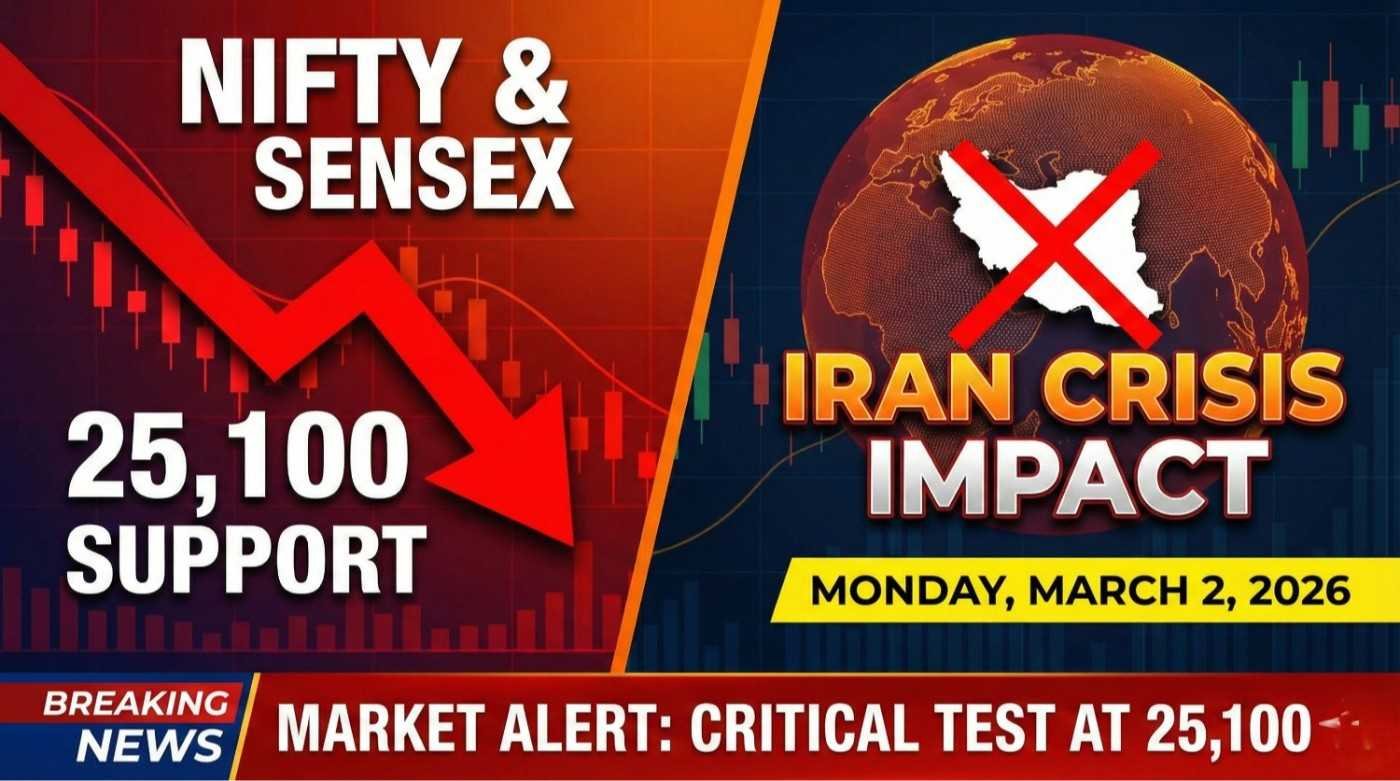
Nifty & Sensex Monday March 2, 2026: What to Expect at 25,100 Critical Support — Iran Supreme Leader Killed, Oil Surges, Markets Brace for Crisis Selloff
By Senior Indian Equity Markets, Geopolitical Crisis and Energy Sector Impact Analyst · March 2, 2026 · 14 Min Read
Indian equity markets face their most severe crisis test in months when trading resumes Monday, March 2, 2026 — entering the session at Friday’s closing levels of Nifty 25,178.65 and Sensex 81,287.19 but confronting a catastrophic weekend development that has sent global financial markets into panic: the killing of Iran’s Supreme Leader Ayatollah Ali Khamenei and subsequent military action disrupting oil shipments through the critical Strait of Hormuz (responsible for 20% of global oil supply). Crude oil prices have surged dramatically with WTI jumping 2.78% to $67.02 per barrel and Brent crude soaring 2.45% to $72.48, creating inflationary nightmare scenarios for India which imports 85% of its oil requirements, while analysts warn of weak opening with 1-1.5% additional correction likely pushing Nifty toward the make-or-break 25,000-25,100 psychological support zone. With Friday’s 1.2% crash already breaking the 25,400 support and 200-day EMA, technical structure deeply damaged, and expert consensus pointing to “cautious to sideways bias” with immediate resistance at 25,350-25,500 acting as “stiff hurdles,” Monday faces a binary outcome: panic capitulation toward 24,700-24,900 if geopolitical escalation continues — or surprise resilience if domestic institutional buying absorbs the shock.
The Weekend Crisis That Changed Everything
What Happened Over the Weekend (February 28 – March 1, 2026):
Event: Killing of Iran’s Supreme Leader Ayatollah Ali Khamenei
Immediate Impact:
- Military action in and around Strait of Hormuz
- Key oil shipment disruptions
- Global oil prices surge 2.5-2.8%
- Volatility spikes across all asset classes
- Safe-haven flows into gold, US Treasuries
Why This Is Market-Shattering for India:
Impact #1: Oil Import Crisis
India imports 85% of crude oil requirements. Current situation:
- WTI Crude: $67.02 (+2.78%)
- Brent Crude: $72.48 (+2.45%)
- Potential Spike: Analysts warn $85-95 per barrel if conflict escalates
- Import Bill Impact: Every $10/barrel increase = ₹80,000-1,00,000 Crore additional annual cost
Translation: India’s already fragile current account deficit (CAD) worsens dramatically, putting pressure on rupee, inflation, and fiscal deficit.
Impact #2: Inflation Acceleration
According to Manoranjan Sharma, Chief Economist at Infomerics Ratings:
“Elevated import costs are likely to widen the current account deficit and further strain the fiscal deficit through increased subsidy obligations.”
Inflation Transmission Mechanism:
- Transport costs rise → Logistics, freight, passenger fares increase
- Manufacturing input costs spike → Petro-chemical derivatives expensive
- Power generation costs up → Diesel gensets, fuel-based power plants
- Consumer prices increase → Petrol, diesel, LPG, food (transport component)
Expected CPI Impact: 50-75 basis points increase in headline inflation if oil sustains $70-75 range
Impact #3: Fiscal Pressure on Government
As Sharma warns:
“If the conflict drags on, the government’s fiscal position could come under strain due to higher subsidy bills, weaker disinvestment prospects, and the need for additional social spending to support the economy.”
Fiscal Stress Points:
- Fuel subsidies: LPG, kerosene subsidies increase
- Fertilizer subsidies: Petro-chemical based, costs rise
- Disinvestment delays: Volatile markets prevent PSU stake sales
- Borrowing costs: Higher fiscal deficit = more bonds = higher yields
Sectoral Impact Analysis: Who Gets Crushed, Who Survives Monday
Sectors Under Maximum Pressure:
| Sector | Expected Monday Impact | Key Stocks at Risk | Why Vulnerable |
|---|---|---|---|
| Aviation | -2% to -4% | IndiGo, SpiceJet | Jet fuel 40% of operating costs |
| Automobiles | -2% to -3% | Maruti, M&M, Tata Motors | Fuel inflation hits demand |
| Logistics/Transport | -1.5% to -2.5% | Blue Dart, TCI, VRL | Diesel cost spike |
| Financials | -1% to -2% | ICICI, HDFC, Kotak | Credit demand falls, NPA risk |
| FMCG | -0.5% to -1.5% | HUL, ITC, Nestle | Input costs, consumer demand hit |
| Oil Marketing (OMCs) | Volatile ±2-3% | BPCL, HPCL, IOC | Margin squeeze vs inventory gains |
According to Manoranjan Sharma:
“Automobiles, financials and FMCG stocks are likely to face pressure.”
Why These Sectors Crash:
Aviation: Jet fuel represents 35-45% of airline operating costs. A $10/barrel oil increase translates to:
- IndiGo: ₹1,500-2,000 Cr annual cost increase
- SpiceJet: ₹300-500 Cr additional burden
- Result: Profitability collapses, stock down 3-5%
Automobiles: Petrol/diesel inflation directly destroys discretionary vehicle demand:
- Two-wheeler sales: -5-8% (price-sensitive buyers delay)
- Passenger vehicles: -3-5% (EMI + fuel double whammy)
- Commercial vehicles: -2-4% (freight economics worsen)
Sectors Offering Relative Safety:
| Sector | Expected Performance | Key Stocks | Why Defensive |
|---|---|---|---|
| IT Services | 0% to +1% | Infosys, TCS, HCL Tech | Dollar earnings, global risk-off favors |
| Pharma | -0.5% to +0.5% | Sun Pharma, Cipla, Dr Reddy’s | Defensive, export-oriented |
| Select PSU Banks | -0.5% to 0% | SBI, BOB, PNB | Government backing, defensive |
| Metals (Mixed) | -1% to +1% | Tata Steel, Hindalco | Commodity volatility |
According to Sharma:
“IT and select export-oriented companies may see some support due to global risk aversion and a stronger US dollar.”
Why IT Outperforms:
- Earns in dollars (70-80% revenue US/Europe)
- Dollar strengthens in crisis (DXY 107+) = rupee weakens = revenue boost
- Global clients accelerate digital transformation (counter-cyclical demand)
Technical Disaster Zone: The 25,100 Line in the Sand
Friday’s Technical Carnage Created:
| Breakdown | What It Means | Monday Implication |
|---|---|---|
| Broke 25,400 | 5+ times defended support failed | Sellers in control |
| Broke 200-day EMA | Long-term trend support lost | Bear market signal |
| Closed at day’s low | No buying interest even at lows | Capitulation not complete |
| Weekly RSI 46.93 | Weak momentum, not oversold yet | Room for further fall |
| Below 20-week EMA | Weekly trend also broken | Multi-timeframe bearish |
Monday’s Critical Levels:
Resistance (Supply Zones Where Rallies Will Fail):
| Level | Nifty | Sensex | Significance |
|---|---|---|---|
| Immediate | 25,350 | 82,000 | First hurdle |
| Key | 25,500 | 82,500 | Strong supply |
| Major | 25,600-25,800 | 83,000-83,500 | Reclaim needed for reversal |
Support (Demand Zones That Must Hold):
| Level | Nifty | Sensex | Consequence if Breaks |
|---|---|---|---|
| Critical | 25,100 | 81,000 | MUST HOLD or panic |
| Psychological | 25,000 | 80,500 | Mass psychology shift |
| Strong | 24,800 | 80,000 | Last defense |
| Breakdown | 24,700 | 79,500 | Capitulation zone |
Expert Technical Views for Monday:
Sumeet Bagadia (Choice FinX):
“For the coming week, the 25,000 psychological mark stands as the make-or-break level and a breakdown here could drag prices toward the 24,800 area. On the upside, 25,350 and 25,600 now act as stiff hurdles. Strategy remains ‘sell on rises’ until the index decisively reclaims 25,600.”
Hariprasad K:
“The 25,000 mark is a critical psychological threshold.”
Ajit Mishra:
“Nifty has surrendered the 25,400 support zone and moved closer to the gap area around 25,100.”
G Chokkalingam (Equinomics Research):
“As long as Nifty holds above 25,100, the short-term bias is cautious consolidation with scope to test 25,400-25,550 if global sentiment improves. A close below 25,100 increases the probability of a move towards 24,900-24,700.”
Three Scenarios for Monday March 2, 2026
Scenario 1: Panic Capitulation — Target 24,700-24,900 (50% Probability)
Opening: Gap-down to 24,950-25,050 (panic mode)
Morning Session (9:15 AM-11:00 AM):
- Opens 125-225 points below Friday close
- Tests 25,000 psychological support immediately
- Breaks below 25,000 by 10:00 AM
- Cascade to 24,850-24,950 by 11:00 AM
- Aviation stocks crash 3-4% (IndiGo, SpiceJet)
- Auto stocks down 2-3% (Maruti, M&M)
Afternoon Session:
- Tests 24,700-24,800 ultimate support
- Either stabilizes or breaks for deeper correction
- Closes: 24,700-24,950 range
- Net loss: -225 to -480 points (-0.90% to -1.90%)
Why Most Likely:
- Weekend Iran crisis creates extreme fear
- Oil price surge confirmed (not speculation)
- Friday already broke key supports
- FII selling to accelerate
- No immediate positive catalyst
Trading Strategy:
- AVOID buying Monday — wait for stabilization
- If already long: Exit on any bounce to 25,200-25,300
- Cash is king: Preserve capital for better entry
- Gold/defensive sectors: Rotate to safety
Scenario 2: Resilient Bounce — Recovery to 25,350-25,500 (30% Probability)
Opening: Modest gap-down to 25,050-25,120
Morning Session:
- Opens weak but finds buyers at 25,100 support
- IT sector leads defense (Infosys, TCS positive)
- DIIs step in with ₹3,000-4,000 Cr buying
- Recovers to 25,250-25,300 by 11:30 AM
Afternoon Session:
- Tests 25,350-25,400 resistance
- Either rejected or breaks through
- Closes: 25,300-25,450 range
- Net change: +120 to +270 points (+0.48% to +1.07%)
Why Possible:
- Oil spike already priced in after Friday’s crash
- Domestic institutions view dip as opportunity
- 25,100 support psychologically defended
- Oversold technical bounce (RSI 46.93 approaching 30)
Trading Strategy:
- Buy only if sustains above 25,150 for 30+ minutes
- Target: 25,350-25,400 exit
- Stop-loss: 25,050 tight
Scenario 3: Consolidation 25,050-25,300 (20% Probability)
All-Day Pattern:
- Opens 25,080-25,150 (small gap-down)
- Oscillates 25,050-25,300 range entire day
- Choppy, volatile, no clear direction
- Low conviction from both bulls and bears
Why Least Likely:
- Crisis situations rarely consolidate Day 1
- Either panic or resilience dominates
- Unlikely market finds equilibrium immediately
Key Takeaways: Monday’s Iran Crisis Test
→ Nifty at 25,179 and Sensex at 81,287 face catastrophic Monday test after weekend Iran Supreme Leader killing triggered Strait of Hormuz oil disruption, crude surging 2.5-2.8% to WTI $67, Brent $72.48, creating inflation nightmare for India importing 85% of oil.
→ Critical 25,100 Nifty support (81,000 Sensex) is make-or-break Monday — experts unanimous this is “psychological threshold” where break below triggers panic toward 24,700-24,900; hold above allows cautious consolidation targeting 25,350-25,500 recovery.
→ Three scenarios: (1) Panic capitulation to 24,700-24,950 most likely (50%) if gap-down opening breaks 25,000 psychological support, (2) Resilient bounce to 25,300-25,450 possible (30%) if DII buying ₹3,000-4,000 Cr defends 25,100, (3) Choppy consolidation 25,050-25,300 unlikely (20%) in crisis environment.
→ Sectoral devastation expected: Aviation -2 to -4% (IndiGo, SpiceJet jet fuel costs), Autos -2 to -3% (Maruti, M&M demand destruction), Financials -1 to -2% (ICICI, HDFC credit slowdown), FMCG -0.5 to -1.5% (HUL, ITC input costs) while IT sector offers relative safety 0 to +1% (Infosys, TCS dollar earnings, risk-off flows).
→ Fiscal nightmare brewing: Manoranjan Sharma warns “higher subsidy bills, weaker disinvestment prospects, additional social spending” if conflict drags — every $10/barrel oil increase costs India ₹80,000-1,00,000 Cr annually widening CAD and fiscal deficit.
→ Friday technical carnage (broke 25,400, 200-day EMA, closed at day’s low, RSI 46.93 weak, below 20-week EMA) leaves Nifty with zero structural support above 25,000 — Sumeet Bagadia strategy “sell on rises until index decisively reclaims 25,600.”
This article is for educational purposes only and does not constitute trading or investment advice. Geopolitical events create extreme volatility. All investment decisions should be made based on individual risk tolerance.
Data: Replete Equities, Choice FinX, Business Today, Outlook Money, Goodreturns, 5paisa as of February 27-March 2, 2026.