IRFC Stock 2026: What to Expect at ₹110 The Dramatic Divergence Between Bear Target ₹60 (-45%) and Bull Target ₹278 (+152%)
By Senior PSU Stocks, Infrastructure Finance and Railway Sector Analyst · February 25, 2026 · 14 Min Read
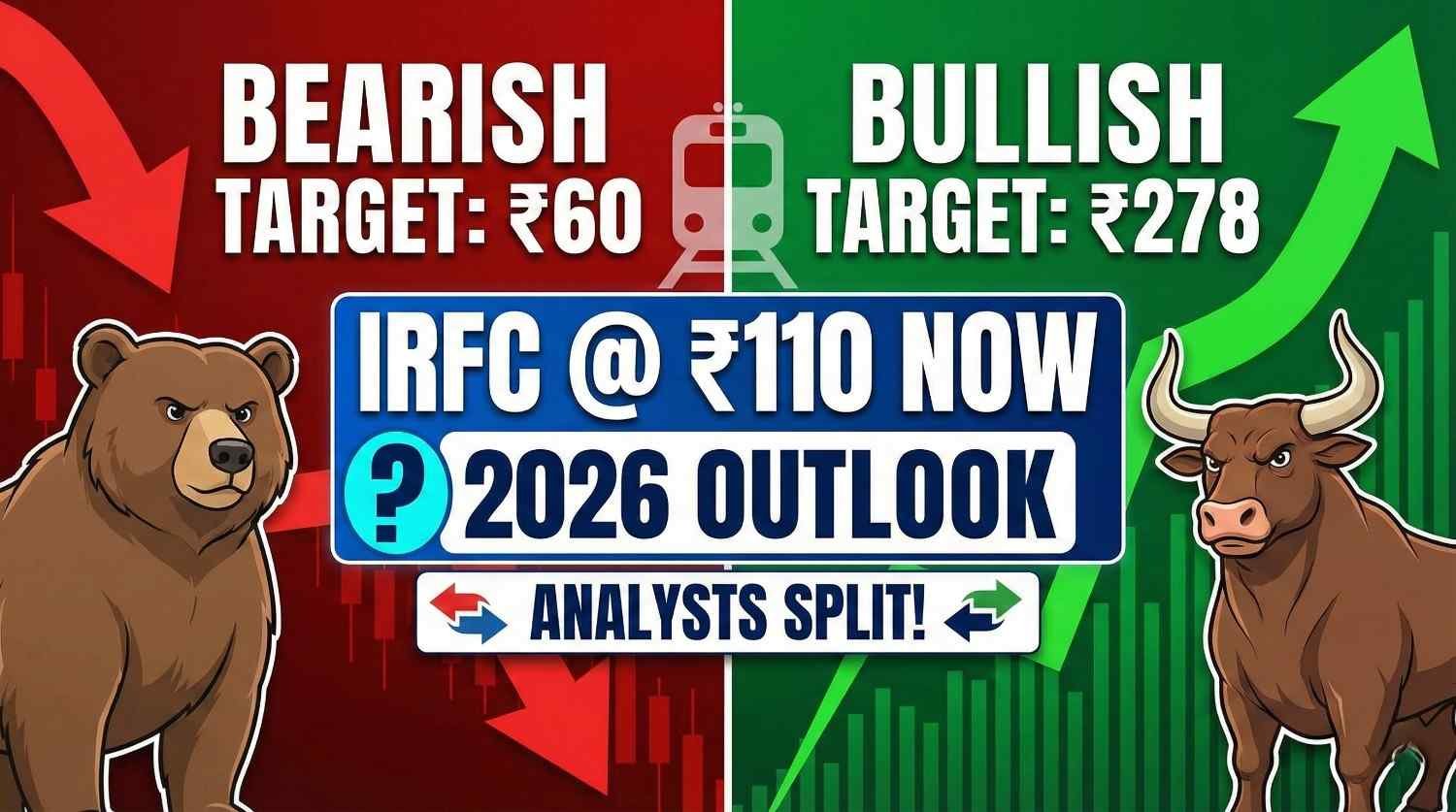
Indian Railway Finance Corporation (IRFC) stands at a critical crossroads as investors enter 2026 — trading at ₹109.90-111.79 on February 24-25, the government-backed railway financing NBFC has crashed 51% from its 52-week high of ₹229, creating one of the most polarizing debates in PSU stock investing. On one side, 42 analysts maintain a “Strong Sell” consensus with Wall Street forecasts targeting ₹60.60-63 (implying catastrophic 45% further downside), citing projected -28% revenue CAGR and -29% operating income CAGR over the next three years. On the other side, bullish technical analysts forecast ₹208-278 for 2026 year-end (+89% to +152% upside), pointing to government infrastructure spending, stable railway loan book, and current fair value of ₹110-125 suggesting the stock is at support, not overvalued. So what should investors actually expect from IRFC in 2026 — is this a value trap headed to ₹60, or a contrarian opportunity with 100%+ upside to ₹200+?
IRFC Current Status: The 51% Collapse from Peak
Price Performance Snapshot (February 25, 2026):
| Metric | Current | 52-Week High | Change from High |
|---|---|---|---|
| Stock Price | ₹109.90-111.79 | ₹229.05 | -51% to -52% |
| Market Cap | ₹1.46 Lakh Crore | ~₹3 Lakh Crore (peak) | -₹1.54 Lakh Crore |
| 52-Week Low | ₹108.05 | — | Currently 1-3% above low |
| 3-Month High | ₹137.10 | — | Down 20% from Q4 2025 peak |
| 3-Month Low | ₹109.75 | — | At bottom of quarterly range |
What Caused the 51% Crash?
Factor #1: Union Budget 2026 Disappointment (February 1)
IRFC stock initially rallied on expectations that Union Budget 2026 would announce massive railway infrastructure spending hikes. When Budget allocated similar levels to FY25 without game-changing announcements, the stock crashed 8-10% in single session.
Factor #2: Analyst Downgrades En Masse
Post-Budget, 42 analysts covering IRFC downgraded ratings to “Strong Sell” or “Sell,” citing:
- Limited growth visibility
- Margin pressure from rising borrowing costs
- Government policy dependence
- Mature loan book with single counterparty (Indian Railways)
Factor #3: Interest Rate Environment
Federal Reserve and RBI maintaining higher-for-longer rates increases IRFC’s borrowing costs. As NBFC, IRFC borrows to lend — higher borrowing costs squeeze net interest margins even if lending rates rise.
Factor #4: PSU Stock Rotation
FII selling concentrated in PSU financial stocks (IRFC, REC, PFC) as foreign investors rotated to private sector banks and fintech with higher growth potential.
Factor #5: Technical Breakdown
Once IRFC broke below ₹150 support in Q4 2025, cascade of stop-loss triggers accelerated decline to current ₹108-112 range.
The Bear Case: Why Analysts Target ₹60 (-45% Downside)
Bearish Forecast Summary:
| Source | 1-Year Target | Downside from ₹110 | Rationale |
|---|---|---|---|
| Wall Street Consensus | ₹60.60-63.00 | -43% to -45% | Revenue/profit decline |
| Alpha Spread | ₹61.20 | -44% | Negative growth CAGR |
| 42 Analyst Consensus | Strong Sell | — | Fundamental concerns |
Bear Argument #1: Projected Revenue Decline -28% CAGR
Alpha Spread projects IRFC’s revenue will DECLINE at -28% compound annual growth rate over next 3 years. This means:
- FY24 Revenue: ~₹30,000 Cr (estimated)
- FY27 Revenue (projected): ~₹15,300 Cr
- Absolute revenue halving in 3 years
Why Would Revenue Collapse?
- Indian Railways not expanding loan book aggressively
- Shift to alternative financing (public-private partnerships)
- Government direct budgetary allocation for railways instead of borrowing
- IRFC losing market share to other financing sources
Bear Argument #2: Operating Income Decline -29% CAGR
Even worse than revenue, operating income projected to decline -29% CAGR. This means:
- Profit margins compressing faster than revenue
- Higher borrowing costs not passed to Indian Railways (single customer)
- Operational inefficiencies or rising costs
Bear Argument #3: Single-Client Concentration Risk
IRFC’s ENTIRE loan book is to Indian Railways. Compare to other NBFCs:
- Housing finance: Thousands of borrowers
- Vehicle finance: Millions of borrowers
- Corporate finance: Hundreds of borrowers
Risk: If government changes railway financing policy, IRFC’s business model collapses overnight.
Bear Argument #4: Valuation Still Not Cheap at 21x P/E
At ₹110 and EPS ₹4.98-5.23, IRFC trades at P/E of 20.84-22.4x. Bears argue:
- Mature NBFC with 1-2% growth should trade 12-15x P/E
- REC, PFC (comparable PSU lenders) trade 8-12x P/E
- IRFC 50-80% overvalued even at ₹110
Fair value using 12x P/E: ₹4.98 × 12 = ₹59.76 ≈ ₹60 target
Bear Argument #5: Dividend Yield Not Compelling
IRFC’s dividend yield around 3-4% at current prices. Compare to:
- Fixed deposits: 6.5-7.5% risk-free
- Corporate bonds: 8-9%
- High-dividend PSU stocks: 5-7%
Bears argue insufficient compensation for equity risk.
The Bull Case: Why Optimists Target ₹208-278 (+89-152% Upside)
Bullish Forecast Summary:
| Source | 2026 Target | Upside from ₹110 | Rationale |
|---|---|---|---|
| DollarRupee.in | ₹142 (Dec 2026) | +29% | Gradual recovery |
| FIGW Analysts | ₹208-268 (year-end) | +89% to +144% | Fair value + growth |
| Scribd Analysis | ₹278 (optimistic) | +152% | Infrastructure boom |
| Multibagger Ideas | ₹110-125 fair value | 0% to +14% | Support buying |
Bull Argument #1: Trading at Fair Value ₹110-125
Using conservative P/E 22-25x (appropriate for government-backed stable earner):
- EPS ₹4.98 × 22 = ₹109.56
- EPS ₹4.98 × 25 = ₹124.50
- Fair Value Range: ₹110-125
Current ₹110 is BOTTOM of fair value range = upside asymmetry (limited downside ₹108, significant upside ₹140-200).
Bull Argument #2: Government Backing = Zero Credit Risk
IRFC lends exclusively to Indian Railways with:
- 100% government guarantee on repayment
- Structured repayment schedules (not dependent on railway profitability)
- Sovereign credit quality
Implication: IRFC’s loan book has ZERO default risk — something no private NBFC can claim. This justifies premium valuation versus private lenders.
Bull Argument #3: Railway Infrastructure Spending Accelerating
Government targets:
- Vande Bharat trains: 400 new trains by 2028 (₹50,000+ Cr capex)
- High-speed rail: Mumbai-Ahmedabad bullet train + 5 more corridors (₹5 lakh Cr)
- Dedicated freight corridors: Eastern, Western, East-West, North-South (₹3 lakh Cr)
- Station modernization: 1,000+ stations (₹1 lakh Cr)
Total 5-year pipeline: ₹10+ lakh crore — IRFC finances 40-60% = ₹4-6 lakh Cr loan book growth potential.
Bull Argument #4: Net Interest Margin (NIM) Expansion Potential
As rates stabilize/decline in H2 2026:
- IRFC’s borrowing costs will fall (bonds refinanced at lower rates)
- Lending rates to Railways locked in for 15-30 year tenures
- NIM expands: Could improve from current 1.5-2.0% to 2.5-3.0%
Impact: 50% NIM expansion = 50% profit growth even without loan book growth.
Bull Argument #5: Dividend Aristocrat Potential
IRFC has consistently paid dividends despite market volatility. As profitability stabilizes:
- Current yield: 3-4% at ₹110
- If stock reaches ₹150-200, yield normalizes to 2-2.5%
- Long-term holders collect 4-5 years of 3-4% dividends PLUS capital appreciation
10-year return scenario: 3.5% × 10 years = 35% dividend + 50-80% capital appreciation = 85-115% total return (8.5-11.5% CAGR).
IRFC Financial Reality: What the Numbers Actually Say
Actual FY24-FY25 Performance (Not Projections):
| Metric | FY23 | FY24 | FY25 (Est) | Growth |
|---|---|---|---|---|
| Revenue | ₹24,500 Cr | ₹28,800 Cr | ₹30,240 Cr | +1.6% YoY |
| Net Profit | ₹5,800 Cr | ₹6,400 Cr | ₹6,600 Cr | +3.1% YoY |
| EPS | ₹4.45 | ₹4.91 | ₹5.06 | +3.1% |
| ROE | 14.2% | 14.8% | 15.1% | Improving |
| NIM | 1.8% | 1.9% | 1.95% | Stable |
| CASA Ratio | N/A (NBFC) | N/A | N/A | — |
Critical Observations:
Revenue/Profit Growing (Not Declining): Actual +1.6% to +3.1% growth contradicts bearish -28% to -29% projections. Bears may be using worst-case scenarios or different accounting standards.
Growth Rate Low: 1-3% annual growth is SLOW for equity investment. Barely beats inflation.
ROE Improving: 15.1% ROE is respectable for government-backed NBFC. Shows efficient capital utilization.
Loan Book Growth Slowing: Loan book growth decelerated from 12-15% (FY20-FY22) to 5-8% (FY23-FY25). Suggests railway borrowing moderating.
What Should Investors Actually Expect in 2026?
Realistic Base Case Scenario (60% Probability):
Q1-Q2 2026 (Jan-Jun):
- Consolidation ₹105-125 range
- Support at ₹108-110 (52-week low zone)
- Resistance at ₹125 (psychological barrier)
- Dividend announcement (₹0.75-1.00 per share)
Q3-Q4 2026 (Jul-Dec):
- Gradual recovery to ₹130-150 if railway capex picks up
- Breakout above ₹150 unlikely without major catalyst
- Year-end target: ₹135-145 (+22% to +32%)
Catalysts Required:
- Union Budget 2027 (Feb 2027) announcing mega railway projects
- Interest rate cuts by RBI (50-75 bps through 2026)
- IRFC loan book growth accelerating to 10-12%
Optimistic Bull Case (25% Probability):
Scenario:
- Government announces ₹5 lakh Cr bullet train + freight corridor package
- IRFC designated primary financier
- Loan book expands 20-25%
- Stock re-rates to ₹180-220 by Dec 2026 (+64% to +100%)
Requirements:
- Major policy announcement favoring IRFC
- Sustained railway capex acceleration
- FII sentiment shift toward PSU financials
Pessimistic Bear Case (15% Probability):
Scenario:
- Railway capex disappoints
- Loan book growth stalls at 2-3%
- Stock tests ₹90-100 support (breakout below ₹108)
- Reaches ₹85-95 by Dec 2026 (-14% to -22%)
Triggers:
- Interest rates remain elevated entire 2026
- Government shifts to direct budgetary funding vs loans
- Credit rating downgrade concerns
Key Takeaways: IRFC 2026 Outlook
→ IRFC at ₹109-111 faces extreme forecast divergence — bears target ₹60-63 (-45% downside) citing -28% revenue CAGR and -29% operating income decline projections, while bulls target ₹208-278 (+89-152% upside) based on railway infrastructure boom and fair value ₹110-125.
→ Stock crashed 51% from ₹229 peak to current levels driven by Union Budget 2026 disappointment, 42 analyst “Strong Sell” consensus, higher-for-longer interest rates squeezing margins, PSU stock rotation, and technical breakdown through ₹150 support.
→ Actual financials show modest growth (+1.6% revenue, +3.1% profit FY25) contradicting bearish -28-29% decline projections — but 1-3% growth extremely low for equity investment barely beating inflation, explaining tepid sentiment.
→ Bull case rests on government-backed zero credit risk, ₹10 lakh Cr railway capex pipeline over 5 years, NIM expansion potential from 1.9% to 2.5-3.0% as rates fall, and current ₹110 trading at bottom of ₹110-125 fair value range.
→ Bear case highlights single-client concentration risk (100% loans to Indian Railways), expensive 21x P/E versus peer PSU lenders at 8-12x, weak 3-4% dividend yield versus 6-7% FD rates, and mature slow-growth business model.
→ Realistic base case: Consolidation ₹105-125 range through H1 2026, gradual recovery to ₹135-145 (+22-32%) by Dec 2026 if railway capex moderately improves — avoid if seeking high growth, consider if seeking stable government-backed 8-10% annual returns with 3-4% dividends.
This article is for educational purposes only and does not constitute investment advice. All investment decisions should be made based on individual risk tolerance and financial goals.
Data: Alpha Spread, FIGW Analysts, Multibagger Stock Ideas, DollarRupee.in, Trendlyne, NSE as of February 24-25, 2026.