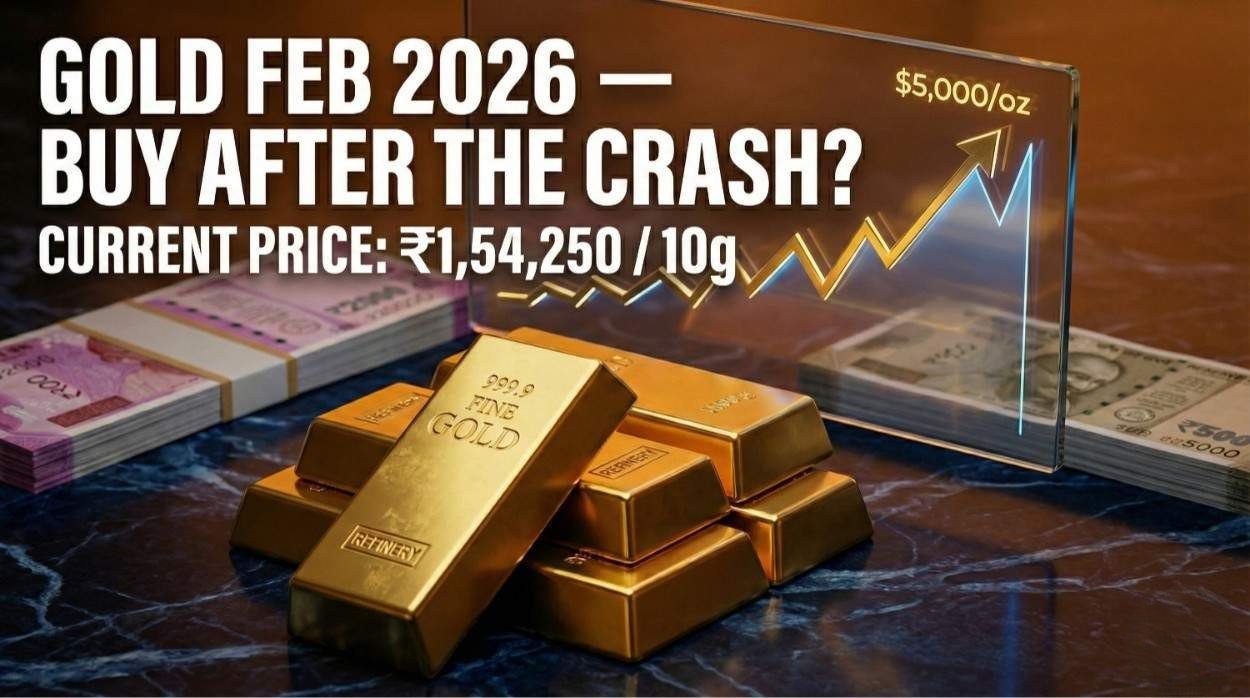
Gold Price India February 2026: Should You Buy After the Crash — Or Wait for Lower Levels?
By Senior Commodities and Portfolio Strategy Analyst · February 18, 2026 · 8 Min Read
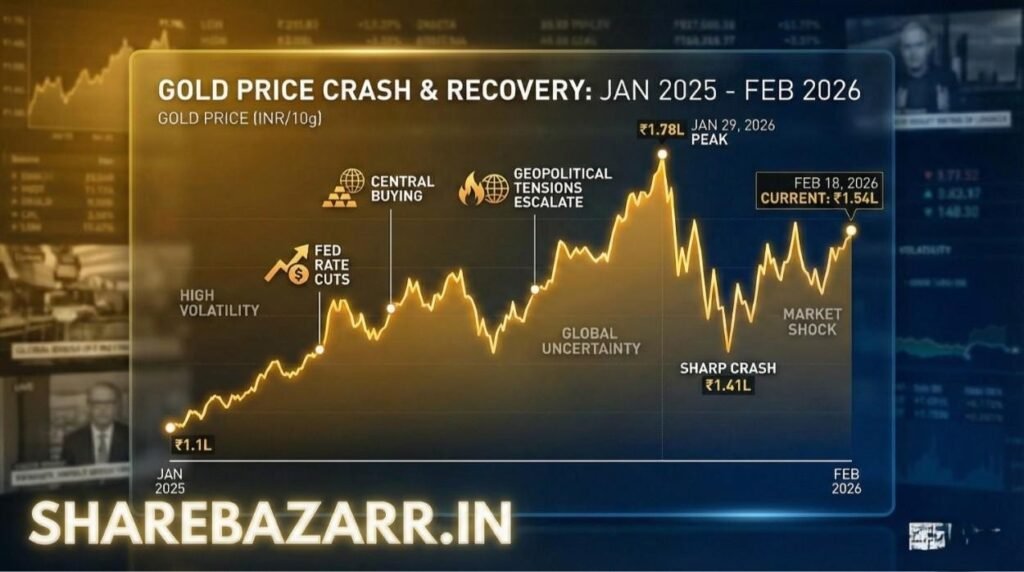
Gold just delivered one of the most violent round-trips in precious metals history — surging 50% through 2025 to peak at ₹1,78,850 per 10 grams on January 29, 2026, then crashing 12% to ₹1,41,900 within ten days, before recovering to today’s ₹1,54,190. That whipsaw left retail investors stunned and institutional desks scrambling to recalibrate models. However, the fundamental drivers that powered gold’s 2025 rally — central bank buying at record pace, Federal Reserve rate cuts, persistent geopolitical risk, and Rupee depreciation — have not disappeared. So should you actually buy gold at ₹1.54 lakh per 10 grams in February 2026 — or is this recovery just a pause before another leg lower?
Gold Price India February 2026: Where We Stand After Historic Volatility
Gold occupies a unique position entering late February 2026 — it has corrected from all-time highs but remains structurally elevated, trading near levels that seemed impossible just eighteen months ago when prices sat closer to ₹60,000-65,000 per 10 grams.
| Metric | Current Status (Feb 17-18, 2026) |
|---|---|
| Gold 24K India (per 10g) | ₹1,54,190 |
| Gold 22K India (per 10g) | ₹1,41,340 |
| Gold Price (per gram 24K) | ₹15,419 |
| International Gold (USD/oz) | $4,900 – $5,060 |
| USD-INR Exchange Rate | ~₹90.61 |
| Gold All-Time High India | ₹1,78,850/10g (Jan 29, 2026) |
| Gold Recent Low | ₹1,41,900/10g (Feb 3, 2026) |
| Gold 2025 Rally | +50% (~55% peak-to-peak) |
| Gold YTD Return (2026) | -13.8% from peak |
| Gold 1-Year Return | +140% from early 2025 |
| Nifty 50 Level | ~25,752 |
| Sensex Level | ~83,553 |
| MCX Gold Futures | ₹1,54,000-1,58,000 range |
| Global Gold Demand 2025 | 5,002 tonnes (record) |
| Central Bank Buying 2025 | 863 tonnes |
| Investment Demand 2025 | 2,175 tonnes |
Note: Prices vary by city, jeweller, and purity. Data compiled from Goodreturns, MCX, Trading Economics as of February 17-18, 2026.
The most striking number in that table is the peak-to-trough-to-recovery sequence. Gold rose from approximately ₹1,10,000 in early January 2025 to ₹1,78,850 by January 29, 2026 — a 63% gain — then crashed 21% to ₹1,41,900 in ten days, before recovering 8.7% to current ₹1,54,190 levels. That volatility profile is unprecedented in Indian gold markets and fundamentally changes the risk assessment for investors considering entry today.
International gold at $4,900-5,060 per troy ounce hovers near two-week highs, supported by weak US retail sales data, expectations of three Federal Reserve rate cuts in 2026 (up from two just a week ago), and ongoing geopolitical tensions. The metal broke above $5,000 earlier this month before pulling back, demonstrating that psychological resistance levels matter even in a structurally bullish market.
The Indian Rupee at ₹90.61 per Dollar — a significant depreciation from approximately ₹83-84 in early 2024 — has been gold’s hidden amplifier for domestic investors. Even when Dollar gold consolidates, Rupee weakness mechanically pushes Indian gold prices higher. That currency dynamic remains intact, with most strategists projecting gradual further weakness toward ₹92-95 by end-2026.
The Case FOR Buying Gold in February 2026: Fundamentals Remain Intact
Despite the terrifying January volatility, the fundamental bull case for gold has not been invalidated — it has been reinforced. The fact that gold found support at ₹1.42 lakh rather than returning to ₹1.10 lakh pre-rally levels suggests that structural demand has created a genuine price floor.
Central Bank Buying Provides Unprecedented Demand Floor: Global central banks added 863 tonnes to reserves in 2025 — the fourth consecutive year above 800 tonnes after averaging only 473 tonnes annually from 2010-2021. That is not speculation — that is sovereign institutions with infinite time horizons systematically accumulating a strategic asset. China’s central bank extended gold purchases for the 15th consecutive month in January 2026. Poland added 102 tonnes in 2025 and announced plans to increase reserves further to 700 tonnes for “national security reasons.” Kazakhstan recorded its highest annual buying on record at 57 tonnes.
| Central Bank Gold Purchases | 2023 | 2024 | 2025 | 2026 Forecast |
|---|---|---|---|---|
| Total (tonnes) | 1,037 | 1,045+ | 863 | 755-1,117 |
| Poland | 45 | 90 | 102 | 150+ (target) |
| China | 225 | 316 | Ongoing | Continuing |
| Kazakhstan | 28 | 35 | 57 | 45-60 |
| Turkey | 75 | 88 | 65 | 60-80 |
| India (RBI) | 18 | 28 | 35 | 40-50 |
| % of Annual Mine Production | ~26% | ~27% | ~24% | ~21-30% |
Note: Figures are approximate estimates from World Gold Council, J.P. Morgan, State Street, various central bank statements.
The 2026 forecast of 755-1,117 tonnes from major institutions like J.P. Morgan and State Street represents a slight moderation from the 1,000+ tonne peaks but remains structurally elevated. As J.P. Morgan noted, “With prices around $4,000/oz and above, central banks simply don’t need to purchase as many tonnes of gold to move their gold share to the desired percentage.” That is a feature, not a weakness — it confirms that central bank demand is strategic allocation, not speculative trading.
Gold Surpassed US Treasuries in Central Bank Reserves for First Time Since 1996: According to Morgan Stanley Research, gold now accounts for a larger share of central bank reserves than US Treasury holdings — a tectonic shift that reflects declining confidence in Dollar hegemony and accelerating de-dollarization across emerging markets. That structural reallocation has years, not quarters, left to run.
Federal Reserve Rate Cut Cycle is Accelerating, Not Reversing: Markets have priced in three Fed rate cuts for 2026 — up from two just a week ago — following weaker-than-expected December retail sales, falling job openings to lowest since 2020, and private payroll growth undershooting forecasts. The US 2-year Treasury Inflation-Protected (TIP) yield is already down almost 20 basis points year-to-date. Lower real rates — nominal rates minus inflation — are historically gold’s most reliable tailwind.
2025 Global Gold Demand Hit Record 5,002 Tonnes Worth $555 Billion: Total demand value surged 45% despite quantity rising only modestly, reflecting the price appreciation component. Investment demand reached 2,175 tonnes — absolutely crushing the jewelry sector which fell 18% due to high prices. That shift from jewelry to investment is structural, not cyclical. Indian and Chinese retail investors are transitioning from viewing gold purely as adornment to recognizing it as financial asset — a behavioral change that creates a new investor class that did not exist at scale a decade ago.
Geopolitical Risk Premium Has Not Diminished: US-Iran tensions persist despite tentative diplomatic progress. Trade tensions between major economies show no signs of resolution. The world is more fragmented, not less, compared to twelve months ago. Gold thrives precisely in this environment — when political risk is elevated and economic policy predictability is low.
The Case AGAINST Buying Gold in February 2026: Why Caution is Warranted
Now the bear case — and this deserves equal weight because the January crash was not theoretical risk, it was a realized event that destroyed portfolios of investors who sized positions incorrectly or bought at the absolute peak.
Still 8.6% Above Pre-Crash Levels Despite Recovery: Gold at ₹1,54,190 remains significantly above the ₹1,41,900 low but also 13.8% below the ₹1,78,850 peak. The question every investor must answer is: how much of that 40%+ gain from ₹1,10,000 to ₹1,54,000 reflects genuine fundamental revaluation versus speculative excess that has not fully purged? If gold retests the ₹1,42 lakh low — or breaks below it — investors who bought at current levels will experience meaningful mark-to-market pain.
Jewelry Demand Collapsed 18% in 2025 Due to High Prices: Indian jewelry demand, which historically accounted for 40% of total gold consumption, fell sharply as prices exceeded psychological thresholds that trigger demand destruction. Chinese jewelry demand dropped 24% — the steepest decline on record. While investment demand surged to offset this, there is no guarantee that investment flows continue at current pace if macro conditions shift. A strengthening Dollar or equity market rally could redirect capital flows away from gold instantly.
Analyst Price Targets Show Wide Dispersion and Uncertainty: While bullish banks like Wells Fargo target $6,100-6,300 and J.P. Morgan forecasts $5,000 by Q4 2026, that optimism is not universal. Conservative estimates cluster near $4,500-4,800. The 20%+ spread in institutional forecasts reflects genuine uncertainty about whether gold’s rally represents a new structural regime or a speculative overshoot that will mean-revert over 12-24 months.
| Institution | Gold Target 2026 | Methodology/Assumption |
|---|---|---|
| Wells Fargo | $6,100 – $6,300 | Extreme risk scenario |
| J.P. Morgan | $5,000 Q4 2026 | Central bank + ETF demand 585t/quarter |
| Goldman Sachs | $5,000 by 2027 | Fiscal instability, safe-haven |
| UBS | $5,000 average | Retail investor inflows |
| Bank of America | $4,538 avg, $5,000 high | Ongoing fiscal concerns |
| Standard Chartered | $4,800 | Moderate case |
| Morgan Stanley | $4,500-4,800 stabilization | Demand concerns |
| Conservative Consensus | $4,500-4,800 | Mean reversion |
Note: Targets represent end-2026 forecasts from institutional research as compiled from various sources.
The pessimistic scenarios involve a stronger Dollar, faster Fed tightening if inflation reaccelerates, or equity market rally that makes gold’s zero-yield characteristic uncompetitive against dividend-paying stocks.
Rupee Weakness is a Double-Edged Sword: While Rupee depreciation from ₹83 to ₹90+ has mechanically boosted Indian gold returns, it also reflects underlying economic stress — current account deficits, capital outflows, inflation persistence. If the Rupee stabilizes or strengthens on better macro data or aggressive RBI intervention, gold in Rupee terms faces a significant headwind even if Dollar gold holds steady.
Opportunity Cost Against Recovering Indian Equities: The Nifty 50 at 25,752 has recovered from correction lows and trades at approximately 18.5x forward P/E — not cheap but reasonable after the selloff. If corporate earnings delivery improves through H2 2026 and FII selling exhausts, Indian equities could deliver 15-25% returns. Gold, barring another crisis, is unlikely to match that from current elevated levels. Every rupee allocated to gold is a rupee not compounding in quality businesses.
Physical Gold Storage, Insurance, and Transaction Costs Erode Returns: Buying physical gold jewelry incurs making charges of 8-25%, GST of 3% on purchase, and resale value typically 5-15% below spot due to dealer margins. Even gold ETFs carry expense ratios of 0.5-1% annually. Over multi-year holding periods, these frictions compound meaningfully.
So Should You Actually Buy Gold in February 2026? The Honest Verdict
The answer is not yes or no — it is “it depends entirely on what problem you are trying to solve and whether you already own gold.”
You SHOULD buy gold in February 2026 if:
- You currently hold zero gold exposure and need portfolio diversification against equity risk and currency depreciation
- You believe central bank de-dollarization and Fed rate cuts represent multi-year structural trends, not temporary cyclical shifts
- Your investment horizon is 3-5+ years and you will not panic-sell during 15-20% corrections
- You understand gold as portfolio insurance and inflation hedge — not as growth investment competing with equities
- You can allocate systematically over 3-6 months rather than deploying lump sum at a single price point
You should NOT buy gold in February 2026 if:
- You are chasing recent performance or buying because “everyone is talking about gold”
- You need capital within 18-24 months and cannot afford mark-to-market volatility
- You have zero exposure to Indian equities and are choosing gold as primary wealth-building vehicle
- You expect gold to replicate its 50% 2025 gain immediately from current levels
- You are buying at current prices because you fear missing out, not because of portfolio construction discipline
How Much Gold Should You Buy?
Portfolio theory suggests 5-15% allocation to gold depending on age, risk tolerance, and existing asset allocation. Conservative investors closer to retirement with capital preservation focus can justify 10-15%. Younger aggressive investors focused on wealth accumulation should limit gold to 5-8% as portfolio hedge and Rupee depreciation insurance.
The allocation should be mechanical and disciplined — not reactive to price moves or headlines. If gold represents more than 20% of your portfolio, you have drifted from hedging into speculation.
What Form of Gold Should You Buy?
Sovereign Gold Bonds (SGBs) remain the most tax-efficient option — zero premium over gold price, 2.5% annual interest paid semi-annually, and full capital gains tax exemption if held to eight-year maturity. The next SGB tranche (if issued) should be prioritized for long-term allocators.
Gold ETFs offer optimal balance of liquidity, cost efficiency, and convenience for tactical allocators. Popular options include Nippon India Gold ETF, ICICI Prudential Gold ETF, and Axis Gold ETF with expense ratios under 1%. These allow systematic investment plans and easy exit without physical storage concerns.
Digital Gold platforms like MMTC-PAMP and Augmont work for small systematic investing under ₹50,000 but carry 3% GST and platform risk.
Physical Gold jewelry and coins make sense only for cultural/ceremonial purposes or amounts under ₹1-2 lakh. The 8-25% making charges and poor resale liquidity destroy investment returns. If you insist on physical holdings, buy 24K gold coins from banks or certified dealers with minimal premiums.
Key Takeaways
→ Gold at ₹1,54,190 per 10g has recovered from ₹1,41,900 crash low but remains 13.8% below the ₹1,78,850 all-time high reached January 29, 2026 — the January volatility was extreme but gold found support rather than collapsing to pre-rally levels.
→ Central bank gold purchases of 863 tonnes in 2025 — with forecasts of 755-1,117 tonnes for 2026 — provide structural demand floor that did not exist in previous cycles, and 95% of surveyed central banks plan to increase gold reserves over next 12 months.
→ Analyst consensus targets range dramatically from conservative $4,500-4,800 to bullish $6,100-6,300, reflecting genuine uncertainty about whether current prices represent fair value or speculative overshoot requiring correction.
→ The Federal Reserve’s pivot toward three rate cuts in 2026 — driven by weakening retail sales, falling job openings, and softening inflation — creates tailwind for gold as real interest rates decline and opportunity cost of holding non-yielding assets decreases.
→ Indian jewelry demand collapsed 18% in 2025 due to high prices, while investment demand surged to record 2,175 tonnes — representing a structural shift in how Indians view gold that creates new investor class beyond traditional jewelry buyers.
→ Systematic allocation of 5-15% of portfolio to gold via Sovereign Gold Bonds or Gold ETFs remains appropriate for most investors — but lump-sum buying at current levels carries timing risk that phased entry over 3-6 months can mitigate.
FAQ: Gold Price India February 2026
Q1. Should I buy gold now after the January 2026 crash and recovery? Gold at ₹1,54,190 per 10g after crashing from ₹1,78,850 to ₹1,41,900 presents a complex entry decision. The fact that gold found support and recovered rather than collapsing to pre-2025 levels near ₹1,10,000 suggests structural demand has created a floor. However, buying at current levels still requires 3-5 year horizon and tolerance for 15-20% corrections. The optimal approach is systematic allocation over 3-6 months via SIP in gold ETFs or waiting for next Sovereign Gold Bond tranche, rather than deploying lump sum today.
Q2. What caused gold’s dramatic peak and crash in January 2026? Gold peaked at ₹1,78,850 on January 29, 2026 driven by culmination of 50% rally through 2025 powered by central bank buying, Fed rate cut expectations, and geopolitical risk. The crash to ₹1,41,900 within 10 days was triggered by profit-taking after parabolic move, alongside silver’s extreme volatility that created deleveraging pressure across precious metals. The recovery to ₹1,54,000 suggests underlying fundamentals remain supportive but speculative excess was purged.
Q3. What are analyst price targets for gold in 2026? Institutional forecasts vary dramatically: Wells Fargo targets $6,100-6,300 in extreme scenario, J.P. Morgan forecasts $5,000 by Q4 2026 based on 585 tonnes quarterly demand from central banks and investors, Goldman Sachs expects $5,000 by 2027, while conservative estimates cluster near $4,500-4,800. The 30%+ dispersion in forecasts reflects genuine uncertainty about whether gold’s rally represents new structural regime or speculative overshoot. For Indian investors, Rupee depreciation toward ₹92-95 would mechanically push gold above ₹1,60,000-1,70,000 per 10g even if Dollar gold stagnates.
Q4. Is gold better than fixed deposits or equities in February 2026? Gold has delivered approximately 140% returns over past year versus 6.75% for FDs and 12% for Nifty 50 — but that backward-looking data does not predict future returns. From current levels, gold offers inflation protection and portfolio diversification that FDs cannot match, but carries volatility that conservative investors cannot tolerate. Versus equities, gold is defensive hedge rather than growth driver — Nifty 50 at 18.5x forward P/E after correction offers compelling long-term wealth creation that gold’s zero cash flow cannot replicate. The answer is not either-or but diversified allocation: 60-70% equity for growth, 10-15% gold for defense, 15-20% fixed income for stability.
Q5. What is the best way to invest in gold in India right now? Sovereign Gold Bonds are optimal for 8+ year horizons — zero premium, 2.5% annual interest, full tax exemption at maturity. Next SGB tranche should be prioritized if issued. Gold ETFs (Nippon, ICICI, Axis) offer best liquidity and convenience for 3-5 year tactical allocation with minimal cost. Digital gold works for systematic investing under ₹50,000 but carries 3% GST. Physical gold jewelry is appropriate only for cultural purposes — 8-25% making charges destroy investment returns. For amounts above ₹5 lakh, consider combination: 60% in SGBs when issued, 40% in Gold ETFs for liquidity.
Q6. What are the main risks of buying gold at ₹1.54 lakh per 10g? Five primary risks demand attention: gold remains 40%+ above pre-2025 levels and could retest ₹1,42 lakh or break lower if speculative positioning unwinds further, Federal Reserve could reverse to tightening if inflation reaccelerates making real rates rise and pressure gold, jewelry demand destruction at current prices means investment demand must continue surging to sustain prices, Rupee stabilization or strengthening would eliminate the currency tailwind that has amplified returns for Indian investors, and opportunity cost versus recovering Indian equities at reasonable valuations is real and measurable. The January volatility demonstrated these risks are not theoretical.
My Take: What Gold’s January Volatility Taught Me About Markets and Human Psychology
I have been covering commodity markets for over twenty years, and gold remains the asset that most reliably exposes the gap between what investors say they want and how they actually behave under stress. The January 2026 peak and crash was not a black swan — it was gold being gold. The mistake most retail investors make is treating gold like equity that should go up smoothly when “the fundamentals are good.”
The most important lesson from January is this: the fundamental case for gold in February 2026 is materially stronger than it was in January 2025 when gold traded at ₹1,10,000. Central bank buying has accelerated, Fed rate cuts are confirmed not speculated, geopolitical risk has escalated not diminished. And yet, investors who bought at ₹1,75,000-1,78,000 during the mania have experienced devastating 15-20% losses despite being “right” about fundamentals.
That paradox — being correct about direction but wrong about timing and price — is what destroys retail portfolios in commodity markets. The discipline gold demands is not market timing genius. It is the emotional capacity to buy boring at ₹1,54,000 after the crash when charts look frightening, rather than buying exciting at ₹1,78,000 when every news channel is breathlessly covering gold’s rally.
I will confess that I personally underweighted gold through most of 2024 because the valuation made me uncomfortable. Watching it rally from ₹60,000 to ₹1,10,000 to ₹1,54,000 while sitting in cash was painful — but watching it spike to ₹1,78,000 and crash to ₹1,42,000 within days validated every instinct that kept me cautious. The investors who made money were either extraordinarily lucky with timing or had the discipline to allocate systematically regardless of price.
What makes gold genuinely compelling right now — at ₹1,54,000 after the crash — is that speculative froth has been violently purged while structural fundamentals remain intact. Central banks are not stopping their buying programs. The Fed is not reversing to tightening. The Rupee is not suddenly strengthening. That combination of purged speculation plus strengthening fundamentals is precisely when asymmetric opportunities emerge for investors with patience.
My honest view for February 2026: if you have zero gold exposure, allocate 8-10% of portfolio now via systematic investment over next 3-6 months through gold ETFs or wait for next SGB tranche. If you already own gold, hold and rebalance only if allocation has drifted above 15%. Do not attempt to trade the volatility. Do not try to time the perfect bottom. And absolutely do not buy more than you can psychologically afford to see decline 20% without panic-selling.
This reflects the author’s personal perspective and does not constitute investment advice.
Conclusion
Should you buy gold in February 2026? The answer is yes for systematic long-term allocators with 3-5 year horizons — but no for speculators chasing recent performance or investors who cannot tolerate volatility. Gold at ₹1,54,190 per 10g offers genuine portfolio diversification, inflation protection, and currency hedge characteristics that remain valuable despite elevated absolute prices. The structural drivers — central bank buying of 755-1,117 tonnes projected for 2026, Fed rate cuts reducing real yields, and geopolitical risk premium that shows no signs of compressing — provide fundamental support that was absent in previous cycles.
However, gold also carries real risk that the January crash made tangible rather than theoretical. A retest of ₹1,42 lakh or break below would inflict meaningful losses on investors entering today. A stronger Dollar, faster Fed tightening if inflation surprises, or sustained equity market rally could all pressure gold sharply. The 30%+ dispersion in institutional price targets reflects genuine uncertainty that demands humility from anyone making allocation decisions.
The investors who build wealth with gold are not those who time perfect entries — that is impossible in a market this driven by unpredictable macro shocks. They are investors who allocate systematically, size positions appropriately at 5-15% of portfolio, and hold through volatility that tests conviction quarterly. Buy small if you must buy. Hold long if you can hold. And never let gold dominate a portfolio designed for wealth creation — because zero cash flow assets cannot compound the way quality businesses do over decades.
This article does not constitute financial advice. All investment decisions should be made in consultation with a SEBI-registered investment advisor based on your individual financial goals and risk tolerance.
Data sourced from publicly available information as of February 17-18, 2026. Sources include: Goodreturns India, Trading Economics, JM Bullion, LiteFinance, Multi Commodity Exchange of India, NSE India, BSE India, Reserve Bank of India, World Gold Council, J.P. Morgan Global Research, Goldman Sachs Commodities, Wells Fargo, UBS, Bank of America, Morgan Stanley Research, State Street Global Advisors, CME Group, Ministry of Finance India, India Bullion and Jewellers Association, Bloomberg Commodities, Moneycontrol, Economic Times Markets, Federal Reserve, People’s Bank of China, National Bank of Poland, National Bank of Kazakhstan.