Reliance Share Price 2026: Can ₹75,000 Cr Green Energy Gamble Deliver Returns Investors Expect?
By Senior Indian Equity Markets and Energy Sector Analyst · February 18, 2026 · 8 Min Read
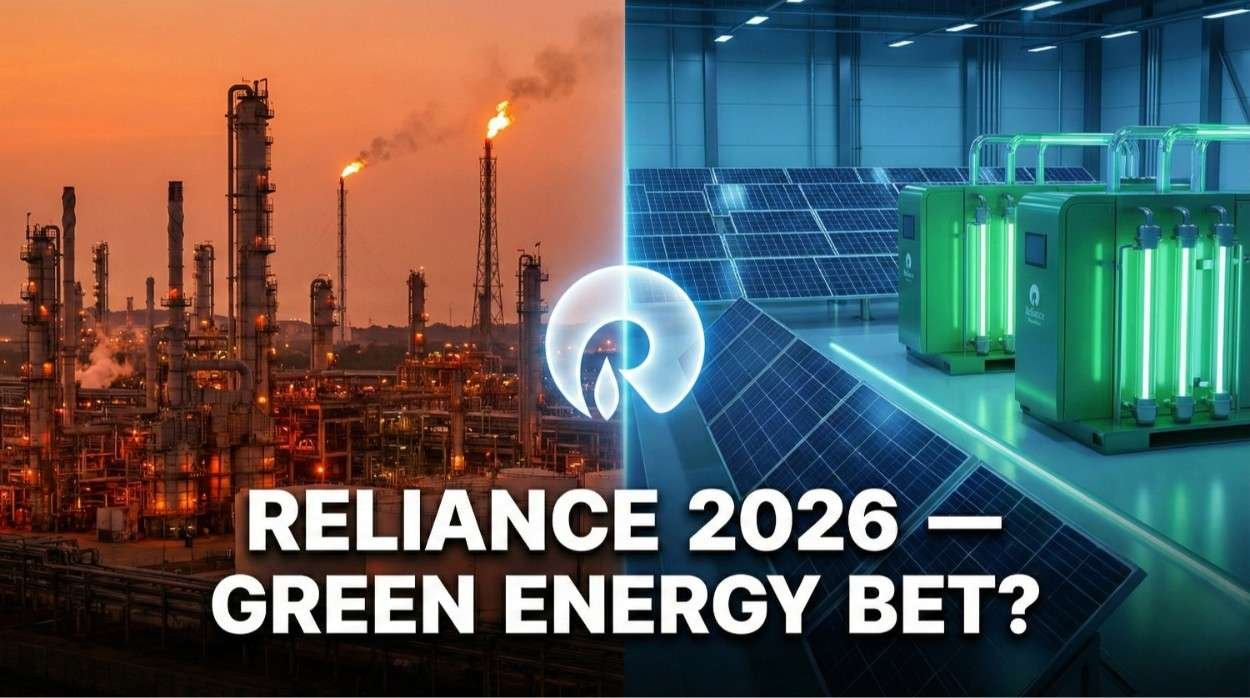
Reliance Industries is making the most audacious energy transition bet in Indian corporate history — ₹75,000 crore into green energy while simultaneously investing another ₹75,000 crore into its legacy oil-to-chemicals business. The stock trades at ₹1,423 today after delivering 13-24% returns over the past year, but the real question haunting institutional desks is whether Mukesh Ambani’s vision of building the world’s largest integrated clean energy hub will create shareholder value or destroy it. With 20 GW solar manufacturing capacity targeting 2026, 40 GWh battery production starting this year, and 3 million tonnes of green hydrogen capacity by 2032, can Reliance’s green energy pivot justify its current ₹19.45 lakh crore market capitalization — or is this a value trap disguised as visionary transformation?
Reliance Share Price Today: Where the Stock Stands in February 2026
Reliance Industries trades at ₹1,423.30 as of February 17, 2026 — sitting approximately 12% below its 52-week high of ₹1,611.80 but 28% above its 52-week low of ₹1,114.85. The stock delivered a strong 29% gain through 2025 — its best year in five — driven by strength in retail and telecom segments combined with steady profitability in the oil-to-chemicals segment.
| Metric | Current Data (Feb 17-18, 2026) |
|---|---|
| Current Share Price (NSE) | ₹1,423.30 |
| Previous Close | ₹1,419.60 |
| Day’s Range | ₹1,418.60 – ₹1,431.80 |
| 52-Week High | ₹1,611.80 (Jan 5, 2026) |
| 52-Week Low | ₹1,114.85 |
| Market Capitalisation | ₹19,44,751 Cr |
| P/E Ratio (TTM) | 27.92 – 40.80 |
| Price-to-Book Ratio | 1.93 – 3.48 |
| EPS (TTM) | ₹51.47 (FY25) |
| EPS (Q3 FY26) | ₹13.78 |
| Dividend Yield | ~0.38% |
| ROE | Healthy |
| Debt-to-Equity | Manageable |
| 1-Year Return | +13.97% to +23.7% |
| Trading Volume | 1.07 Cr shares |
Note: Data compiled from INDmoney, Tickertape, Investing.com, Dhan, Yahoo Finance as of February 17-18, 2026.
The P/E ratio range of 27.92x to 40.80x (depending on calculation methodology) reflects a stock that trades at a moderate premium to its own five-year average but remains cheaper than peak 2021 valuations when the telecom and retail boom drove multiples above 50x. The current valuation suggests the market has priced in steady execution across existing businesses but has not yet assigned significant premium to the green energy transformation story.
The market capitalization of ₹19.45 lakh crore makes Reliance India’s second-largest company by market cap and a heavyweight that moves the Nifty 50 with every price swing. The stock’s 29% gain in 2025 outpaced the Nifty 50’s 10.5% return — demonstrating that despite its massive size, Reliance can still deliver index-beating performance when execution aligns with narrative.
However, the January 2026 high of ₹1,611.80 followed by a 12% correction to current levels signals that profit-taking has occurred as investors digest Q3 results and reassess whether green energy investments will deliver returns on the aggressive timelines management has outlined.
Q3 FY26 Results: Steady Execution but Green Energy Remains a Promise
Reliance’s Q3 FY26 results released in January 2026 demonstrated consistent operational execution across its legacy businesses while green energy remained primarily a capital deployment story with minimal revenue contribution to date.
| Financial Metric | Q3 FY26 | Q3 FY25 | YoY Growth | QoQ Growth |
|---|---|---|---|---|
| Gross Revenue | ₹2,93,829 Cr | ₹2,67,136 Cr | +10.0% | — |
| Consolidated Net Profit | ₹22,290 Cr | ₹21,930 Cr | +1.6% | +2.64% QoQ |
| Profit Before Tax | ₹29,697 Cr | ₹28,637 Cr | +3.7% | — |
| EBITDA | ₹50,932 Cr | ₹48,003 Cr | +6.1% | — |
| Operating Revenue (standalone) | ₹2,58,898 Cr | ₹2,35,463 Cr | +9.94% (Q2 YoY) | — |
| Net Profit (standalone Q2) | ₹18,165 Cr | ₹16,590 Cr | +9.54% (Q2 YoY) | — |
| EPS (Q3 FY26) | ₹13.78 | — | — | — |
| EPS Estimate (Q3) | ₹15.11 | — | -8.65% surprise | — |
Note: Some data reflects Q2 FY26 where Q3 specifics were not fully detailed. Compiled from Tickertape, INDmoney, TradingView, Kotak Neo.
The 1.6% net profit growth on 10% revenue growth reflects margin pressure in the refining and petrochemicals business — Reliance’s historical cash cow — where global demand weakness and inventory gains normalization compressed profitability. That dynamic is precisely why the green energy pivot matters: the O2C (Oil-to-Chemicals) segment that historically generated 60-70% of EBITDA is facing structural headwinds that cannot be ignored.
However, the EPS miss of 8.65% versus estimates triggered the stock’s 2% decline on results day despite Reliance issuing optimistic commentary on digital services, retail momentum, and green energy progress. Markets rewarded execution, not promises — a pattern that will define how Reliance’s green energy investments are valued over the next 24-36 months.
The critical question Q3 results did not answer: when will green energy transition from capital expenditure story to revenue and profit contributor? Management commentary indicated solar manufacturing is operational, battery production targets 2026 launch, and green hydrogen remains on 2032 trajectory — but none of these timelines have accelerated, and none are generating material cash flow yet.
The ₹75,000 Crore Green Energy Bet: What Reliance is Actually Building
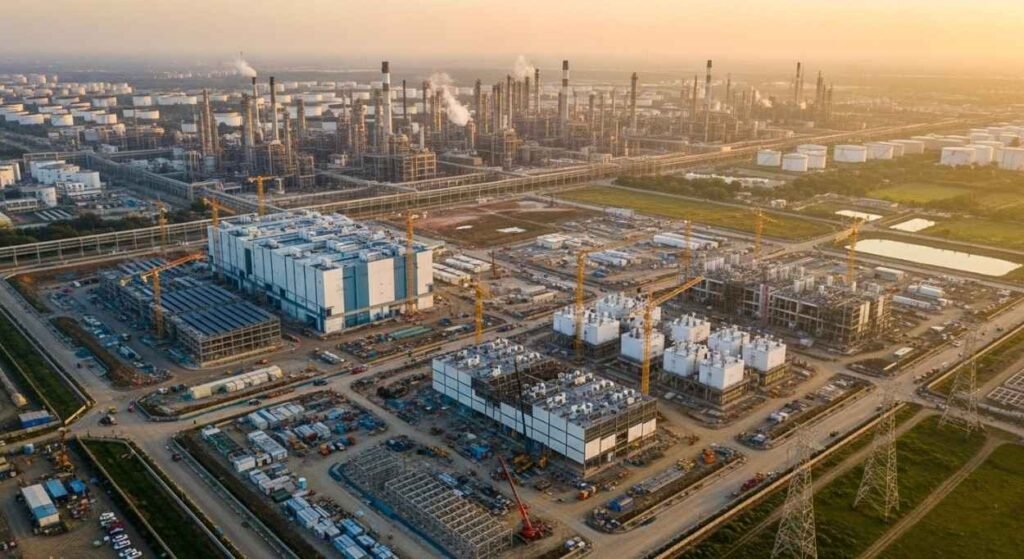
Reliance’s green energy ambitions are not incremental — they are transformational. The company is constructing what it claims will be the world’s largest integrated renewable energy manufacturing hub at its existing Jamnagar refinery site, targeting operational scale that dwarfs competitors globally.
The Dhirubhai Ambani Green Energy Giga Complex (Jamnagar)
Spanning 5,000 acres adjacent to the world’s largest oil refining complex, the Jamnagar hub will house four integrated gigafactories under one roof:
- Solar PV Manufacturing: 20 GW annual capacity by 2026 — already operational with four module lines commissioned and first solar cell line launching shortly. This would be the largest single-site solar manufacturing facility globally, producing high-efficiency HJT (Heterojunction) modules with higher yields and lower degradation than conventional panels.
- Battery Energy Storage: 40 GWh initial annual capacity targeting 2026 production start, modularly scalable to 100 GWh. Civil construction and engineering for the facility is complete with production equipment ready for installation. This positions Reliance to capture India’s energy storage boom and export to global markets.
- Electrolyzer Manufacturing: 3 GW annual capacity by end-2026, enabling cost-competitive green hydrogen production at global scale backed by exclusive technology partnerships with Denmark’s Stiesdal A/S and other global leaders.
- Integrated Value Chain: Unlike competitors building isolated facilities, Reliance is creating end-to-end capability from polysilicon and wafers through modules, batteries, electrolyzers, and downstream green chemicals (ammonia, methanol, sustainable aviation fuel).
The Kutch Renewable Energy Mega Project
Separately, Reliance is developing what may be the world’s largest single-site solar power generation project spanning 550,000 acres in Kutch, Gujarat — approximately three times the land area of Singapore.
| Kutch Project Specifications | Target/Scale |
|---|---|
| Total Land Area | 550,000 acres (3x Singapore) |
| Peak Daily Installation Rate | 55 MW solar modules + 150 MWh batteries |
| Potential Electricity Generation | ~10% of India’s total demand (within decade) |
| Solar Generation Start | H1 FY27 (April-Sep 2026) |
| Green Hydrogen Target (by 2032) | 3 million tonnes annually |
| Green Fuels Production | Ammonia, methanol, sustainable aviation fuel |
| Export Infrastructure | Integrated with Jamnagar & Kandla ports |
The scale is genuinely unprecedented. At peak deployment, Reliance expects to install 55 MW of solar modules and 150 MWh of battery containers every single day — one of the fastest installation rates globally. Within ten years, this single site could theoretically meet nearly 10% of India’s electricity needs.
Total Investment Commitment: ₹75,000 Crore ($10 Billion)
Management has committed over ₹75,000 crore to building this integrated renewable ecosystem — matching the identical ₹75,000 crore being invested simultaneously into expanding the legacy O2C petrochemicals business. That parallel investment strategy signals Reliance’s belief that both fossil and renewable energy businesses can coexist profitably through the 2030s.
However, the green energy business remains pre-revenue at scale. Solar manufacturing is producing modules but not yet at the 20 GW run-rate. Batteries and electrolyzers are still under construction. The Kutch solar project will not generate power until H1 FY27. The 3 million tonne green hydrogen target is six years away.
Analyst Ratings: What 34 Institutional Analysts Recommend on Reliance
Analyst consensus on Reliance Industries is overwhelmingly bullish — but price targets suggest limited near-term upside from current levels, with most of the opportunity tied to long-term green energy execution rather than immediate returns.
| Rating Category | Number of Analysts | Percentage |
|---|---|---|
| Buy / Strong Buy / Outperform | 34 | 94% |
| Hold / Neutral | 2 | 6% |
| Sell / Underperform | 0 | 0% |
| Total Analysts Covering | 36 | 100% |
| Price Target Range | Value (₹) | Implied Upside/Downside |
|---|---|---|
| Average 12-Month Target | ₹1,716.65 | +20.48% |
| Highest Target | ₹2,020 | +41.9% |
| Lowest Target | ₹1,370 | -3.7% |
| Current Price | ₹1,423.30 | — |
Note: Data from Investing.com, TradingView, various institutional research as of February 2026.
The “Strong Buy” consensus rating from 94% of analysts reflects institutional belief in Reliance’s long-term transformation thesis. However, the average price target of ₹1,716 implies only 20% upside over twelve months — respectable but not exceptional given the execution risk embedded in the green energy bet.
More importantly, price target dispersion from ₹1,370 to ₹2,020 reveals genuine uncertainty about valuation. The bears worry that ₹75,000 crore deployed into green energy will not generate adequate returns to justify the capital allocation versus reinvesting in higher-ROIC retail and digital businesses. The bulls argue that Reliance is creating strategic positioning in what will be India’s largest growth sector for the next three decades.
The technical analysis signal from Investing.com shows “Sell” based on moving averages — suggesting near-term price momentum has weakened despite long-term fundamental bullishness from equity analysts. That divergence between technical and fundamental signals is typical of stocks in transition phases where legacy businesses mature while new ventures scale.
Will Green Energy Investment Drive Reliance Share Price Higher? The Bull Case
The optimistic scenario for Reliance’s green energy pivot rests on several compelling strategic and financial arguments that justify paying current multiples for exposure to what could become India’s most valuable renewable energy conglomerate.
1. First-Mover Scale Advantage in India’s Energy Transition: India targets 500 GW of non-fossil fuel capacity by 2030 and net-zero emissions by 2070. That transition requires manufacturing capacity that India currently lacks — over 90% of solar modules are imported. Reliance’s 20 GW domestic manufacturing capacity could capture 30-40% of India’s annual solar deployment, creating a revenue stream that scales from zero to ₹40,000-50,000 crore annually within five years if executed.
2. Integrated Model Creates Unmatched Cost Position: Unlike competitors building isolated solar or battery factories, Reliance’s end-to-end integration from polysilicon to modules to batteries to hydrogen to green chemicals creates cost advantages that pure-play manufacturers cannot match. That vertical integration — similar to Tesla’s Gigafactory strategy — should deliver gross margins of 25-30% versus 15-20% for standalone players.
3. Export Opportunity Dwarfs Domestic Market: India’s renewable capacity is tiny compared to global markets. Reliance’s Jamnagar port infrastructure positions it to export solar modules, batteries, and green hydrogen derivatives (ammonia, methanol, SAF) to Europe, Middle East, and Southeast Asia — markets that are willing to pay premium prices for certified green products with supply chain traceability. Export revenues could exceed domestic revenues by 2x-3x by 2030.
4. Green Energy Reduces Reliance’s Own Energy Costs by 25%: Beyond third-party sales, Reliance’s captive renewable energy generation will reduce energy costs across its existing refining, petrochemicals, retail, and telecom operations by an estimated 25%. That operational efficiency gain alone could add ₹3,000-5,000 crore annually to EBITDA across legacy businesses — a benefit that is not yet reflected in consensus models.
5. Policy Support and PLI Incentives De-Risk Investment: Reliance has been awarded capacity under India’s Solar PLI Scheme (10 GW polysilicon-to-module) and Advanced Chemistry Cell PLI (5 GWh batteries). These government incentives reduce capital intensity and guarantee offtake pricing that ensures minimum returns on investment regardless of market conditions.
The Bear Case: Why Green Energy Investment Could Destroy Value
The pessimistic scenario argues that Reliance’s ₹75,000 crore green energy bet is mistimed, over-capitalized, and structurally incapable of generating returns that justify the opportunity cost versus alternative capital allocations.
1. Execution Risk on Unprecedented Scale and Timelines: Reliance has never built and operated manufacturing businesses at this scale and technical complexity. Solar module manufacturing requires precision engineering, battery production involves complex chemistry and safety protocols, and electrolyzer technology is nascent globally. Any delays in commissioning, quality issues, or technology obsolescence would turn the ₹75,000 crore investment into stranded capital earning sub-10% returns.
2. Chinese Competition Will Destroy Module Pricing Power: China controls 80%+ of global solar manufacturing capacity and can produce modules at costs Reliance cannot match due to decade-long scale advantages and government subsidies. If Chinese manufacturers flood Indian and export markets with below-cost pricing — which they have done repeatedly — Reliance’s domestic manufacturing will struggle to achieve profitability regardless of PLI support.
3. Green Hydrogen Economics Remain Unproven at Scale: The 3 million tonnes annual green hydrogen target by 2032 assumes electrolyzer costs decline 70%, renewable electricity prices fall to ₹1.50-2.00 per kWh, and demand for hydrogen derivatives materializes at scale. If any of those assumptions fail — and history suggests most mega-project assumptions do — the hydrogen business will not be economically viable without perpetual subsidies.
4. Capital Allocation Mistake Versus Retail and Digital: Reliance’s highest-ROIC businesses are retail (EBITDA margins 8-10%) and digital services (EBITDA margins 50%+). Both are asset-light, capital-efficient, and generate cash immediately. Allocating ₹75,000 crore to capital-intensive manufacturing with 5-10 year payback periods represents a fundamental misallocation versus reinvesting in expanding Jio’s 5G monetization or Reliance Retail’s omnichannel dominance.
5. O2C Business Decline Accelerates Faster Than Green Energy Scales: Reliance’s core thesis is that green energy replaces declining O2C profitability. However, if global refining margins compress faster than expected due to EV adoption and petrochemical demand peaks sooner than 2035-2040 consensus, Reliance will face a profitability gap where O2C cash generation falls before green energy cash generation rises. That “valley of death” could force dividend cuts, balance sheet stress, or equity dilution that crushes valuations.
Key Takeaways
→ Reliance at ₹1,423 trades 12% below January 2026 peak but 29% above 52-week low — analyst consensus targets ₹1,716 implying 20% upside driven primarily by long-term green energy execution rather than near-term earnings growth.
→ Q3 FY26 results showed 1.6% net profit growth despite 10% revenue growth, reflecting margin pressure in core O2C business that validates the strategic necessity of the green energy pivot but reveals execution is steady rather than spectacular.
→ Reliance’s ₹75,000 crore green energy investment targets 20 GW solar manufacturing (2026), 40 GWh battery production (2026), 3 GW electrolyzer capacity (2026), and 3 million tonnes green hydrogen (2032) — scale that would make it the world’s largest integrated renewable energy company if executed.
→ The Kutch solar project spanning 550,000 acres (3x Singapore) could theoretically meet 10% of India’s electricity demand within a decade and begins power generation in H1 FY27 — but remains entirely pre-revenue with no cash flow contribution to offset ongoing capital deployment.
→ The bull case rests on first-mover scale advantage in India’s energy transition, integrated cost position creating 25-30% gross margins, export opportunity exceeding domestic market by 2-3x, and 25% energy cost reduction across legacy businesses adding ₹3,000-5,000 Cr annual EBITDA.
→ The bear case centers on execution risk at unprecedented scale, Chinese competition destroying module pricing power, unproven green hydrogen economics, capital allocation mistake versus higher-ROIC retail and digital businesses, and risk that O2C decline accelerates faster than green energy scales creating profitability gap.
FAQ: Reliance Share Price 2026 Green Energy Investment
Q1. Will Reliance’s green energy investment increase the share price in 2026? Reliance’s ₹75,000 crore green energy investment is unlikely to materially move the share price in 2026 because the business remains pre-revenue at scale. Solar manufacturing is operational but ramping, battery production starts 2026, and Kutch solar generation begins H1 FY27. Analyst targets of ₹1,716 (20% upside) reflect long-term (2028-2030) value creation rather than immediate 2026 earnings impact. The stock will trade primarily on O2C, retail, and digital performance in 2026 while green energy remains a “promise” that institutional investors monitor for execution milestones.
Q2. Is Reliance Industries a good buy for green energy exposure in February 2026? Reliance offers leveraged exposure to India’s energy transition at scale no pure-play renewable company can match — but you are paying for conglomerate complexity, execution risk, and a 5-10 year timeline before green energy contributes meaningfully to profits. At ₹1,423, the stock prices in steady O2C/retail/digital execution plus moderate green energy optionality. Buy if you believe Reliance can execute manufacturing at scale and want defensive diversification. Avoid if you seek pure-play renewable returns or cannot tolerate 3-5 year capital deployment cycle before green energy scales.
Q3. What are the risks of Reliance’s ₹75,000 crore green energy investment? Five critical risks: execution failure at unprecedented scale causing delays and cost overruns, Chinese manufacturers flooding markets with below-cost modules destroying pricing power, green hydrogen remaining economically unviable without perpetual subsidies, capital misallocation versus higher-ROIC retail and digital businesses, and O2C business decline accelerating faster than green energy scales creating profitability gap. Additionally, technological obsolescence risk as solar/battery/electrolyzer technology evolves rapidly and Reliance’s 2026 installations could be outdated by 2030.
Q4. When will Reliance’s green energy business contribute to profits? Material profit contribution unlikely before FY29-FY30. Solar manufacturing generates modest revenue in FY27, battery production scales through FY27-FY28, Kutch solar generation begins H1 FY27 but takes 2-3 years to reach meaningful capacity, and green hydrogen remains 2032 target. Even optimistic scenarios show green energy contributing under 10% of EBITDA before FY29. Near-term (FY26-FY28), green energy is capital deployment story reducing reported earnings through depreciation and interest costs on debt funding.
Q5. How does Reliance’s green energy compare to competitors globally? By scale, Reliance’s plan exceeds most global competitors. The 20 GW solar manufacturing capacity rivals China’s largest single facilities. The integrated model (solar-battery-hydrogen-chemicals) is more ambitious than Tesla’s Gigafactory or European initiatives. However, Reliance lacks the decade of operational track record that Chinese manufacturers possess, faces technology licensing dependencies for electrolyzers and batteries, and enters markets where Chinese competitors have unassailable cost positions from scale and subsidies. Reliance bets India’s domestic demand and export opportunity justify premium costs.
Q6. Should I hold or sell Reliance stock given green energy uncertainty? Hold if you own Reliance as core portfolio position for defensive diversification across O2C, retail, and digital — green energy is upside optionality not core thesis. Sell if your primary holding thesis was green energy transformation because 5-10 year capital deployment cycle with uncertain returns offers better risk-reward in pure-play renewable stocks with immediate cash flow. Buy if you currently have zero exposure and want leveraged bet on India’s energy transition at conglomerate scale with downside protected by profitable legacy businesses.
My Take: What Covering Reliance for 15 Years Taught Me About Ambition vs. Execution
I have been analyzing Reliance Industries for over fifteen years, and Mukesh Ambani has consistently defied skeptics who underestimated his ability to execute visionary projects. The telecom revolution with Jio in 2016 was dismissed as “too late” and “capital-intensive” — yet Jio became India’s largest and most profitable telecom operator within four years. Reliance Retail was called “unfocused” and “competing with kiranas” — yet it is now India’s largest retailer generating ₹60,000+ crore revenue annually.
That track record matters when evaluating the ₹75,000 crore green energy bet. The instinct is to dismiss it as “too ambitious” or “unproven at scale” — but Reliance has repeatedly proven it can deploy capital at scale, execute complex logistics, and build dominant market positions in seemingly mature industries through sheer execution intensity.
However — and this is the critical caveat — the green energy pivot is fundamentally different from Jio and Retail. Those were asset-light service businesses with immediate cash flow. Green energy is capital-intensive manufacturing with 5-10 year payback periods, exposure to Chinese competition that did not exist in telecom/retail, and technology risks that a service business avoids. Manufacturing physical products at global scale is harder than selling data plans or groceries.
The most important question is not whether Reliance can build the factories — they will build them, on schedule, at scale. The question is whether the factories generate economic returns that justify the ₹75,000 crore capital allocation versus alternative uses of that capital. A Jio-like success generates 50%+ ROCEs. A manufacturing business generating 12-15% ROCE would be considered successful but mediocre for Reliance’s standards.
My honest view for February 2026: Reliance at ₹1,423 with 20% upside to consensus target of ₹1,716 is a Hold for existing shareholders who value defensive diversification and a long-term bet on India’s energy transition. It is not a screaming Buy because green energy value creation is 3-5 years away and near-term earnings growth is modest. And it is definitely not a Sell because underestimating Mukesh Ambani’s execution capability has been the single most expensive mistake equity analysts have made repeatedly over two decades.
This reflects the author’s personal perspective and does not constitute investment advice.
Conclusion
Reliance Industries at ₹1,423 sits at a genuine inflection point — the legacy O2C business that built the empire is facing structural margin pressure, while the ₹75,000 crore green energy bet will not contribute meaningfully to profits for 3-5 years. That transition creates valuation uncertainty that explains why the stock trades 12% below January peaks despite overwhelmingly bullish analyst ratings.
The green energy investment is strategically correct — India’s energy transition is inevitable, manufacturing capacity must be built domestically, and Reliance’s scale and capital access position it to capture that opportunity better than any Indian competitor. However, strategic correctness does not guarantee financial returns. Execution risk, Chinese competition, green hydrogen economics, and capital allocation versus higher-ROIC alternatives are real concerns that could turn visionary ambition into value-destructive distraction.
The investors who build wealth with Reliance over the next decade will not be those who time perfect entries based on quarterly results. They will be investors who understand that buying a conglomerate executing a once-in-a-generation transformation requires patience, tolerance for volatility, and conviction that Mukesh Ambani’s track record of defying skeptics will repeat once more. At ₹1,423 with 20% upside to consensus targets, Reliance is neither cheap nor expensive — it is fairly valued for the risk and opportunity of backing India’s energy transition at scale.
This article does not constitute financial advice. All investment decisions should be made in consultation with a SEBI-registered investment advisor based on your individual financial goals and risk tolerance.
Data sourced from publicly available information as of February 17-18, 2026. Sources include: NSE India, BSE India, INDmoney, Tickertape, Investing.com, Dhan, Yahoo Finance, TradingView, Kotak Neo, Reliance Industries investor relations filings, Q3 FY26 results presentations, Reliance official website, Bloomberg, Reuters, Outlook Business, EQ Mag, SAUREnergy, Hydrogen Central, Energy Storage News, Net Zero Investor, AL Circle, Ministry of New and Renewable Energy India, International Energy Agency, Solar PLI Scheme documentation.