Silver Price Today Feb 18, 2026: ₹2.6L Per Kg Live Rate
Silver Price Today February 18, 2026: Trading at ₹2.6 Lakh After Crashing from ₹3.5 Lakh Peak
By Senior Commodities and Real-Time Markets Analyst · February 18, 2026 · 8 Min Read
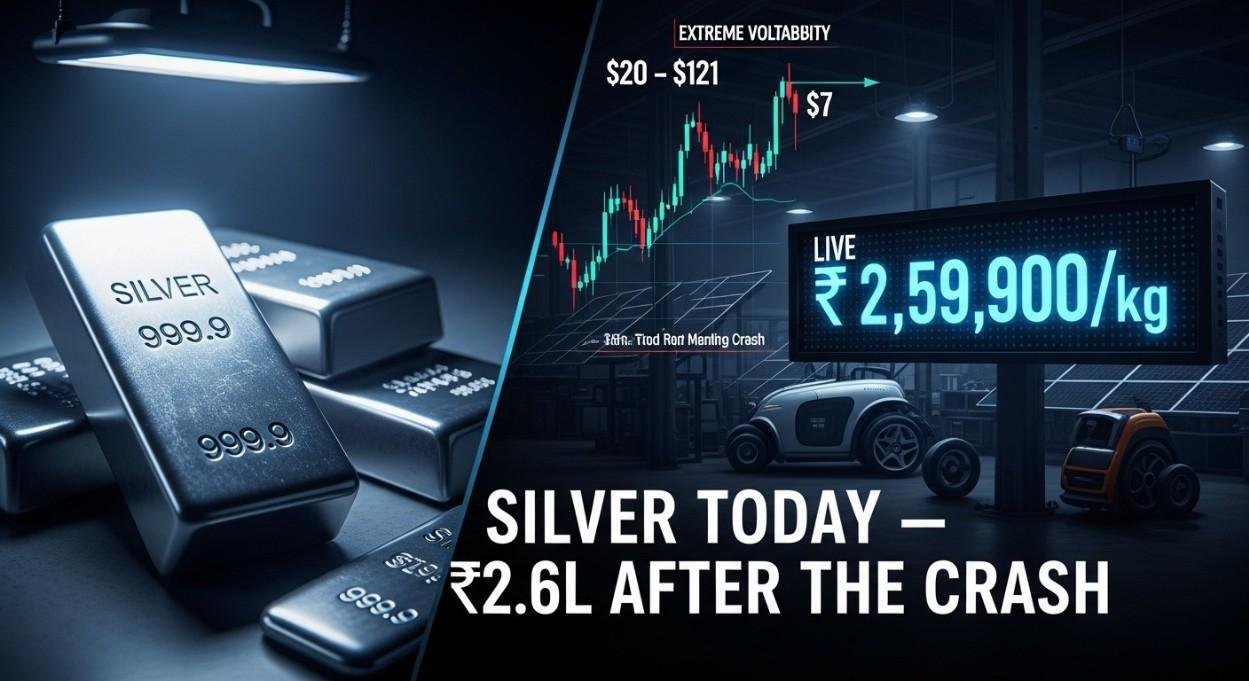
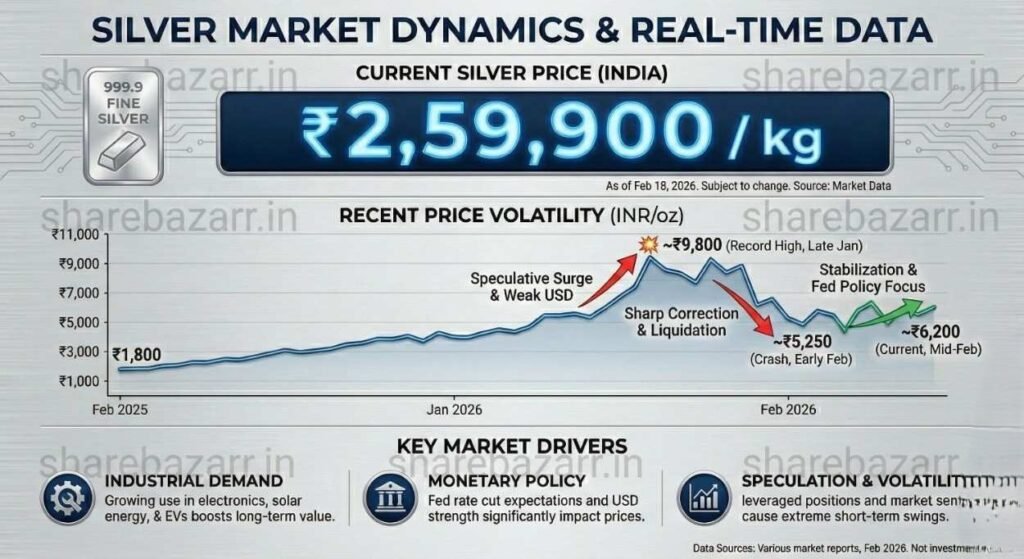
Silver just delivered the most violent price action in precious metals history — surging from $30 per ounce in early 2025 to an all-time nominal high of $121.67 on January 29, 2026, before crashing 40% to $72 within two weeks, and now recovering to today’s $74.23. That translates to Indian prices falling from a February 1 peak of ₹3,50,000 per kilogram to today’s ₹2,59,900 — a 26% collapse in under three weeks. So where does silver stand right now, and is the current price a buying opportunity or a bull trap before another leg lower?
Silver Price Today: Live Rates Across Markets (February 18, 2026)
Silver occupies the most volatile corner of commodity markets today — trading near two-week recovery highs after finding support following the historic January-February crash that erased nearly half the metal’s value from peak levels.
| Metric | Live Price (Feb 18, 2026) |
|---|---|
| Silver Price India (per kg) | ₹2,59,900 |
| Silver Price India (per gram) | ₹259.90 |
| Silver India Yesterday | ₹2,60,000/kg (-₹100 today) |
| International Silver (USD/oz) | $74.23 – $74.43 |
| Silver Previous Close | $76.97/oz |
| Silver Daily Change | -$2.54 (-3.3%) |
| Silver All-Time High | $121.67/oz (Jan 29, 2026) |
| Silver Feb 2026 India Peak | ₹3,50,000/kg (Feb 1, 2026) |
| Silver Recent Low | $72.44/oz (Feb 17, 2026) |
| Silver 1-Year Ago Price | ~$32/oz (Feb 2025) |
| Silver 1-Year Return | +132% ($32 → $74) |
| Silver YTD Peak-to-Current | -39% from $121.67 |
| USD-INR Exchange Rate | ₹90.61 – ₹90.71 |
| Gold Price (USD/oz) | $4,900 – $5,060 |
| Gold-Silver Ratio | 66-67:1 |
| MCX Silver Futures | ₹2,59,000-2,62,000 range |
| Nifty 50 Level | 25,752.65 |
| Sensex Level | 83,553.59 |
Note: Prices vary by city, jeweller, and dealer. Data compiled from Goodreturns, Trading Economics, Fortune, JM Bullion, USAGOLD as of February 17-18, 2026.
The most important number in that table is the peak-to-current drawdown. Silver at $74.23 sits 39% below the $121.67 all-time high reached just 20 days ago. In Indian Rupee terms, silver has fallen from ₹3,50,000 per kilogram to ₹2,59,900 — a 26% collapse that has destroyed portfolios of investors who bought during the speculative mania.
However — and this is critical — silver did not return to pre-rally levels near $30-35 per ounce. It found support near $72 and has stabilized in the $72-82 range, suggesting that industrial demand fundamentals have created a price floor that prevents complete retracement to 2024-2025 levels.
The daily price movement shows silver down $2.54 or 3.3% from yesterday’s close at $76.97, reflecting ongoing profit-taking and “liquidity vacuum” created by Shanghai Gold Exchange closure for Lunar New Year through February 23. Without China’s massive physical buying and speculative leverage, silver is trading almost exclusively on US economic data and Federal Reserve rate expectations.
What’s Driving Silver Price Today: The Forces Behind Extreme Volatility
Silver’s current price action is being driven by a collision of forces that rarely align simultaneously — speculative deleveraging, physical market tightness, Federal Reserve policy signals, Asian market closure, and industrial demand that continues accelerating regardless of price.
Shanghai “Liquidity Vacuum” Creates Technical Pressure: The Shanghai Gold Exchange and Shanghai Futures Exchange closed February 9 for Lunar New Year and remain shut through February 23. This matters enormously because Shanghai has become the world’s largest source of incremental physical silver demand and speculative leverage. According to USAGOLD analysis, without Shanghai’s session, silver is trading “almost exclusively on US macro data” — revealing that the current weakness is a temporary “liquidity vacuum” rather than fundamental deterioration.
The Shanghai exchanges were trading at significant premiums to London and New York prices during the rally, with Chinese traders using leveraged positions to push silver into parabolic territory. The closure has removed that bid, allowing Western markets to discover price without the speculative overlay. This is creating a unique entry opportunity for physical buyers and industrial consumers who understand that Shanghai will reopen with depleted vaults and pent-up US Economic Data Driving Fed Rate Cut Expectations: US retail sales data released February 11 showed activity unexpectedly stalled in December, highlighting pressure on consumer spending. The GDP control group fell 0.1%, reinforcing signs of slowing demand and easing inflation pressure. Markets now price in approximately 60 basis points of Federal Reserve easing by year-end — up from 40 basis points just a week ago.
| US Economic Indicator | Recent Data | Impact on Silver |
|---|---|---|
| Retail Sales (Dec) | Unexpectedly flat | Bullish – signals slowdown |
| GDP Control Group | -0.1% | Bullish – supports rate cuts |
| Job Openings | Delayed (Jan data) | Awaiting release |
| Fed Rate Cut Pricing | 60 bps by year-end | Bullish – lowers real rates |
| US Dollar Index | Firmer recently | Bearish – strengthens DXY |
| Treasury Yields | Declining | Bullish – lowers opportunity cost |
The softer consumption backdrop has lowered rate expectations and improved the near-term policy outlook for non-yielding metals. Silver remains roughly 30% below its late January peak, but the macroeconomic setup is becoming more supportive as real interest rates decline.
US Treasury Secretary Blames Chinese Speculation: US Treasury Secretary Scott Bessent publicly attributed silver’s extreme swings to “speculative activity, particularly from Chinese traders.” That official statement — unusual for a Treasury Secretary to comment on specific commodity moves — validates what market participants observed: the $30 to $121 rally was driven by speculative positioning that overwhelmed physical market fundamentals, not by sustainable industrial demand growth.
The crash from $121 to $72 represented the violent unwinding of that leverage as Chinese traders were forced to close positions. However, the fact that silver found support at $72 rather than collapsing to $30-40 suggests the speculative premium has been purged while structural demand remains intact.
Industrial Demand Continues Accelerating Despite Price Volatility: Solar panel production, electric vehicle manufacturing, and AI data center buildout are consuming silver at record rates that price volatility does not meaningfully impact. According to industry data:
- Solar photovoltaic demand: Projected to reach 240 million ounces in 2026, up from 145 million in 2025
- EV sector demand: Expected at 70-75 million ounces in 2026, growing at 18% CAGR
- AI/Data center demand: Estimated 78 million ounces annually, up from 15 million in early 2024
- Total industrial fabrication: Record 680.5 million ounces in 2024, projected 750 million in 2026
These industrial applications are not price-sensitive in the short term because silver represents a small fraction of total manufacturing costs. A solar panel manufacturer will not redesign entire production lines to eliminate silver when it represents less than 3% of panel cost. The demand is structural, contractual, and largely immune to quarterly price swings.
Silver Price in Major Indian Cities Today (February 18, 2026)
Silver prices vary slightly across Indian cities due to local taxes, transportation costs, and dealer premiums, but the differences are typically minimal for a nationally-traded commodity.
| City | Per Gram | Per 10 Grams | Per 100 Grams | Per Kilogram |
|---|---|---|---|---|
| Delhi | ₹260 | ₹2,600 | ₹26,000 | ₹2,60,000 |
| Mumbai | ₹260 | ₹2,600 | ₹26,000 | ₹2,60,000 |
| Kolkata | ₹260 | ₹2,600 | ₹26,000 | ₹2,60,000 |
| Chennai | ₹260 | ₹2,600 | ₹26,000 | ₹2,60,000 |
| Bangalore | ₹260 | ₹2,600 | ₹26,000 | ₹2,60,000 |
| Hyderabad | ₹260 | ₹2,600 | ₹26,000 | ₹2,60,000 |
| Pune | ₹260 | ₹2,600 | ₹26,000 | ₹2,60,000 |
| Ahmedabad | ₹260 | ₹2,600 | ₹26,000 | ₹2,60,000 |
| Jaipur | ₹260 | ₹2,600 | ₹26,000 | ₹2,60,000 |
| Kerala | ₹260 | ₹2,600 | ₹26,000 | ₹2,60,000 |
Note: Prices exclude 3% GST and dealer making charges of 5-25%. Data from Goodreturns, PolicyBazaar, LatestLY.
The remarkable uniformity across cities reflects silver’s status as a globally-traded commodity with efficient arbitrage. Unlike gold jewelry where local craftsmanship creates significant price variation, silver bars and coins trade at near-identical prices nationwide.
Important Cost Considerations:
- GST: 3% on all silver purchases in India
- Making Charges: 5-25% for jewelry, 2-10% for coins
- Storage Costs: Significant for physical silver due to bulk
- Dealer Premiums: ₹10-50 per gram over spot price
For investment purposes, silver ETFs eliminate GST (charged only at entry, not exit) and making charges entirely, making them economically superior to physical purchases for amounts above ₹50,000.
Is Today’s Silver Price a Buying Opportunity? The Critical Analysis
The question every investor is asking: is silver at ₹2,60,000 per kilogram — after crashing from ₹3,50,000 but still 200%+ above 2024 levels — a compelling buy, a value trap, or simply too volatile to justify ownership?
The Bull Case for Buying Silver Today:
- Speculative Excess Has Been Purged: The crash from $121 to $72 violently deleveraged speculative positioning that drove the parabolic rally. That purge creates cleaner technical setup than existed at any point during the $90-120 mania.
- Industrial Demand is Real and Accelerating: Unlike crypto or meme stocks, silver’s industrial consumption is verifiable, contractual, and growing at double-digit rates in solar, EV, and AI sectors that represent multi-decade adoption curves.
- Supply Deficit Remains Structural: Global silver markets have run deficits exceeding 200 million ounces annually for multiple consecutive years. Mine supply growth is constrained by long lead times and capital intensity.
- Fed Rate Cuts Lower Opportunity Cost: With 60 basis points of cuts priced for 2026, real yields are declining, reducing the opportunity cost of holding non-yielding silver versus Treasury bills.
- Gold-Silver Ratio Suggests Relative Value: At 66-67:1, silver offers potential for outperformance if the ratio compresses toward 50-60:1 levels seen during industrial commodity booms.
The Bear Case Against Buying Silver Today:
- Still 135% Above Pre-Rally Levels: Silver at $74 remains massively elevated versus $30 one year ago. How much of that 135% gain reflects sustainable fundamentals versus speculation that hasn’t fully unwound?
- Extreme Volatility Destroys Wealth: Silver’s 40% peak-to-trough crash in 20 days demonstrates volatility that 90% of investors cannot psychologically tolerate. Buying today risks another 20-30% drawdown if leverage unwinds further.
- Stronger Dollar Creates Headwind: If US economic data improves or Fed pauses rate cuts, Dollar strength would pressure silver sharply. The inverse correlation is mechanically reliable.
- Industrial Demand is Recession-Vulnerable: Unlike gold’s counter-cyclical safe-haven appeal, silver’s industrial consumption collapses during manufacturing recessions. Global growth disappointment would hit silver harder than gold.
- Opportunity Cost vs Equities at Reasonable Valuations: Nifty 50 at 25,752 (18.5x forward P/E) after correction offers compelling long-term wealth creation that zero-yield silver cannot match.
Key Takeaways
→ Silver price today is ₹2,59,900/kg in India and $74.23/oz internationally — down 26% from February 1 peak of ₹3,50,000/kg but still 135% above $32 levels from one year ago.
→ Silver’s all-time nominal high of $121.67 on January 29, 2026 was driven by speculative Chinese trading that US Treasury Secretary Scott Bessent publicly blamed — the subsequent 40% crash to $72 purged that leverage violently.
→ Shanghai Gold Exchange closure through February 23 for Lunar New Year created “liquidity vacuum” removing China’s physical buying and speculative leverage — allowing Western markets to discover price based purely on US economic data.
→ Industrial silver demand remains structurally strong with 240 million ounces projected for solar in 2026, 70-75 million for EVs, and 78 million for AI data centers — none of which are meaningfully price-sensitive at current levels.
→ Federal Reserve rate cut expectations have increased to 60 basis points by year-end following weak retail sales and GDP data — lowering real yields and improving outlook for non-yielding metals like silver.
→ Gold-silver ratio at 66-67:1 suggests potential for silver outperformance if ratio compresses toward 50-60:1 — but extreme volatility makes silver unsuitable for conservative investors or those with investment horizons under 3 years.
FAQ: Silver Price Today February 18, 2026
Q1. What is the silver price today in India? The silver price today in India is ₹2,59,900 per kilogram and ₹259.90 per gram as of February 18, 2026. This represents a decline of ₹100 from yesterday’s close and a 26% drop from the February 1 peak of ₹3,50,000/kg. However, silver remains 200%+ above its early 2025 levels near ₹80,000-85,000/kg, reflecting the structural rally that preceded January’s speculative spike.
Q2. Why did silver price crash from ₹3.5 lakh to ₹2.6 lakh? Silver crashed from ₹3,50,000/kg on February 1 to current ₹2,59,900 levels following the violent unwinding of speculative Chinese trading positions that drove the metal from $30 to $121.67 in a parabolic rally. US Treasury Secretary Scott Bessent publicly attributed the extreme swings to Chinese speculation. The Shanghai exchange closure for Lunar New Year removed the speculative bid, allowing deleveraging that erased gains but found support near structural demand levels rather than collapsing to pre-rally prices.
Q3. Is silver a good buy at ₹2.6 lakh per kg today? Silver at ₹2,60,000/kg after the crash presents a complex risk-reward. The bull case: speculative excess purged, industrial demand accelerating, supply deficit structural, Fed rate cuts supportive. The bear case: still 135% above $32 levels from one year ago, extreme volatility unsuitable for most investors, opportunity cost vs equities, recession vulnerability. Appropriate only for investors with 3-5+ year horizons, high risk tolerance, and position sizing under 5% of portfolio. Not suitable for conservative capital preservation.
Q4. What caused silver’s all-time high of $121 in January 2026? Silver’s all-time nominal high of $121.67 on January 29, 2026 was driven by speculative Chinese trading activity using leveraged positions on Shanghai exchanges that overwhelmed physical market fundamentals. The Shanghai Gold Exchange closure for Lunar New Year created a “liquidity vacuum” that exposed the speculative nature of the rally. However, the fact that silver found support at $72 rather than returning to $30-40 suggests underlying industrial demand provided a floor once leverage was purged.
Q5. Will silver price go up or down from current levels? Short-term direction depends on Shanghai exchange reopening (February 23), US jobs data releases, and Federal Reserve signals. Bullish catalysts: Shanghai physical buying resumes with depleted vaults, Fed confirms multiple rate cuts, industrial demand data exceeds expectations. Bearish catalysts: stronger US Dollar, equity market rally reducing safe-haven demand, further deleveraging if hidden positions remain. Most analysts expect consolidation in $70-85 range before next major directional move. Extreme volatility makes precise timing impossible.
Q6. How is silver price in India different from international price? Silver price in India is derived from international Dollar price multiplied by USD-INR exchange rate, plus import duty (currently minimal), GST (3%), and local dealer premiums. The Rupee depreciation from ₹83 to ₹90.61 has amplified returns for Indian investors — even when Dollar silver stagnates, Rupee weakness mechanically pushes Indian prices higher. This makes silver an automatic hedge against currency debasement for Indian savers, a characteristic not available to Dollar-based investors.
My Take: What Silver’s Extreme Volatility Taught Me About Greed, Fear, and Structural Demand
I have covered commodity markets for over twenty years, and silver’s January-February 2026 price action will be studied in finance textbooks for decades as a case study in speculative excess meeting structural scarcity. The metal that went from $30 to $121 to $72 in under twelve weeks has taught lessons that no academic model can capture.
The most important lesson: fundamentals can be completely correct while your entry timing destroys you. The industrial demand thesis for silver — solar, EVs, AI data centers consuming record quantities against constrained supply — was entirely accurate at $30, $60, $90, and even $120. Yet investors who bought at $100+ experienced devastating 30-40% losses within days despite being “right” about structural trends.
That paradox separates wealth-building investors from speculators who confuse direction with timing. I watched retail investors chase silver from $90 to $120 based on social media hype and “silver to $200” predictions — then panic-sell at $75 after the crash, locking in permanent capital destruction on a metal whose long-term trajectory they correctly identified.
What makes silver genuinely interesting right now — at $74 after purging speculative excess — is that industrial fundamentals have strengthened while price has collapsed. Solar installations are accelerating, not slowing. EV adoption is growing faster than 2024 models projected. AI data center buildout is consuming silver at rates that seemed like “bull case scenarios” just 18 months ago.
However, I will not sugarcoat this: silver at $74 still carries risk that $30 silver did not. The metal has attracted global attention, leverage has entered the system at scale, and Chinese traders have demonstrated willingness to push prices into parabolic territory that fundamentals cannot justify. The next spike to $90-100 could arrive tomorrow — or silver could retest $60 if hidden leverage continues unwinding.
My honest view for February 2026: if you have high risk tolerance, deep conviction in green energy transition, and iron stomach for 30% volatility, a 3-5% portfolio allocation to silver via ETFs is justifiable at current levels. The risk-reward is materially better at $74 post-crash than it was at $30 pre-rally (when nobody wanted it) or $110 during mania (when everyone wanted it). But if you cannot psychologically survive seeing that allocation cut in half without panic-selling, silver ownership at any price will damage your wealth more than preserve it.
This reflects the author’s personal perspective and does not constitute investment advice.
Conclusion
Silver price today at ₹2,59,900 per kilogram sits at a fascinating inflection point — 26% below the speculative mania peak of ₹3,50,000 but 200%+ above the quiet accumulation zone near ₹80,000-85,000 where the structural rally began. The metal that delivered the most violent precious metals volatility in modern history has purged speculative excess while retaining industrial demand fundamentals that continue strengthening regardless of price.
The decision to buy silver at current levels is not about market timing — that is impossible in an asset this volatile — but about portfolio construction discipline and psychological risk tolerance. Silver offers asymmetric upside from structural supply deficits, accelerating solar and EV demand, and Federal Reserve rate cuts reducing opportunity cost. However, it also carries downside volatility that destroyed unprepared investors who bought near the peak and sold near the trough.
The investors who build wealth with silver are not those who perfectly time entries — they are those who allocate 3-5% systematically, size positions to survive 30-50% drawdowns, and hold through chaos while industrial super-cycles play out over years. Buy small if you must buy today. Buy smart through silver ETFs, not physical metal with prohibitive premiums. And never, ever let silver dominate a portfolio designed for compounding wealth — because zero cash flow assets cannot compound the way quality businesses do over decades.
This article does not constitute financial advice. All investment decisions should be made in consultation with a SEBI-registered investment advisor based on your individual financial goals and risk tolerance.
Data sourced from publicly available information as of February 17-18, 2026. Sources include: Goodreturns India, Trading Economics, Fortune Magazine, JM Bullion, USAGOLD, APMEX, SD Bullion, Kitco, LatestLY, PolicyBazaar India, News24 India, GoldBroker.com, Multi Commodity Exchange of India, NSE India, BSE India, Shanghai Gold Exchange reports, US Treasury Department, Federal Reserve, World Silver Survey, Silver Institute, Ministry of Finance India.