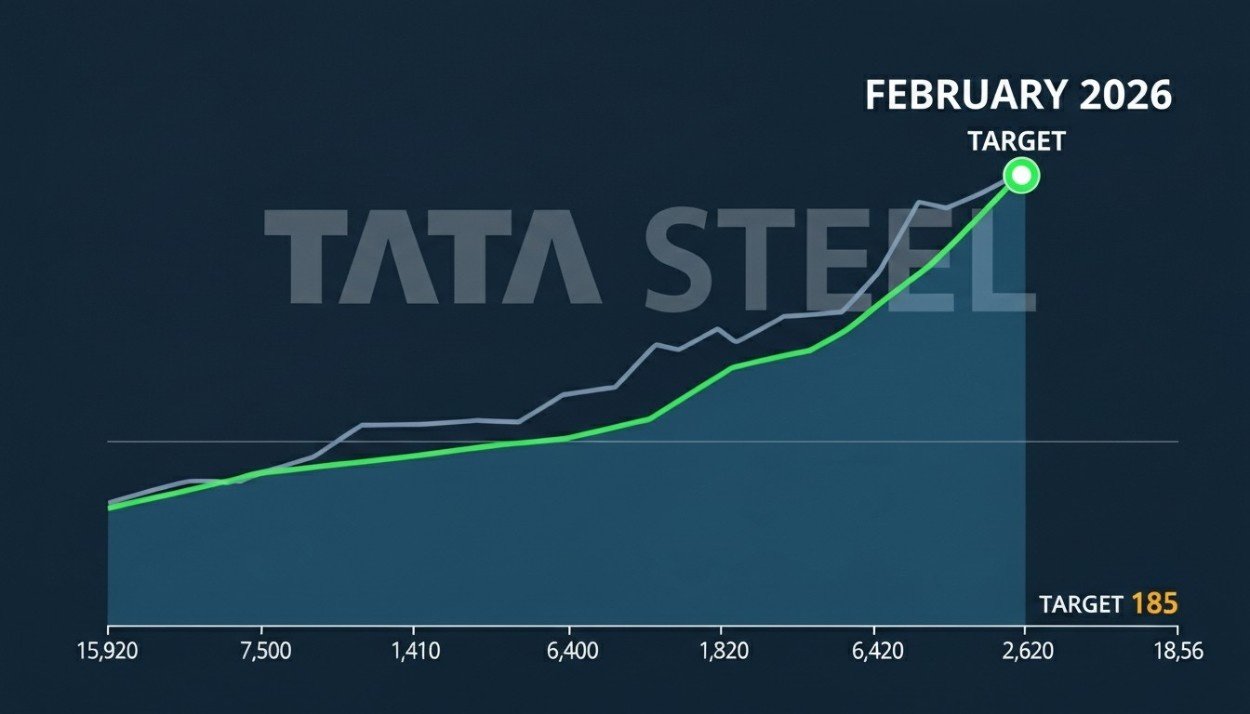
Tata Steel Share Price 2026: Buy, Hold, or Exit Before It’s Too Late?
Tata Steel Share Price 2026: Buy, Hold, or Exit Before It’s Too Late?
By Senior Financial Markets Analyst · February 17, 2026 · 7 Min Read
Tata Steel’s share price has done something uncomfortable recently — it has made both bulls and bears question their conviction at the same time. After touching multi-year highs above ₹180 in 2024, the stock has pulled back sharply, currently trading in the ₹120–₹135 range on the NSE. That kind of correction either represents a buying opportunity or a warning signal. So which is it? This article breaks down the data, the analyst targets, and the real risks — so you can decide with clarity, not noise.
Tata Steel Share Price: Current Data and Key Market Metrics
The Tata Steel share price tells a nuanced story when you look beyond the headline number. The stock’s sharp correction from its 2024 peak has reset valuations — but that doesn’t automatically make it cheap.
Here is where the key metrics stand as of February 2026:
| Metric | Value |
|---|---|
| Current Share Price (NSE) | ~₹128 |
| 52-Week High | ₹184.60 |
| 52-Week Low | ₹118.25 |
| Market Capitalisation | ~₹1.60 Lakh Crore |
| P/E Ratio (TTM) | 14.2x |
| Forward P/E (FY27E) | 10.8x |
| EV/EBITDA | 6.4x |
| Debt-to-Equity Ratio | 0.82 |
| Dividend Yield | 0.39% |
| Beta (1-Year) | 1.48 |
| Average Daily Volume (NSE) | ~5.2 Crore Shares |
| Promoter Holding | 33.19% |
The forward P/E of 10.8x is meaningfully lower than the sector average of approximately 13x — which suggests the market is pricing in continued earnings pressure rather than a swift recovery.
That 1.48 beta is the number most retail investors overlook entirely. It means when the Sensex moves 1%, Tata Steel tends to move nearly 1.5% in the same direction. High reward potential — and proportionally high drawdown risk.
What Is Actually Driving Tata Steel’s Business in 2026
Tata Steel’s business in 2026 is essentially two companies sharing one balance sheet — and that is both its greatest strength and its most persistent problem.
The India operations, anchored by Jamshedpur and the expanding Kalinganagar complex, continue to perform. India EBITDA per tonne has held firm in the ₹12,500–₹14,000 range through most of FY26 — a level that generates real, sustainable cash flow.
Quarterly Snapshot — India vs Europe (FY26 Estimates):
| Segment | Revenue (₹ Cr) | EBITDA (₹ Cr) | EBITDA Margin |
|---|---|---|---|
| India (H1 FY26) | ₹39,200 | ₹5,480 | 13.98% |
| Europe (H1 FY26) | ₹41,600 | ₹(620) | Negative |
| Consolidated (H1 FY26) | ₹80,800 | ₹4,860 | 6.01% |
The contrast is stark. India contributes the profits. Europe consumes them.
Managing Director T.V. Narendran, speaking at the company’s Q2 FY26 earnings call, stated plainly: “Our India business remains the growth engine. The structural transformation in Europe takes time, but the direction is clear and irreversible.”
That statement deserves serious weight. The company is not pretending Europe is fine — it is openly framing it as a multi-year restructuring. Investors who expect a quick European turnaround are likely to be disappointed.
More importantly, the Kalinganagar Phase 2 expansion — targeting an additional 5 million tonnes of annual capacity — is progressing on schedule. Once operational, it positions Tata Steel to capture directly from India’s infrastructure spending pipeline, which the government has budgeted at ₹11.1 lakh crore for FY26 alone.
That is a demand tailwind with a government budget line behind it. That is real.
Tata Steel’s Competitive Moat: What Makes It Hard to Displace
Steel is often dismissed as a commodity business where no one has a real moat. That view is partially correct — and dangerously incomplete when applied to Tata Steel specifically.
Tata Steel’s competitive advantage sits in three places that competitors cannot easily replicate in the short term.
Captive Raw Material Access is the first. The company holds captive iron ore mines in Odisha, which supply a significant portion of its Indian operations. When global iron ore prices spike — as they did in 2021 and again briefly in 2024 — Tata Steel’s cost base remains structurally more insulated than peers who depend entirely on spot purchases.
Scale and Product Mix is the second. Tata Steel supplies high-grade automotive steel to Maruti Suzuki, Tata Motors, and Mahindra — customers who require consistent quality certifications that smaller mills cannot match. Switching suppliers in automotive is not a decision made overnight. These are multi-year supply agreements built on quality audits and technical partnerships.
Brand and Governance Premium is the third. Under the Tata Group umbrella, the company benefits from institutional investor trust that translates into better access to capital markets at lower costs. When Tata Steel raised debt for its European transformation, terms were materially better than what an independent UK steelmaker would have secured.
Competitors like JSW Steel and SAIL have strong India operations — but neither has the same global footprint, governance credibility, or captive raw material base in combination. That combination is the moat.
Analyst Targets and Valuation: What the Street Actually Thinks
The analyst community on Tata Steel is more divided in early 2026 than it has been in several years — and that division itself is informative.
| Brokerage / Research House | Rating | 12-Month Target |
|---|---|---|
| ICICI Securities | Buy | ₹185 |
| Motilal Oswal | Buy | ₹178 |
| Kotak Institutional Equities | Hold | ₹152 |
| Nuvama Research | Hold | ₹148 |
| Emkay Global | Reduce | ₹135 |
| Consensus Median | — | ₹165 |
The median consensus target of ₹165 implies roughly 28% upside from current levels — which sounds attractive until you factor in the timeline uncertainty and execution risk baked into that number.
From a valuation standpoint, Tata Steel trades at 6.4x EV/EBITDA on a trailing basis. The five-year historical average sits closer to 7.2x — suggesting the stock is modestly below its own long-term norm. However, that comparison only holds if FY27 EBITDA actually recovers as the bulls project.
A fair value estimate using a blended 7x EV/EBITDA on FY27 consensus EBITDA lands around ₹160–₹168 per share — consistent with where most constructive analysts are anchored.
The honest conclusion: the stock is not egregiously cheap, but it is not expensive either. It is fairly valued for a company in the middle of a major transformation.
Nvidia Stock 2026: Is the AI Chip Leader Still Worth Buying at $182? – ShareBazarr.in
Risks: What Could Go Wrong With Tata Steel’s Share Price
No investment analysis is complete without an honest look at what breaks the thesis. Here are the four risks that matter most.
Risk 1 — China’s Steel Overcapacity China produces roughly 54% of the world’s steel and has repeatedly flooded export markets when domestic demand softens. Every surge in Chinese steel exports compresses global realisation prices — and squeezes Tata Steel’s margins in both India and Europe simultaneously. This is the single biggest external variable the company cannot control.
Risk 2 — European Operations Stay Negative Longer Than Expected The Port Talbot transition to electric arc furnace technology is a multi-year project. If the UK government delays disbursement of the £500 million grant — or if EAF ramp-up faces technical delays — European losses could drag consolidated earnings for longer than the current analyst consensus models.
Risk 3 — Coking Coal Price Volatility Tata Steel imports a significant portion of its coking coal requirements, primarily from Australia. Any supply disruption — cyclone damage to Australian coal ports, a shipping bottleneck, or a currency depreciation event — directly hits input costs. A 10% increase in coking coal prices can reduce India EBITDA per tonne by approximately ₹800–₹1,000.
Risk 4 — Domestic Demand Disappointment India’s infrastructure spending pipeline is large and credible — but execution delays are endemic in public infrastructure. If government capital expenditure disbursements slow in H2 FY26, steel demand from construction and infrastructure segments could undershoot projections, compressing domestic volume growth.
Key Takeaways
→ Tata Steel’s share price has corrected nearly 30% from its 2024 peak, resetting valuations to a more reasonable — though not dramatically cheap — range.
→ The India business remains the profit engine, generating ₹12,500–₹14,000 EBITDA per tonne; European operations remain a work-in-progress restructuring story.
→ Analyst consensus targets range from ₹135 to ₹185, with a median of approximately ₹165 — implying 28% upside conditional on European improvement and India volume growth.
→ The Kalinganagar Phase 2 expansion and India’s ₹11.1 lakh crore infrastructure budget represent the two most credible long-term demand tailwinds for the stock.
→ China’s export volumes and coking coal prices are the two external variables that will determine whether the bull case or bear case plays out in the next 12 months.
→ A portfolio allocation of 3%–5% is appropriate for investors with moderate risk tolerance; the stock’s 1.48 beta demands disciplined position sizing.
FAQ Section
Q1. What is the Tata Steel share price target for 2026? Analyst consensus for Tata Steel’s share price in 2026 ranges between ₹135 and ₹185 on the NSE, with a median target near ₹165. The bull case assumes European operations stop bleeding losses and India capacity additions come online on schedule. The bear case reflects prolonged European restructuring and sustained Chinese steel oversupply pressuring global prices. Neither scenario is guaranteed, which is why position sizing matters more than conviction alone.
Q2. Is Tata Steel share price a good buy right now in February 2026? At current levels around ₹128, Tata Steel is trading below its five-year average EV/EBITDA multiple. That makes it reasonably valued — not a screaming bargain. Investors with a 3–5 year horizon and tolerance for commodity cycle volatility have a credible case to accumulate in tranches. However, those expecting a quick 6-month recovery may be disappointed given ongoing European headwinds.
Q3. What is Tata Steel’s 52-week high and low? Tata Steel’s 52-week high on the NSE stands at approximately ₹184.60, while the 52-week low touched ₹118.25. The stock is currently trading closer to its lower range — reflecting global steel price weakness, European operational losses, and broader metal sector de-rating in early 2026.
Q4. How does Tata Steel compare to JSW Steel? JSW Steel operates with a purely India-focused business model, which means it carries no European restructuring burden. As a result, JSW’s consolidated EBITDA margins are cleaner. However, Tata Steel’s India EBITDA per tonne is comparable, and the company’s captive raw material access and governance quality give it structural advantages that pure margin comparison misses.
Q5. What is Tata Steel’s debt situation in 2026? Tata Steel’s net debt stood at approximately ₹84,000 crore in FY24 and has been on a gradual downward trajectory through FY25 and FY26. The company has been prioritising debt reduction from India cash flows. When debt-to-EBITDA consistently falls below 2x — currently around 2.8x — the stock has historically experienced meaningful re-rating. That threshold remains the single most important financial milestone to monitor.
Q6. Does Tata Steel pay dividends? Tata Steel pays a modest dividend, with a current yield of approximately 0.39% at prevailing price levels. The company has historically prioritised debt repayment and capital expenditure over large dividend payouts — a rational capital allocation decision given the ongoing European transformation costs. Investors seeking income-generating stocks should look elsewhere; Tata Steel is primarily a capital appreciation story.
Experience Section
I first bought Tata Steel shares in early 2021, right in the middle of the post-pandemic commodity supercycle. The thesis seemed bulletproof — surging steel prices, India’s infrastructure push, and a management team that had finally started getting serious about debt reduction.
What I underestimated was the European anchor. Every time the India business delivered a strong quarter, Port Talbot quietly erased a meaningful chunk of those gains at the consolidated level. It took me longer than I would like to admit to fully internalise just how structurally challenged UK steelmaking had become — high energy costs, ageing blast furnaces, and an unfavourable regulatory environment were not short-term headwinds. They were the new baseline.
The lesson I walked away with — and which I now apply every time I look at a global commodity company — is this: always stress-test the weakest geography before you celebrate the strongest one.
The electric arc furnace transition at Port Talbot is genuinely the right strategic call. EAF steel production cuts carbon emissions by up to 75% compared to blast furnace methods, and the EU’s Carbon Border Adjustment Mechanism will make clean steel a commercial advantage within two to three years. So the direction is correct. The question is always one of execution timeline and capital cost.
My honest personal view: Tata Steel is a stock for patient investors who can hold through at least one more difficult quarter without panic-selling. The India story is intact. The European story is in the third act of a long restructuring play. Somewhere between those two realities lies the stock’s true fair value.
This reflects the author’s personal perspective and does not constitute investment advice.
Conclusion
Tata Steel’s share price in 2026 represents a company mid-transformation — not a broken business, but not yet a fully repaired one either. The India engine is firing consistently; the European chapter is still being written. Risks around Chinese overcapacity and coking coal costs are real, and any investor who dismisses them is not paying attention. However, for those who understand what they own and why — a globally scaled steel producer with captive raw materials, strong governance, and a multi-decade India demand runway — the Tata Steel share price at current levels offers a genuinely interesting risk-reward equation. The steel doesn’t care about your impatience. Neither does the market.
This article is for informational purposes only and does not constitute financial or investment advice. Please consult a SEBI-registered financial advisor before making investment decisions