Nvidia Stock 2026: Is the AI Chip Leader Still Worth Buying at $182?
Nvidia Stock 2026: Is the AI Chip Leader Still Worth Buying at $182?
By Senior Technology & Markets Analyst · February 15, 2026 · 8 Min Read
Nvidia is the most valuable company on Earth.
Its stock has risen over 1,000% in three years. Its quarterly revenue just hit $57 billion. Its chips power virtually every major AI system built today.
And yet — the most important question for investors in 2026 is not where Nvidia has been.
It is whether there is still serious money to be made from here.
This article delivers a complete, data-driven answer. No hype. No filler. Just the numbers, the risks, and a straight verdict.
Nvidia’s Current Stock Price — Where Does NVDA Stand Today?
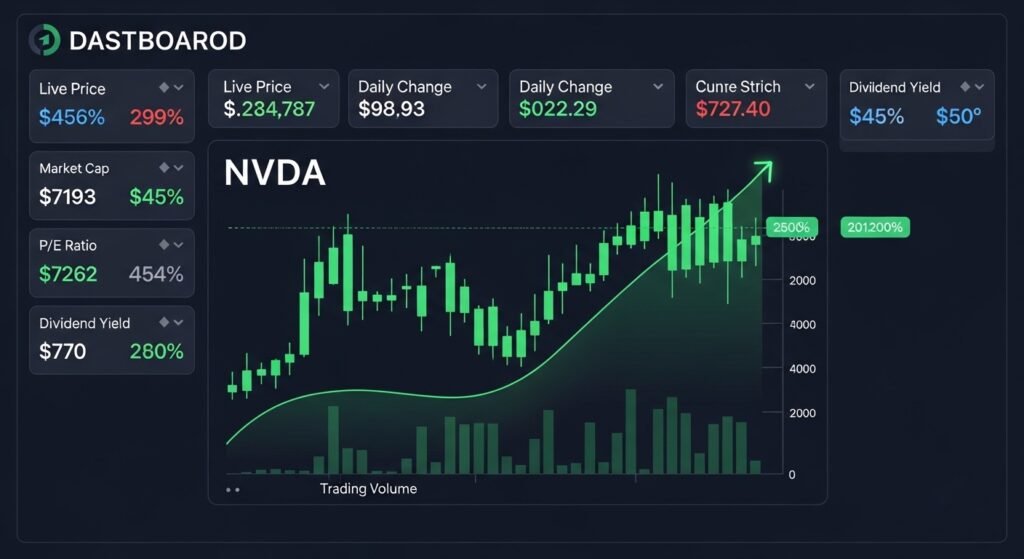
As of February 15, 2026, Nvidia (NASDAQ: NVDA) trades at $182.88.
The 52-week range runs from $86.62 at its lowest to $212.19 at its all-time high.
That is a 145% price range in a single year — a reflection of both the extraordinary opportunity and the real volatility that comes with owning the world’s most dominant AI company.
| Metric | Value (Feb 15, 2026) |
|---|---|
| Current Stock Price | $182.88 |
| 52-Week Low | $86.62 |
| 52-Week High | $212.19 |
| Market Capitalization | $4.5 Trillion |
| Trailing P/E Ratio | 45.28x |
| Forward P/E Ratio (FY2028) | ~19x |
| Dividend Per Share | $0.01 Quarterly |
| Cash & Equivalents | $37.6 Billion |
| Analyst Consensus | Strong Buy |
| Average Price Target | $257.35 |
The stock currently sits approximately 14% below its all-time high — a level many analysts describe as a healthy consolidation before the next leg higher.
Cantor Fitzgerald recently named NVDA their top pick for 2026, citing demand visibility, valuation reset, and next-generation architecture momentum.
Record Revenue That Redefined What a Hardware Company Can Earn
Nvidia’s Q3 FY2026 earnings were not just impressive. They were historic.
Total revenue hit $57 billion — beating Wall Street estimates by over $1.8 billion.
That single quarter’s revenue would have represented Nvidia’s entire annual revenue just two years ago.
| Q3 FY2026 Metric | Result |
|---|---|
| Total Revenue | $57.0 Billion (+62% YoY) |
| Data Center Revenue | $51.2 Billion (+66% YoY) |
| Gaming Revenue | $4.3 Billion (+30% YoY) |
| Automotive Revenue | $449 Million (+72% YoY) |
| Non-GAAP Gross Margin | 73.6% |
| Non-GAAP EPS | $1.30 (+60% YoY) |
| Q4 FY2026 Revenue Guidance | $65 Billion |
| Full Year FY2026 Revenue Forecast | $213 Billion |
| Full Year FY2027 Revenue Forecast | $321 Billion |
Goldman Sachs believes Nvidia will deliver a $2 billion revenue surprise in its Q4 FY2026 results, with their internal estimate at $67.3 billion — well above the street consensus.
Full-year FY2026 EPS is expected to reach $4.42 per share — a 50.9% surge year over year.
FY2027 EPS is projected to grow a further 55.7% to $6.88.
These are not small adjustments. These are structural earnings explosions driven by a once-in-a-generation technology shift
The Blackwell Architecture — Why Demand Cannot Be Fulfilled
The engine behind all of this growth is one product family: Blackwell.
CEO Jensen Huang described it simply on the Q3 earnings call: “Blackwell sales are off the charts, and cloud GPUs are sold out.”
The Blackwell GB200 NVL72 delivers 5x faster AI training performance than its predecessor, the H100. It wins every major benchmark — MLPerf Training, MLPerf Inference, and SemiAnalysis InferenceMAX.
Each Blackwell rack contains over 600,000 individual components. Production is ramping at full speed. Yet supply still cannot meet demand.
Every major hyperscaler on Earth is ordering at maximum capacity:
- Microsoft — Blackwell fully integrated across Azure AI infrastructure globally
- Amazon AWS — Up to 150,000 GB300 accelerators actively deployed
- Google Cloud — Building next-generation AI clusters entirely on Blackwell
- xAI (Elon Musk) — Entire Colossus 2 data center runs on Nvidia silicon
- OpenAI — Committed to deploying at least 10 gigawatts of Nvidia systems
- Anthropic — Long-term compute agreement for Grace Blackwell and Vera Rubin capacity
- Meta — Llama open-source models now handle 25% of all global AI token volume on Nvidia hardware
Nvidia has confirmed $500 billion in committed Blackwell and early Rubin orders through the end of 2026. Of that, $150 billion has already been fulfilled.
CFO Colette Kress has confirmed the $500 billion figure has already grown larger, as full-year orders for next-generation Rubin chips are now being added to the backlog.
This is not speculative demand. This is signed, committed capital from the world’s most sophisticated technology buyers.

The CUDA Moat — Nvidia’s Real Competitive Weapon
Nvidia’s hardware is extraordinary. But it is not the deepest part of its competitive advantage.
CUDA is.
CUDA is Nvidia’s proprietary software platform. It is the foundational layer on which virtually every AI model in the world is trained, fine-tuned, and deployed.
Nvidia controls 80% to 95% of the AI GPU market. Its CUDA ecosystem is deeply embedded in the workflows of over 4 million developers worldwide.
Switching away from CUDA means retraining entire teams. Rewriting years of code. Accepting meaningfully worse performance during a disruptive transition.
Google, Amazon, and Microsoft have each spent billions building their own AI chips. All three still purchase Nvidia hardware at record levels.
That one fact communicates more about the depth of Nvidia’s moat than any financial model
Nvidia’s Global Expansion — This Is Now a Worldwide Story
Nvidia’s growth is no longer confined to Silicon Valley or Wall Street.
The company is now central to the national AI strategies of governments worldwide.
United Kingdom — Nvidia committed £2 billion in investment, building next-generation AI infrastructure with Microsoft, CoreWeave, and Nscale.
South Korea — Over 260,000 advanced Nvidia GPUs supplied to Samsung, Hyundai Motor Group, SK Group, and NAVER Cloud.
Germany — World’s first Industrial AI Cloud launched with Deutsche Telekom, helping European manufacturers modernize through AI.
Japan — Collaborating on FugakuNEXT, Japan’s next-generation AI supercomputer, powered by Nvidia architecture.
India — Major data center partnerships in progress as India races to build sovereign AI infrastructure.
China — The U.S. government has recently authorized Nvidia to resume H200 chip shipments to China. CEO Jensen Huang is reportedly planning a return visit. This represents a potential $54 billion revenue opportunity from over 2 million H200 chip orders currently pending.
Jensen Huang stated at the World Economic Forum in January 2026: “Some $10 trillion or more of the last decade of computing is now being modernized. A hundred trillion dollars of industry is shifting over to artificial intelligence.”
This is the size of the opportunity Nvidia is positioned at the center of.
What Wall Street Analysts Say — Ratings and Price Targets
The analyst community is overwhelmingly bullish on Nvidia stock in 2026.
Of 64 analysts currently covering NVDA, 60 recommend buying the stock.
| Rating | Number of Analysts |
|---|---|
| Strong Buy | 12 |
| Buy | 48 |
| Hold | 3 |
| Sell | 1 |
| Firm | Price Target |
|---|---|
| Evercore ISI (Street High) | $352 |
| Bank of America | $275 |
| Goldman Sachs | $250 |
| Stifel | Buy-equivalent |
| Truist | Buy-equivalent |
| Cantor Fitzgerald | Top Pick 2026 |
| Consensus Average | $257.35 |
The consensus average of $257.35 represents 34% upside from the current price of $182.88.
The street-high target of $352 from Evercore ISI implies 93% upside — nearly a double from current levels.
Renowned investor Michael Burry holds the minority bearish view, citing valuation concerns. He remains a clear outlier against the overwhelming institutional consensus
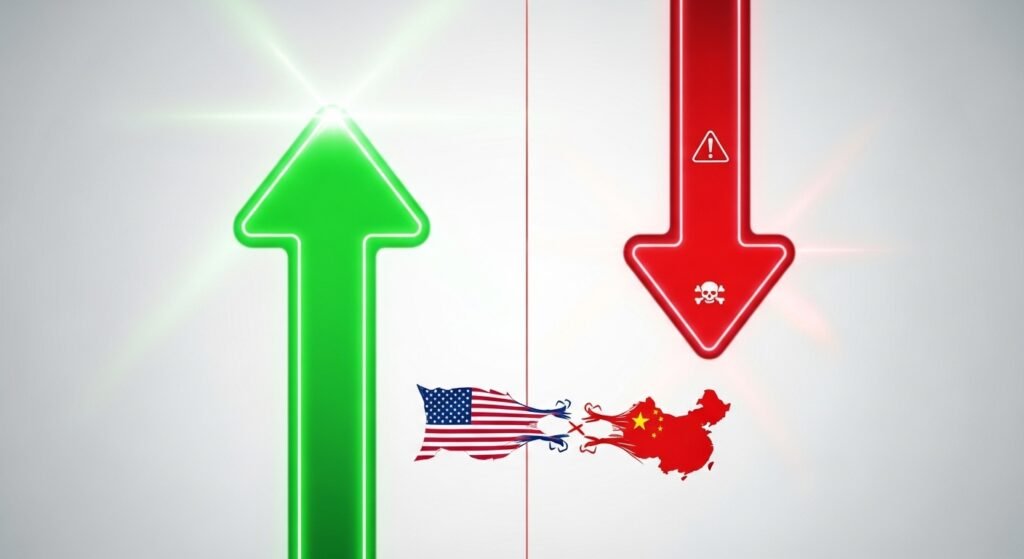
The Risks Every Honest Nvidia Investor Must Understand
Nvidia is exceptional. No stock is risk-free.
1. U.S.–China Export Restrictions
This is the single biggest near-term risk.
Nvidia took a $5.5 billion charge in early 2025 when the U.S. government restricted H20 chip exports to China. H20 sales went from a major revenue source to “insignificant” almost overnight.
The situation is now improving — H200 shipments to China are being authorized again. But regulatory uncertainty remains. Any reversal could trigger another multi-billion dollar inventory charge.
2. Extreme Revenue Concentration
Data Center represents nearly 90% of total Nvidia revenue.
If AI infrastructure spending moderates — whether from economic pressure, regulatory intervention, or shifts in enterprise AI priorities — Nvidia has almost no revenue cushion elsewhere. Gaming contributes just 7.5% today.
3. Growing Competition
AMD’s MI350 series is improving. Intel’s Gaudi 3 is gaining traction. Broadcom and Marvell are developing custom ASIC chips for hyperscalers. Huawei’s Ascend chips are emerging as a competitor in China.
None of these threaten Nvidia’s dominance today. But the trajectory is accelerating.
4. Margin Pressure from Blackwell Complexity
Blackwell racks contain over 600,000 components. The complexity of scaling this architecture is putting pressure on Nvidia’s gold-standard gross margins. Investors should watch whether 73.6% margins hold into Q4 FY2026 results on February 25.
5. AI Monetization Timeline
Hyperscalers are investing at historic rates. But enterprise AI ROI is still proving itself in the real world. If returns disappoint expectations, capital expenditure cycles could compress faster than current consensus forecasts assume.
Key Takeaways — Everything You Need to Know
→ Nvidia trades at $182.88 with a $4.5 trillion market cap — the world’s most valuable company.
→ Q3 FY2026 revenue hit a record $57 billion (+62% YoY). Data Center alone: $51.2 billion (+66%).
→ Full-year FY2026 revenue is forecast at $213 billion. FY2027 at $321 billion — roughly 50% growth year over year.
→ $500 billion in committed Blackwell and Rubin orders through end of 2026. $150 billion already fulfilled.
→ CUDA ecosystem locks in 4 million developers worldwide. Switching costs are enormous.
→ 60 out of 64 analysts rate NVDA Buy. Consensus price target: $257.35. High target: $352.
→ China re-entry is a potential $54 billion catalyst if H200 shipment approvals proceed fully.
→ Key risks: export restrictions, 90% revenue concentration, rising competition, and margin sustainability.
Frequently Asked Questions
Q1. What is Nvidia’s stock price in February 2026?
Nvidia (NASDAQ: NVDA) is trading at $182.88 as of February 15, 2026. Its 52-week range is $86.62 to $212.19. The company holds a market capitalization of $4.5 trillion, making it the most valuable publicly traded company in the world. For real-time pricing, check any major financial platform.
Q2. Is Nvidia stock a buy or sell in 2026?
Of 64 analysts covering NVDA, 60 recommend buying the stock. The consensus rating is Strong Buy. The average price target is $257.35, representing approximately 34% upside from current levels. Evercore ISI holds the most bullish target at $352. This article does not constitute personal investment advice — always consult a licensed financial advisor.
Q3. What is Nvidia’s revenue forecast for 2026 and 2027?
Full-year FY2026 revenue is forecast at $213 billion — up from $130.5 billion in FY2025. FY2027 revenue is projected at $321 billion, representing approximately 50% year-over-year growth. Q4 FY2026 results will be reported on February 25, 2026, with consensus revenue expectations of $65 to $67 billion.
Q4. What is Nvidia’s price target for 2026?
The Wall Street consensus 12-month price target is $257.35. Goldman Sachs targets $250. Bank of America targets $275. Evercore ISI carries the street-high target at $352 — implying approximately 93% upside from current levels. These are analyst projections based on earnings models. They are not guaranteed outcomes.
Q5. What is Nvidia’s CUDA ecosystem and why does it matter?
CUDA is Nvidia’s proprietary software platform — the foundational layer on which virtually all global AI development runs. Over 4 million developers build on CUDA. Switching to a competing platform requires retraining teams, rewriting code, and accepting worse performance. This ecosystem lock-in is the deepest source of Nvidia’s competitive moat and pricing power.
Q6. What are the biggest risks of investing in Nvidia in 2026?
The primary risks are U.S.–China export restrictions (which already cost $5.5 billion in charges), extreme revenue concentration in data centers at approximately 90% of total revenue, growing competition from AMD, Broadcom, and custom hyperscaler silicon, potential gross margin pressure from Blackwell’s manufacturing complexity, and the broader risk that enterprise AI ROI disappoints, slowing future infrastructure spending.