IT Stock Crash 2026: TCS, Infosys, Wipro Plunge 20% as AI Fears Grip Market — Should You Buy the Dip?
IT Stock Crash 2026: TCS Infosys Wipro Down 20% | Buy or Sell?
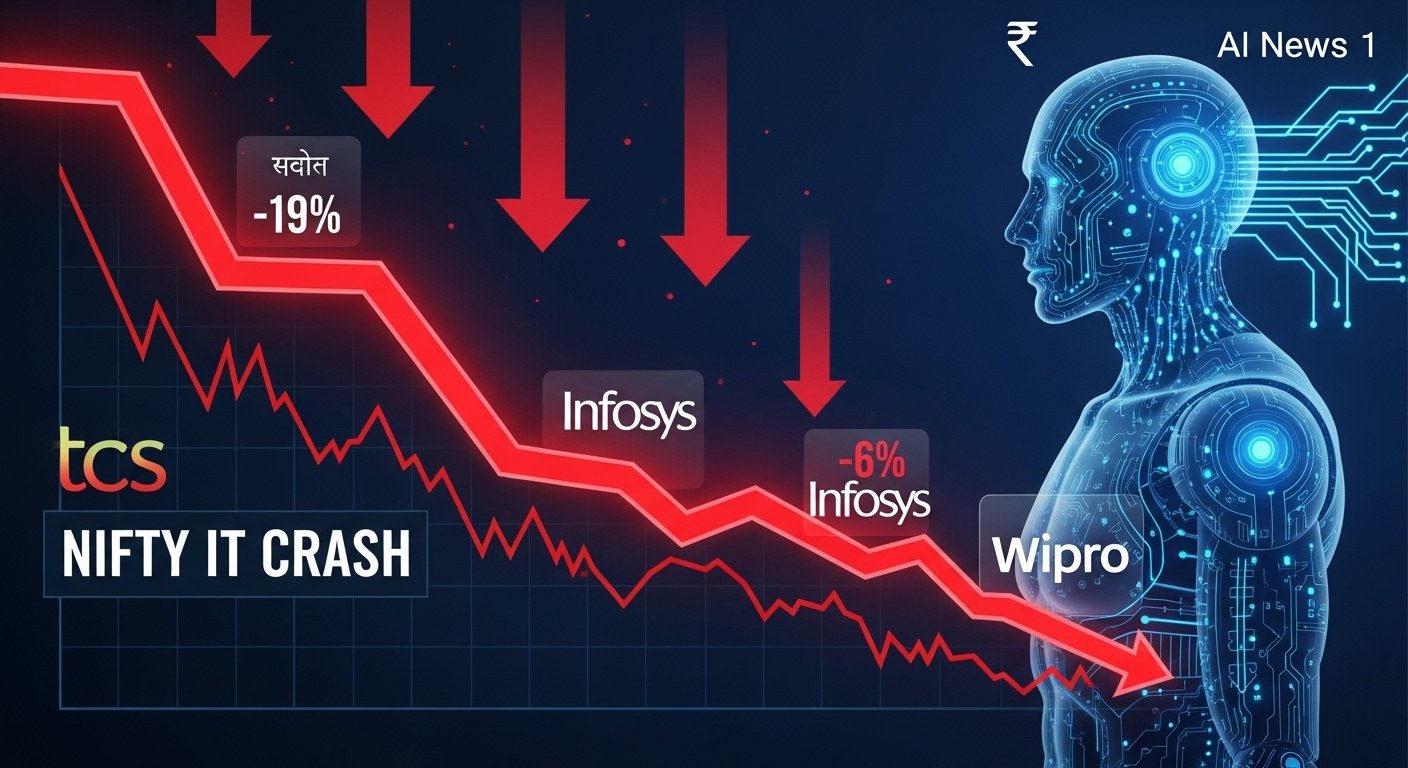
Mumbai, February 15, 2026 — Indian IT stocks suffered their worst selloff in over two years. The Nifty IT index plunged 19% in just eight trading sessions, erasing approximately ₹2 lakh crore in market value.
TCS, Infosys, and Wipro all hit 52-week lows on February 14. The crash began when Anthropic unveiled AI agents capable of automating IT services tasks. Elon Musk’s public attack on Anthropic amplified the panic.
What Triggered the Massive Selloff?
The carnage started on February 4 when Anthropic launched Claude Cowork. This AI agent can handle legal contracts, sales operations, and data analysis — work typically outsourced to Indian IT firms.
Within 48 hours, global technology stocks lost $285 billion in value. Wall Street analysts called it the “SaaSpocalypse” — a potential apocalypse for software service business models.
Infosys ADRs crashed 9.4% to $14.21 on the New York Stock Exchange. Wipro ADRs fell 4.6% to $2.28. When Indian markets opened, domestic IT stocks extended losses dramatically.
By February 14, Infosys had dropped 8% to ₹1,281.50, marking its 52-week low. TCS declined 6% while Wipro fell 5%. Tech Mahindra, Persistent Systems, and Coforge all suffered losses exceeding 6%.
The Numbers: How Bad Is the Damage?
The Nifty IT index fell from 38,611.75 on February 3 to 31,272 by February 14. That’s a 19% crash in eight trading days — the worst performance since the March 2020 COVID panic.
Individual stock losses were brutal:
- Infosys: Down 13% over two days
- TCS: Hit ₹2,579 (52-week low)
- Wipro: Dropped to ₹185 levels
- HCL Tech: Fell 7% in single session
- Tech Mahindra: Lost 8% intraday
Mid-cap IT stocks suffered worse. Sonata Software, KPIT Technologies, Birlasoft, and Zensar Technologies declined 6-8%. The selloff showed no discrimination between large caps and smaller names.
Elon Musk Calls Anthropic “Evil”
Tesla CEO Elon Musk intensified market chaos with a scathing attack. On February 12, he called Anthropic’s AI models “misanthropic and evil” on social media.
Musk alleged bias in Anthropic’s systems, claiming they discriminate against specific groups. The comment came after Anthropic announced a $30 billion funding round at $380 billion valuation.
This represents the second-largest private tech funding round in history, behind only OpenAI’s $40 billion raise. Musk’s xAI competes directly with Anthropic through its Grok chatbot.
The billionaire’s intervention validated investor fears that AI competition had moved beyond technology into ideological warfare. When high-profile entrepreneurs publicly attack rivals, it signals severe business model disruption ahead.
Why Investors Are Panicking
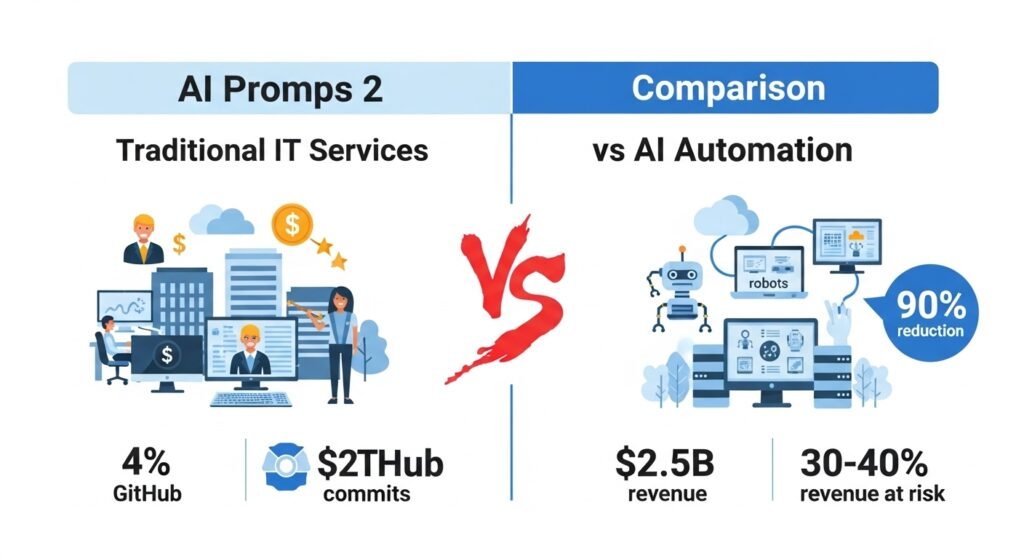
Anthropic’s Claude Code now authors 4% of all public GitHub commits worldwide. The product has surpassed $2.5 billion in annualized revenue, more than doubling since early 2026.
These aren’t theoretical concerns. Companies are actively replacing human coders with AI agents. Meta, Alphabet, and Microsoft continue laying off engineers despite strong revenue growth.
Traditional application development and maintenance represent 30-40% of Indian IT services revenue. If AI can deliver comparable quality at 10% of current costs, clients will inevitably shift spending.
ICICI Securities notes that rising anxiety around medium-term revenue resilience is driving the selloff. The weakness in US-listed Indian IT ADRs acts as a sentiment proxy, amplifying downside volatility.
Nirmal Bang warned that Anthropic has accelerated repricing by attacking time and workflow economics. These fundamentals underpin traditional IT services pricing models.
The Bull Case: Why This Could Be Opportunity
Samir Arora, prominent fund manager, offered perspective. He tweeted: “WhatsApp disrupted SMS but you still use SMS. OTT disrupted TV but you still watch TV. Disruption means lower valuations, lower growth — but not zero.”
Historical patterns support this view. Technology disruption rarely eliminates incumbent businesses entirely. Instead, it forces adaptation and margin compression over years.
Indian IT companies possess defensive characteristics. Enterprise clients don’t casually abandon long-standing vendor relationships. Migration requires extensive reengineering and operational risk.
Switching costs remain substantial. Even if AI tools prove superior for specific tasks, wholesale replacement would take years to implement across Fortune 500 client bases.
Second, Indian IT firms are investing heavily in AI capabilities. TCS, Infosys, and Wipro have all launched AI-focused services. They’re building AI-enhanced offerings that could offset legacy revenue pressures.
Third, valuations have compressed meaningfully. Forward price-to-earnings multiples have declined to levels not seen since the March 2020 crash. If fundamentals prove resilient, current prices offer compelling entry points.
Fourth, margin structures provide cushion. Indian IT companies operate at 20-25% EBITDA margins. Even if AI reduces billable hours by 15-20%, margins would compress to 15-18% — still profitable.
The Bear Case: Why More Downside Possible
Bears argue that bulls underestimate AI’s transformative potential. Large language models can now handle end-to-end workflows across coding, testing, and documentation.
This isn’t margin compression. It’s revenue model obsolescence. No amount of switching costs can withstand 90% cost advantages indefinitely.
US technology employment data supports the bearish thesis. Despite robust GDP growth, tech sector job creation has stalled. Layoffs continue across software firms from Meta to Alphabet.
If established technology companies are reducing headcount while investing in AI, it signals management teams believe fewer workers can deliver comparable output. This directly threatens headcount-based outsourcing models.
Financial technology firm Altruist recently launched AI tax planning tools that pressured Charles Schwab stock. Similar launches across legal, accounting, and consulting will continue eroding addressable markets.
VK Vijayakumar, Chief Investment Strategist at Geojit Investments, cautioned that the real impact remains uncertain. He advised against panic selling but suggested waiting for clarity on deal wins and revenue growth.
Risk Management Strategies
Existing investors should consider several approaches:
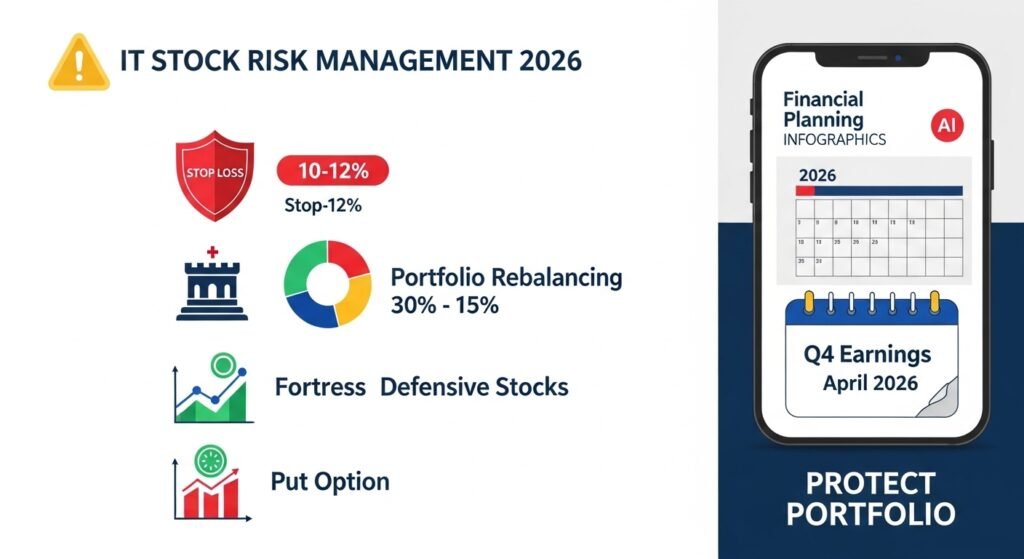
Stop-Loss Discipline: Set trailing stops 10-12% below current prices. TCS at ₹2,300, Infosys at ₹1,150, Wipro at ₹185 represent logical stop-loss levels.
Diversification Rebalancing: Reduce IT exposure from 25-30% of equity allocation to 15-20%. This maintains participation while limiting concentration risk.
Defensive Selection: Focus on companies with regulated industry expertise. Healthcare, banking, and insurance IT may prove more resilient than pure application development.
Options Hedging: Three-month put options struck 15% below current prices cost 3-4% of position value. Expensive but potentially worthwhile given volatility.
Wait for Earnings: Q4 FY2026 results (announced in April) will provide concrete evidence of deal pipeline health. Management commentary on AI impact will clarify investment outlook.
Global Factors Adding Pressure
Federal Reserve policy expectations shifted hawkish. Markets now price only 50 basis points of rate cuts in 2026 versus earlier expectations of 75-100 basis points.
Higher-for-longer rates reduce present value of future cash flows. This disproportionately impacts high-multiple technology stocks.
Foreign institutional investor flows remain critical. January and February 2026 show net FII selling in technology sector. Sustained selling creates technical pressure regardless of fundamentals.
US dollar strength against rupee also matters. Recent dollar weakness removed the tailwind that benefits Indian IT exporters when converting dollar earnings to rupees.
Expert Opinions Divided
Gaurav Vasu, CEO of UnearthInsights, noted that Indian selloff mirrors broader US market trends. Technology sector rotation has intensified beyond India-specific factors.
24/7 Wall Street maintains that valuations remain elevated despite the correction. The firm suggests waiting for further downside before establishing positions.
BCA Research, one of few bearish voices on Wall Street, warns of potential US recession risks. However, the firm stays neutral on equities due to AI capital expenditure tailwinds.
Goldman Sachs analysts observe that investors have “underestimated AI capex every quarter for the past two years.” This suggests infrastructure buildout has further to run.
The Verdict: Selective Approach Recommended
The AI-driven selloff represents a genuine inflection point. Technology transitions from productivity tool to competitive threat.
For risk-averse investors, staying on sidelines until business model clarity emerges makes sense. Potential for further downside remains elevated given technical breakdown and negative momentum.
For value investors with multi-year horizons, current valuations may prove attractive. But selectivity matters more than sector-wide bets.
Companies with strong client relationships in regulated industries offer better risk-reward. Pure-play application development firms face existential threats.
The key question isn’t whether AI will disrupt IT services. The question is degree and timing. Measured disruption over five years allows adaptation. Rapid disruption over 18 months threatens survival.
Wait for Q4 earnings before making significant portfolio changes. Management commentary will provide the first concrete data on whether deal pipelines are deteriorating or holding firm.
Key Takeaways
- Nifty IT crashed 19% in 8 trading sessions, erasing ₹2 lakh crore market cap as Anthropic AI triggered panic selling
- TCS, Infosys, Wipro hit 52-week lows with losses of 6-13% as investors fear AI automation replacing IT services revenue
- Elon Musk called Anthropic “misanthropic and evil” after $380 billion valuation funding, amplifying market chaos
- Anthropic’s Claude Code now authors 4% of GitHub commits with $2.5B revenue, proving AI disruption is real
- Bulls cite switching costs and 20-25% margins as cushion; bears warn of 90% cost advantages making disruption inevitable
- Risk management includes stop-losses at key levels, portfolio rebalancing, and waiting for Q4 FY2026 earnings clarity
Frequently Asked Questions
Q1. Why did IT stocks crash in February 2026? Anthropic’s Claude Cowork AI agent announcement triggered fears that AI could automate tasks traditionally outsourced to IT services firms. This threatens 30-40% of industry revenue. Elon Musk’s criticism amplified panic.
Q2. How much did IT stocks fall? Nifty IT index fell 19% from 38,611 to 31,272 in eight days. Infosys dropped 13% over two sessions. TCS, Wipro, Tech Mahindra all hit 52-week lows. Total market cap loss exceeded ₹2 lakh crore.
Q3. What did Elon Musk say about Anthropic? Musk called Anthropic’s AI models “misanthropic and evil” on February 12, 2026, alleging bias. His xAI competes with Anthropic’s Claude. The comment came after Anthropic raised $30 billion at $380 billion valuation.
Q4. Should you buy IT stocks now? Depends on risk tolerance. Conservative investors should wait for Q4 FY2026 earnings (April) for clarity on deal pipelines. Value investors with 3-5 year horizons may find opportunity if they believe AI augments rather than replaces services.
Q5. Which IT stocks hit 52-week lows? TCS (₹2,579), Infosys (₹1,281), Wipro, Cyient, Hexaware, L&T Tech, Mastek, Oracle Financial, and Tata Technologies all touched 52-week lows during February selloff.
Q6. What is Claude Cowork? Anthropic’s enterprise AI agent that autonomously handles legal contracts, compliance, sales operations, and data analysis — tasks previously requiring human professionals or IT outsourcing.
Q7. How can investors manage risk? Set stop-losses 10-12% below current prices. Reduce IT allocation from 25-30% to 15-20% of portfolio. Focus on defensive stocks with regulated industry exposure. Use put options for hedging.
Q8. Will AI completely replace IT companies? Complete replacement unlikely but significant disruption probable. History shows incumbents adapt rather than disappear. However, lower valuations and growth rates are likely for several years.
Q9. What are key support levels? Technical support: TCS at ₹2,300-2,400, Infosys at ₹1,150-1,200, Wipro at ₹185-195. Breaking these could trigger further selling. Holding them may signal bottoming.
Q10. When is next earnings season? Q4 FY2026 earnings (January-March results) will be announced in April 2026. This will provide first concrete evidence of AI impact on deal wins and revenue growth.
Disclaimer: This article is for informational purposes only. Not investment advice. Stock markets involve risk including loss of capital. Consult financial advisor before investing.