Gold Price Forecast 2026: Will XAU/USD Hit $6,300?
Gold Price 2026: Live Data and Key Market Metrics
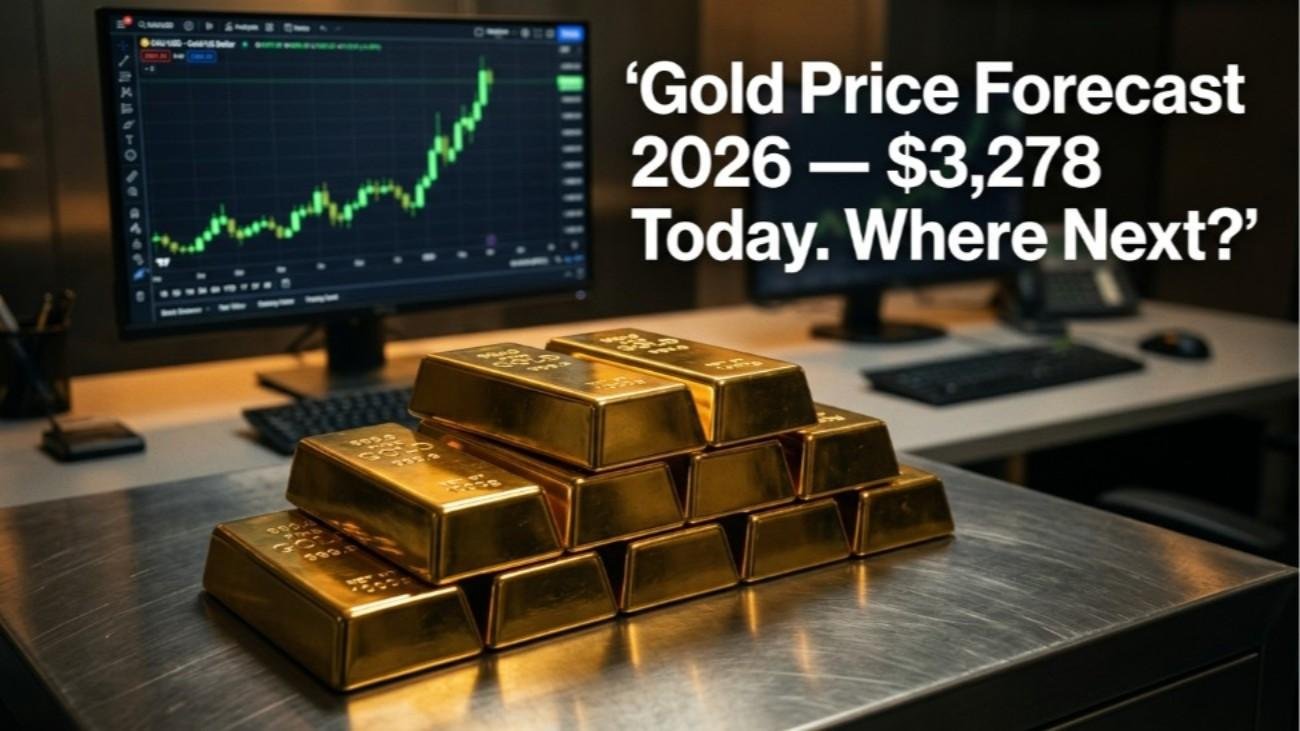
As of March 1, 2026, spot gold (XAU/USD) is trading at $5,277.85, with an all-time high of $5,597.23 hit earlier this year. The metal is up 22.42% year-to-date. That kind of move in under two months would have seemed extraordinary even twelve months ago.
Today’s intraday range has been $5,182.90 to $5,299.00, with the previous close at $5,194.20 — a single-session move of $102.20, or nearly 2%. That level of volatility is becoming routine for a market that is being driven by forces far larger than any single data release.
| Metric | Data (March 1, 2026) |
|---|---|
| Spot Gold Price (XAU/USD) | $5,277.85 / oz |
| All-Time High | $5,597.23 (Jan 29, 2026) |
| Today’s Intraday Range | $5,182.90 – $5,299.00 |
| YTD Return (2026) | +22.42% |
| 2025 Annual Return | +64% |
| 52-Week Range | $2,859.02 – $5,597.23 |
| Gold Futures (April 2026) Open | $5,231.50 |
| Price Per Gram (USD) | $170.16 |
| Price Per Kilogram (USD) | $170,162.97 |
| MCX Gold (India) | ₹1,62,050 / 10g (Feb 26) |
| Global Annual Demand 2025 | 5,002 tonnes |
Gold is stretching its February advance as an outright US-Iran conflict, Trump’s global tariff plan, and a softer dollar combine to keep safe-haven demand pinned near the upper-$5,000s. The metal is now tracking its seventh consecutive monthly gain — a streak that reflects something far more durable than short-term speculation.
That said, the divergence between analyst forecasts is the widest it has been in years. A $1,977 gap separates Macquarie’s average 2026 call of $4,323 from J.P. Morgan’s year-end target of $6,300. When professionals disagree that sharply on a single asset, the underlying narrative is genuinely contested — and every investor needs to understand both sides of it.
Why Gold Keeps Rising: The Structural Drivers Behind the 2026 Rally
This is not a fear trade. Fear trades fade. This is a structural repricing — and the distinction is everything.
Three forces are doing the heavy lifting right now. Central banks are buying at historically elevated levels. Western investors are rotating out of dollar-denominated assets at an accelerating pace. And the so-called debasement trade — the growing conviction that governments will inflate away their debt — is pulling in an entirely new category of buyers who never touched gold before.
| Demand Driver | Detail |
|---|---|
| Central Bank Purchases (Goldman Forecast 2026) | 60 tonnes per month |
| CB Purchases (J.P. Morgan Forecast 2026) | 755 tonnes annually |
| China PBOC Buying Streak | 15 consecutive months through Jan 2026 |
| Quarterly Investor + CB Demand (J.P. Morgan) | ~585 tonnes average |
| ETF Inflows Expected (2026) | ~250 tonnes |
| Bar & Coin Demand Expected (2026) | 1,200+ tonnes annually |
| Western ETF Inflows (Since Early 2025) | ~500 tonnes |
| Gold’s Share of Global Financial Assets | ~2.8% (Q3 2025) |
| Global Gold Demand 2025 | 5,002 tonnes |
| Jewelry Demand Drop 2025 | -18% globally, -24% in China |
Goldman Sachs Senior Commodities Analyst Lina Thomas stated in February 2026: “Our forecast only takes into account that central banks keep buying at the pace that they have been buying, which is a very reasonable assumption given that EM central banks are still underweight gold.”
J.P. Morgan’s analyst Greg Shearer put it plainly: “We continue to lean on the relationship between tonnes of quarterly investor and central bank demand and prices to derive our gold price forecast.” That model explains around 70% of the quarter-on-quarter change in gold prices. Every 100 tonnes of quarterly demand above 350 tonnes drives approximately a 2% additional gain.
In 2025, global gold demand rose to 5,002 tonnes, while central bank gold purchases totaled 863 tonnes — and are expected to ease slightly to 850 tonnes in 2026. That slight moderation in central bank volume is mechanical, not structural. With gold above $5,000, central banks simply need fewer tonnes to achieve the same percentage allocation. The intent has not changed.
More importantly, the debasement argument is now mainstream. In 2025, gold overtook the euro as the world’s second most widely held reserve asset and was recognised as a Tier 1 asset in the international banking system. That is not a speculative development. That is a structural reclassification that took decades to arrive — and it fundamentally changes who buys gold and why.
Gold’s Competitive Moat: Why Nothing Else Does What Gold Does Right Now
Gold pays no dividend. It has no earnings. It cannot be printed, sanctioned, or frozen. And yet it has outperformed 90% of financial assets over the past five years.
No other asset simultaneously functions as a currency hedge, an inflation store, a geopolitical buffer, and a portfolio diversifier at sovereign scale. Silver has risen sharply — and is up double digits in 2026 already — but it lacks the liquidity depth and institutional credibility that gold commands at the trillion-dollar level.
According to the World Gold Council, 76% of central bank officials expect gold to make up a higher share of international reserves over the next five years. That survey result is extraordinary when you consider that these are the same institutions managing multi-trillion-dollar balance sheets. When 76% of central bankers are telling you they plan to buy more, the demand floor is not in question.
UBP analysts described the structural backdrop as “likely to persist in 2026 and over the coming years”, noting that “The underlying trend towards a more multi-polar world is constructive for gold, given the potential for trade conflicts, supply-chain disruption, and higher inflation outcomes over time.”
Compare gold’s 2025 performance of +64% against the S&P 500’s roughly +23% gain, and the divergence is stark. More importantly, that divergence occurred during a period when equity markets were not collapsing. Gold gained in an environment where risk assets were also performing — that is the hallmark of structural demand, not panic buying.
The democratisation of gold access is also worth noting. Costco Wholesale — not traditionally a bullion retailer — now sells physical gold bars to retail customers in the United States. That channel expansion signals a broadening buyer base that goes well beyond sovereign wealth funds and institutional allocators.
Analyst Price Targets 2026: Goldman vs J.P. Morgan vs Everyone Else
The spread between the most bullish and most cautious 2026 forecasts is nearly $2,000 per ounce. That is not a rounding error — it is a fundamental disagreement about what gold is pricing right now.
| Institution | 2026 Price Target | Issued |
|---|---|---|
| J.P. Morgan | $6,300 (Q4 2026) | Feb 25, 2026 |
| Wells Fargo Investment Institute | $6,100 – $6,300 (Year-End) | Feb 4, 2026 |
| UBS | $6,200 (Target) / $7,200 (Upside) | Jan 29, 2026 |
| Societe Generale | $6,000 (Year-End) | Jan 26, 2026 |
| Deutsche Bank | $6,000 | Jan 26, 2026 |
| ANZ | $5,800 (Q2 2026) | Feb 2026 |
| UBP | $5,200 (Q4 2026) | 2026 |
| Goldman Sachs | $5,400 (Year-End) | Jan 22, 2026 |
| Morgan Stanley | Bull Case: $5,700 | Jan 23, 2026 |
| TD Securities | Avg $4,831 / High $5,400 | 2026 |
| Macquarie Group | Avg $4,323 | Feb 5, 2026 |
Goldman Sachs analysts Daan Struyven and Lina Thomas noted that risks to their $5,400 forecast are “significantly skewed to the upside because private-sector investors may diversify further on lingering global policy uncertainty.” Goldman also firmly rejected the commodity supercycle narrative. As Thomas stated: “We’re not expecting a super cycle where prices will just go higher forever.”
J.P. Morgan, on February 2, 2026, raised its gold price target to $6,300 per ounce by end of 2026, up from its previous target of $5,055, driven by continued demand from central banks and investors. That is a $1,245 upward revision in a single note — one of the most aggressive institutional adjustments seen in the gold market in years.
From a valuation standpoint, gold does not carry a traditional P/E ratio. However, its inverse relationship with real yields remains the most reliable pricing proxy available. With real yields compressed and the Federal Reserve holding rates at 3.50–3.75% — where 98% of market participants expect them to remain through March — the opportunity cost of holding a non-yielding asset stays low. According to CME Group data, the probability of a rate cut to 3.25–3.50% in March stands at just 2%. That near-zero cut probability is, paradoxically, not hurting gold — because the debasement and geopolitical narratives have taken over as the primary pricing drivers.
Risks to the Gold Rally: What Could Send Gold Sharply Lower
Gold’s structural case is compelling. But compelling cases have broken before — and the risks here are real enough to treat seriously.
Risk 1 — Speculative Positioning Unwind Gold’s late-January correction — which pulled prices from the $5,597 all-time high to below $5,200 within days — demonstrated how quickly speculative excess reverses. Independent analyst Alan Hibbard noted that “I could see gold get stuck around $5,000 for a while” before any sustained push to $6,000 or higher. Investing.com Momentum-driven markets do not climb in straight lines, and a sharp positioning unwind can arrive without any fundamental trigger.
Risk 2 — Federal Reserve Hawkish Pivot UBS explicitly identifies a “hawkish Fed” as gold’s chief downside risk. LiteFinance If inflation data surprises to the upside and the Fed signals rate hikes rather than cuts, real yields rise — and the opportunity cost of holding gold rises with them. That scenario is currently priced at near-zero probability, which means it carries the highest potential for surprise.
Risk 3 — Central Bank Demand Reversal Gold purchases by central banks are expected to ease slightly to 850 tonnes in 2026, down from 863 tonnes in 2025. Devere Group Any acceleration of that slowdown — or an outright reversal driven by fiscal pressure — removes the primary structural pillar of the rally. This is a low-probability scenario, but if it materialises, there is no secondary buyer large enough to replace sovereign demand at scale.
Risk 4 — Geopolitical Resolution Gold performs best in uncertainty. A meaningful de-escalation in the US-Iran situation, a US-China trade truce, or a resolution to major geopolitical flashpoints could rapidly reduce safe-haven premium. HSBC’s James Steel warned that easing trade tensions or fiscal consolidation akin to the post-1980 era might relieve some of gold’s risk premium. LiteFinance
Risk 5 — High Jewellery Price Sensitivity Due to exceptionally high prices, global jewellery sales fell 18% in 2025, with the sharpest decline in China where demand dropped 24%. Devere Group Jewellery is not just an aesthetic category — it represents a historically important demand anchor. If consumer demand stays suppressed at these price levels, the burden of sustaining the rally falls entirely on investors and central banks, creating a more fragile structure.
Key Takeaways
→ Gold is trading at $5,277.85 per ounce on March 1, 2026 — up 22.42% year-to-date after a 64% surge in 2025. → The all-time high of $5,597.23 was set on January 29, 2026; the metal has corrected but has held above $5,100 consistently. → J.P. Morgan leads institutional forecasts at $6,300 by Q4 2026; Goldman Sachs takes the more measured position at $5,400 year-end. → Central bank demand remains the structural backbone — Goldman forecasts 60 tonnes per month; J.P. Morgan projects 755 tonnes for full-year 2026. → The debasement trade and US-Iran geopolitical tensions are the two primary near-term price catalysts heading into March. → Downside risks are real: a hawkish Fed, speculative unwind, or jewellery demand collapse could return gold to the $4,400–$4,800 range faster than most investors are positioned for.
FAQ: Gold Price Forecast 2026
Q1. What is the gold price forecast for 2026? The gold price forecast for 2026 ranges from $4,323 on the cautious end to $6,300 on the bullish end, based on the most recent institutional research. Goldman Sachs targets $5,400 by year-end. J.P. Morgan revised its target upward to $6,300 in late February 2026. UBS sits at $6,200 with a $7,200 upside scenario. The wide range reflects genuine disagreement about whether central bank and investor demand can continue at current pace throughout the year.
Q2. Will gold reach $6,000 per ounce in 2026? The gold price forecast 2026 from J.P. Morgan, Wells Fargo, Deutsche Bank, and Societe Generale all point to $6,000 or above before year-end. With gold currently at $5,278, that represents approximately 14% additional upside — a credible move if central bank demand, geopolitical stress, and dollar weakness persist. However, Goldman Sachs deliberately set a more conservative target of $5,400, arguing the structural case is real but the pace of gains cannot continue indefinitely without correction.
Q3. Why did gold surge over 64% in 2025? Gold surged 64% in 2025 driven by four simultaneous forces: persistent central bank buying exceeding 863 tonnes for the year, massive ETF inflows totalling roughly 500 tonnes since early 2025, growing fiscal deficit fears driving the debasement trade, and escalating geopolitical instability boosting safe-haven demand. The metal broke above $3,000, $4,000, and $5,000 for the first time in history within the same calendar year — a sequence that has no modern precedent.
Q4. Is gold a good investment at current levels in 2026? At $5,278 per ounce, gold is not cheap. The structural case — central banks still buying, real yields suppressed, dollar under pressure — remains intact. However, the risk-reward ratio at these levels is considerably less favourable than it was at $2,000 or $3,000. Dollar-cost averaging and position sizing discipline are more appropriate than lump-sum allocation at all-time highs. Investors with existing positions have little fundamental reason to exit; new buyers should be measured about entry sizing.
Q5. What is the biggest risk to gold in 2026? The most underappreciated risk is not a geopolitical resolution or a Fed pivot — it is the speculative positioning layer sitting on top of the structural demand. When momentum buyers are concentrated in a single direction, even minor sentiment shifts can trigger violent short-term corrections. Gold’s drop from $5,597 to below $5,200 in January demonstrated exactly how fast that can happen. The structural floor is real, but the distance between that floor and current prices represents significant speculative premium.
Q6. How does the US-Iran conflict affect the gold price in 2026? The US-Iran escalation is one of the primary near-term catalysts keeping gold pinned near $5,200–$5,300 right now. Geopolitical risk events compress the dollar and redirect capital into safe-haven assets. However, gold’s reaction to such events has historically been sharp and short-lived. If the conflict de-escalates or moves toward a negotiated resolution, some of the geopolitical risk premium — which analysts estimate at $100–$200 per ounce currently — could unwind relatively quickly.
My Experience With Gold: A Personal Perspective
I have been covering commodities and macro markets for over a decade. I remember a specific dinner conversation in mid-2022 when a very senior macro strategist — someone whose opinions I genuinely respected — told me that gold was structurally obsolete. His argument was considered and articulate: digital assets had replaced it as a hedge, rate normalisation would destroy its appeal, and institutional allocators had better tools.
I wrote that down in my notebook. I still have it.
From under $1,800 in late 2022, gold proceeded to deliver one of the most sustained bull runs in modern commodity history — right through the very conditions that supposedly would have killed it. Higher rates. A strong dollar. Equity markets performing. None of it stopped it. The metal simply repriced upward at every inflection point, and the analyst community spent three years playing catch-up with their forecasts. The joke in our newsroom became: “whatever the consensus gold target is today, add $500 and give it nine months.”
What I find genuinely unusual about the 2026 setup is that consensus has now shifted fully bullish. Goldman, J.P. Morgan, UBS, Deutsche Bank — they are all pointing higher. And that shift in institutional positioning is itself a data point worth sitting with. Bull markets do not die when everyone is bearish; they die when the last bear capitulates.
I am not suggesting the rally is over. The structural drivers I have reported on for two years remain completely intact — central bank accumulation, dollar debasement, geopolitical realignment. However, a $2,000 gap between the most bullish and most bearish credible forecasts is the market’s honest admission that the future is genuinely unclear. My personal view is that $5,400 by year-end is the most defensible base case — and that the $6,000+ scenario is plausible but priced with far too much certainty by too many investors right now.
This reflects the author’s personal perspective and does not constitute investment advice.
Conclusion
The gold price forecast for 2026 sits at one of the most genuinely complex junctures the market has seen in years.
The structural case is robust: central banks are buying at near-record pace, the debasement trade is structurally entrenched, and the dollar faces meaningful headwinds from fiscal deterioration and geopolitical repositioning. J.P. Morgan’s $6,300 target and UBS’s $7,200 upside scenario are not fantasy — they are the logical extension of demand trends that have been building since 2022.
However, the risks deserve equal weight. A Fed policy surprise, a rapid geopolitical de-escalation, or the simple unwinding of speculative positioning layered above the structural demand could return gold to $4,500 faster than most investors currently expect. The January correction from $5,597 to below $5,200 was a reminder that even the strongest bull markets do not travel in straight lines.
At $5,278 per ounce, gold is not obviously expensive — but it is not obviously cheap either. The gold price forecast for 2026 ultimately depends on whether the forces that drove the 2025 surge persist, moderate, or reverse. Right now, they are persisting. The question is for how long.
Investors who will navigate this correctly are not the ones chasing the $6,300 headline. They are the ones who already know what they will do if gold prints $4,600 instead.
This article is for informational purposes only and does not constitute investment or financial advice. Always consult a qualified financial advisor before making investment decisions.
Data sourced from publicly available information as of March 1, 2026. Sources include: JM Bullion (live spot data), LiteFinance, TradersUnion, Investing.com, J.P. Morgan Global Research, Goldman Sachs Research, UBS Global Wealth Management, Wells Fargo Investment Institute, Deutsche Bank Research, Societe Generale, Morgan Stanley Research, ANZ Banking Group, TD Securities, Macquarie Group, Scottsdale Bullion & Coin, devere-group.com, World Gold Council, CME Group.