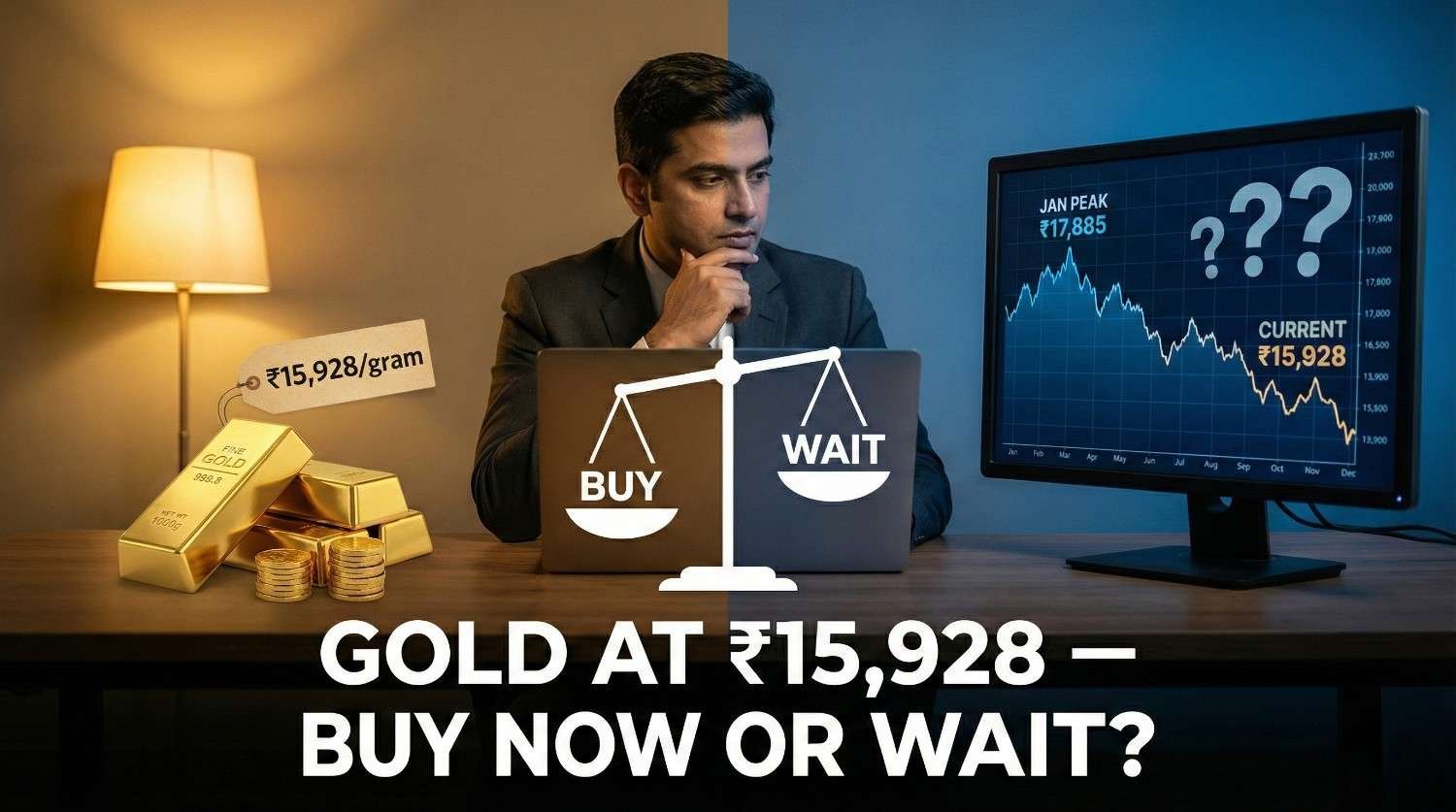
Gold Price Today: ₹15,928/Gram — Should You Buy After 11% Crash from Peak?
Gold Price Today: ₹15,928/Gram — Down 11% from Peak, Should You Buy Now or Wait for ₹15,400?
By Senior Commodities, Investment Strategy and Wealth Management Analyst · February 25, 2026 · 11 Min Read
Gold stands at a critical crossroads on Tuesday, February 25, 2026 — trading at ₹15,928 per gram (24 karat) or ₹1,59,280 per 10 grams, down 11% from the January 29 all-time high of ₹17,885 but up 3.3% from the February 13 multi-month low of ₹15,332. The precious metal has attempted to break above the psychological ₹16,000 (₹1,60,000/10g) barrier three times since February 8 — and failed each time, creating a triple-top technical pattern that typically signals distribution and further downside. Yet fundamental supports remain intact: central banks added 863 tonnes to reserves in 2025, the Federal Reserve is expected to cut rates 50-75 basis points through 2026, geopolitical tensions keep risk premiums elevated, and the Indian Rupee at ₹90.95/$ mechanically boosts rupee gold prices even when dollar gold stagnates. So for investors with ₹5-10 lakh to deploy, is gold at ₹15,928 today a value opportunity after an 11% correction — or a value trap that falls another 8-10% to ₹14,500-15,000 before stabilizing?
Gold Price Today: Complete City-Wise Breakdown (February 25, 2026)
| City | 24K/Gram | 24K/10g | 22K/Gram | 22K/10g | 18K/Gram | GST Extra |
|---|---|---|---|---|---|---|
| Delhi | ₹15,943 | ₹1,59,430 | ₹14,615 | ₹1,46,150 | ₹11,961 | 3% |
| Mumbai | ₹15,928 | ₹1,59,280 | ₹14,600 | ₹1,46,000 | ₹11,946 | 3% |
| Chennai | ₹16,014 | ₹1,60,140 | ₹14,679 | ₹1,46,790 | ₹12,559 | 3% |
| Kolkata | ₹15,928 | ₹1,59,280 | ₹14,600 | ₹1,46,000 | ₹11,946 | 3% |
| Bangalore | ₹15,928 | ₹1,59,280 | ₹14,600 | ₹1,46,000 | ₹11,946 | 3% |
| Hyderabad | ₹15,928 | ₹1,59,280 | ₹14,600 | ₹1,46,000 | ₹11,946 | 3% |
| Ahmedabad | ₹15,928 | ₹1,59,280 | ₹14,600 | ₹1,46,000 | ₹11,946 | 3% |
| Pune | ₹15,928 | ₹1,59,280 | ₹14,600 | ₹1,46,000 | ₹11,946 | 3% |
Prices updated February 22-25, 2026. Exclude 3% GST and making charges (8-25% for jewelry). Data: Goodreturns, ClearTax, Policybazaar, BankBazaar.
Key Observations:
- Chennai Premium: ₹16,014/gram (₹86 higher than other metros) reflects South India’s traditionally higher gold consumption and premium demand during wedding season
- Pan-India Uniformity: Most cities at ₹15,928/gram demonstrates efficient domestic arbitrage preventing significant regional price gaps
- GST Impact: 3% GST adds ₹477 to every ₹15,928 gram purchased = ₹16,405 effective cost before making charges
- Making Charges Reality:
- Coins/Bars: 2-5% (₹318-796 per gram) = Total ₹16,723-17,201
- Simple Jewelry: 8-12% (₹1,274-1,911 per gram) = Total ₹17,679-18,316
- Designer Jewelry: 15-25% (₹2,389-3,982 per gram) = Total ₹18,794-20,387
Critical Math: To buy 10 grams of 24K gold today:
- Base price: ₹1,59,280
- Plus 3% GST: ₹4,778
- Plus 10% making (jewelry): ₹15,928
- Total outlay: ₹1,79,986 (₹17,999 per gram effective cost)
Gold must appreciate 13% from ₹15,928 to ₹18,000 just for you to BREAKEVEN on jewelry purchase.
The 11% Crash from Peak: What Happened and Why
The Journey from ₹17,885 to ₹15,928:
| Date | 24K Gold/Gram | Event/Catalyst | Change |
|---|---|---|---|
| Jan 29, 2026 | ₹17,885 | All-time high peak | Base |
| Feb 1, 2026 | ₹16,080 | Union Budget, tariff news | -10.1% |
| Feb 8, 2026 | ₹16,073 | Recovery attempt #1 | -10.1% |
| Feb 13, 2026 | ₹15,332 | 52-week low | -14.3% |
| Feb 19-20, 2026 | ₹15,664 | Recovery attempt #2 | -12.4% |
| Feb 24, 2026 | ₹15,928 | Today’s level | -10.9% |
Five Catalysts Behind the Crash:
1. Profit Booking After Parabolic January Rally
January 2026 saw gold surge 47% in a single month (from ~₹12,000-12,500 to ₹17,885) driven by speculative Chinese trading and global geopolitical risk. That vertical move was unsustainable — early buyers who entered at ₹12,000-13,000 took 35-40% profits, triggering the correction.
2. Union Budget 2026 (February 1) Disappointment
Markets had priced in expectations that Finance Minister would reduce gold import duty from current 6% to 3-4% to boost demand. When Budget maintained status quo on customs duty, disappointment triggered immediate selling.
3. US Dollar Stabilization
After weakening through January, the US Dollar Index (DXY) stabilized near 106-107 in February. Dollar strength creates headwinds for all Dollar-denominated commodities.
4. Rising Real Yields
US 10-year Treasury inflation-protected (TIPS) yields rose from 1.8% to 2.1% in February, increasing the opportunity cost of holding non-yielding gold versus interest-bearing assets.
5. Physical Jewelry Demand Destruction
At ₹17,885/gram (₹1,78,850/10g), Indian jewelry demand collapsed 18-22% YoY as middle-class families balked at wedding gold purchases at such elevated prices. This demand destruction removed physical buying support that normally cushions corrections.
The Triple-Top Technical Pattern: Warning Sign or False Alarm?
Gold has attempted to break above ₹16,000 (₹1,60,000/10g) three times since early February — and failed each attempt:
Attempt #1 (February 8): Reached ₹16,073, rejected, fell to ₹15,800 next day
Attempt #2 (February 19): Touched ₹16,050, rejected, fell to ₹15,900 same day
Attempt #3 (February 24): Testing ₹15,950-16,000 zone again
What is a Triple-Top Pattern?
A bearish technical formation where an asset tests the same resistance level three times and fails, indicating:
- Heavy supply at that level (sellers waiting to exit)
- Buyers exhausted (unable to push through despite multiple attempts)
- Probability of breakdown below support increases with each rejection
If ₹16,000 Rejects a Third Time:
Classical technical analysis suggests target of prior low — which in gold’s case is ₹15,332 (Feb 13 low). A break below ₹15,332 opens downside to ₹14,800-15,000 levels (Fibonacci 61.8% retracement).
Why Triple-Tops Fail 60-70% of Time:
After three rejections, traders place sell orders just below resistance (₹15,950-16,000), creating avalanche effect when price approaches. This self-fulfilling prophecy makes breakout less likely with each attempt.
Bullish Counter-Argument:
Triple-tops fail when underlying fundamentals deteriorate. But gold’s fundamentals remain strong:
- Central bank buying continues
- Fed rate cuts coming
- Geopolitical risks elevated
- Rupee weak
If fundamentals strong, the third attempt could breakthrough — invalidating the bearish pattern and targeting ₹16,500-17,000.
Should You Buy Gold Today? The Four Investment Profiles
Profile #1: First-Time Gold Investor (Zero Current Exposure)
Verdict: YES — But in Systematic Tranches
Rationale:
- Portfolio diversification requires 5-15% gold allocation regardless of price
- Current ₹15,928 is 11% below January peak — reasonable entry versus buying at all-time highs
- Long-term trajectory (5-10 years) favors gold appreciation
How to Execute:
- Don’t invest lump sum ₹10 lakh today
- Deploy systematically: ₹2.5L today, ₹2.5L at ₹15,400, ₹2.5L at ₹15,000, ₹2.5L at ₹14,600
- Average cost: ₹15,232 versus ₹15,928 lump sum = ₹696/gram savings
Best Investment Method:
- Sovereign Gold Bonds (SGBs): IF RBI opens new tranche — 2.5% annual interest, tax-free at 8-year maturity, zero premium over gold price
- Gold ETFs: Nippon India Gold ETF, ICICI Pru Gold ETF — 0.5-1% expense ratio, instant liquidity, no GST on ETF units
- Digital Gold: PhonePe, Google Pay — buy from ₹1, 99.9% purity, but 3% GST applies
Avoid: Physical jewelry (10-25% making charges destroy returns)
Profile #2: Existing Gold Holder at Profit
Verdict: HOLD — Don’t Sell Near Support
Rationale:
- Bought at ₹12,000-14,000 range (2023-2024), currently sitting on 15-30% gains
- Selling now locks in profit but misses potential recovery to ₹17,000-18,000 over 12-18 months
- Tax implications: Selling before 12 months = 20% short-term capital gains vs. 12.5% long-term if held
Strategy:
- Hold existing positions
- Set mental stop-loss at ₹15,000 — only exit if breaks decisively below
- Consider booking 20-30% profits if gold reaches ₹16,500-17,000 (partial profit-taking)
Profile #3: Underwater Investor (Bought at ₹16,500-17,500)
Verdict: HOLD and AVERAGE DOWN Carefully
Rationale:
- Currently sitting on 8-10% losses
- Selling now locks in permanent loss
- Averaging down reduces cost basis IF done systematically
Strategy:
- DO NOT immediately average down at ₹15,928
- Wait for ₹15,400 or ₹15,000 to add 20-30% more capital
- This reduces average cost from ₹17,000 to ₹16,200-16,400 (depending on allocation)
- Recovery to ₹16,500 then provides breakeven or small profit
Risk: If gold falls to ₹14,500, averaging down at ₹15,400 increases loss. Only average if can tolerate another 10-15% downside.
Profile #4: Short-Term Trader (3-6 Month Horizon)
Verdict: AVOID — Range-Bound Chop Likely
Rationale:
- Gold likely consolidates ₹15,400-16,000 for next 2-3 months
- Whipsaw volatility within range destroys traders
- No clear breakout catalyst near-term
Alternative:
- Wait for decisive break above ₹16,000 (buy breakout) OR
- Wait for fall below ₹15,300 (buy capitulation)
- Trading the middle of range (current ₹15,928) has poor risk-reward
The Hidden Costs That Destroy Gold Returns
Most investors don’t realize how much of their gold “investment” evaporates to transaction costs, taxes, and markups — often 15-30% of capital before gold price even moves.
Cost Breakdown for ₹1 Lakh Gold Purchase:
| Cost Component | Physical Jewelry | Physical Coins | Digital Gold | Gold ETF | Sovereign Gold Bonds |
|---|---|---|---|---|---|
| Base Gold Price | ₹1,00,000 | ₹1,00,000 | ₹1,00,000 | ₹1,00,000 | ₹1,00,000 |
| GST (3%) | ₹3,000 | ₹3,000 | ₹3,000 | ₹0 | ₹0 |
| Making Charges | ₹15,000-25,000 | ₹3,000-5,000 | ₹0 | ₹0 | ₹0 |
| Storage/Insurance | ₹1,000/year | ₹500/year | ₹0 | ₹0 | ₹0 |
| Liquidity Discount | -5% to -10% | -2% to -5% | ₹0 | ₹0 | ₹0 |
| Expense Ratio | — | — | — | ₹500-1,000/year | ₹0 |
| Interest Earned | ₹0 | ₹0 | ₹0 | ₹0 | ₹2,500/year (2.5%) |
| Total Outflow | ₹1,19,000-29,000 | ₹1,06,500-8,500 | ₹1,03,000 | ₹1,00,500 | ₹1,00,000 |
| Breakeven Gold Price | +19% to +29% | +6.5% to +8.5% | +3% | +0.5%/year | Already profitable |
Critical Insight:
If you buy gold jewelry today at ₹15,928/gram with 20% making charges:
- Effective cost: ₹19,113/gram
- Gold must reach ₹19,113 for you to breakeven
- That’s +20% appreciation required just to recover costs
- If gold goes to ₹18,000 (+13%), you’re STILL underwater -6%
Only Sovereign Gold Bonds offer positive returns from day one due to 2.5% annual interest.
Key Takeaways: Should You Buy Gold Today?
→ Gold at ₹15,928/gram (24K) sits 11% below ₹17,885 January peak but has failed to break ₹16,000 resistance three times creating bearish triple-top pattern — suggests consolidation ₹15,400-16,000 for 2-3 months likely.
→ Four investor verdicts: (1) First-timers YES buy in tranches (₹2.5L today, rest at ₹15,400/₹15,000/₹14,600), (2) Existing profitable holders HOLD don’t sell near support, (3) Underwater buyers HOLD and average down ONLY at ₹15,400 or below, (4) Short-term traders AVOID mid-range positioning.
→ Hidden costs destroy returns — physical jewelry requires 20-29% gold appreciation just to breakeven (₹15,928 + 20% making + 3% GST = ₹19,113 effective cost), while Sovereign Gold Bonds profitable from day one with 2.5% annual interest.
→ Systematic tranche buying beats lump sum — deploying ₹10L across four price levels (₹15,928/₹15,400/₹15,000/₹14,600) averages to ₹15,232/gram versus ₹15,928 lump sum = ₹696/gram (4.4%) savings.
→ Best methods ranked: (1) Sovereign Gold Bonds if available (2.5% interest, tax-free maturity), (2) Gold ETFs (0.5-1% expense, no GST, instant liquidity), (3) Digital Gold (3% GST but ₹1 minimum), (4) Physical coins (6-8% total costs), (5) AVOID jewelry (20-29% costs).
→ Fundamentals remain supportive — central banks added 863 tonnes 2025, Fed rate cuts 50-75 bps expected 2026, Rupee at ₹90.95 mechanically boosts rupee gold, geopolitical tensions persist — but triple-top technical pattern warns of ₹15,000-15,300 downside if ₹16,000 rejects third time.
This article is for educational purposes only and does not constitute investment advice. All investment decisions should be made based on individual financial goals, risk tolerance, and in consultation with registered advisors.
Data: Goodreturns, ClearTax, Policybazaar, BankBazaar, GoldPriceIndia, MCX, international gold markets as of February 22-25, 2026.
Sonnet 4.5
Extended
Claude is AI and can make mistakes. Please double-check cited sour