Best Stocks for Daily Trading India 2026: Top 15 Intraday Picks
Best Stocks for Daily Trading India 2026: Top 15 High-Volume, Liquid Stocks for Intraday Profits
By Senior Indian Equity Markets and Intraday Trading Specialist · February 24, 2026 · 12 Min Read
Intraday trading — buying and selling stocks within the same trading day to profit from short-term price movements — succeeds or fails based on one critical decision: stock selection. The 89% of retail traders who lose money in intraday trading (per SEBI study) typically make the fatal error of trading illiquid, low-volume stocks where a single large order moves prices 2-3% against them, destroying profits through slippage. The profitable 11% consistently trade a core group of 15-20 high-volume, liquid stocks with predictable volatility patterns, tight bid-ask spreads, and sufficient daily movement to generate 1-3% intraday returns. So which specific stocks should you focus on for daily trading in 2026 — and what criteria separate the consistent profit generators from the account destroyers?
The 5 Non-Negotiable Criteria for Selecting Daily Trading Stocks
Before examining specific stocks, understanding the selection criteria prevents the costly mistake of trading random stocks based on tips, news, or yesterday’s price movement.
Criterion #1: High Daily Trading Volume (Minimum 50 Lakh Shares)
Volume measures how many shares trade hands daily. High volume ensures:
- Instant execution: Your buy/sell orders fill immediately at desired price
- Low slippage: Price doesn’t move against you between order placement and execution
- Tight spreads: Small difference between buying price and selling price (typically ₹0.05-0.20 for high-volume stocks vs ₹2-5 for low-volume)
| Volume Category | Daily Volume | Execution Quality | Example Stocks |
|---|---|---|---|
| Excellent | 100 lakh+ shares | Instant, zero slippage | SBI, Reliance, ICICI Bank |
| Good | 50-100 lakh | Quick, minimal slippage | Bharti Airtel, Axis Bank |
| Acceptable | 25-50 lakh | Moderate delays | Select mid-caps |
| Avoid | <25 lakh | High slippage risk | Most small-caps |
Criterion #2: Moderate to High Intraday Volatility (2-5% Daily Range)
Volatility creates profit opportunities. Without price movement, you cannot make money.
| Volatility Type | Daily Range | Opportunity | Risk Level |
|---|---|---|---|
| Too Low | <1.5% | Limited profit potential | Low but unprofitable |
| Ideal | 2-5% | Sufficient for 1-3% gains | Manageable |
| Too High | >7% | Large gains possible | Stop-losses frequently hit |
Why 2-5% is optimal: A stock with 3% intraday range allows you to capture 1-1.5% profit (33-50% of daily movement) with proper entry/exit timing. Stocks moving <1.5% require excessive leverage to generate meaningful returns, while >7% movement triggers too many stop-losses.
Criterion #3: High Liquidity (Tight Bid-Ask Spread <0.05%)
Liquidity ensures you can enter and exit without affecting price. Measured by bid-ask spread:
- Highly liquid: ₹0.05-0.20 spread on ₹100 stock (0.05-0.2%)
- Moderately liquid: ₹0.50-1.00 spread (0.5-1%)
- Illiquid (avoid): ₹2-5 spread (2-5%)
Example: Reliance at ₹1,423 with ₹0.10 bid-ask spread = 0.007% cost. You lose only ₹10 per ₹1 lakh position to spread. Low-volume stock at ₹450 with ₹3 spread = 0.67% cost = ₹670 per ₹1 lakh — destroying profitability before the trade even moves.
Criterion #4: Correlation with Market/Sector Trends
Stocks that move predictably with Nifty or sector indices are easier to trade. When Nifty rallies 0.8%, high-correlation stocks (beta 1.0-1.2) move 0.8-1% proportionally — creating predictable setups.
Criterion #5: News-Driven or Technically Responsive
Best intraday stocks either:
- React strongly to news (banks to RBI policy, IT to Dollar movement, metals to commodity prices)
- Respect technical levels (support/resistance, VWAP, moving averages)
Stocks that do neither — moving randomly regardless of news or technical levels — are impossible to trade profitably.
Top 15 Best Stocks for Daily Trading in India (February 2026)
Based on the five criteria, here are the consistently best-performing stocks for intraday trading, ranked by liquidity and proven track record.
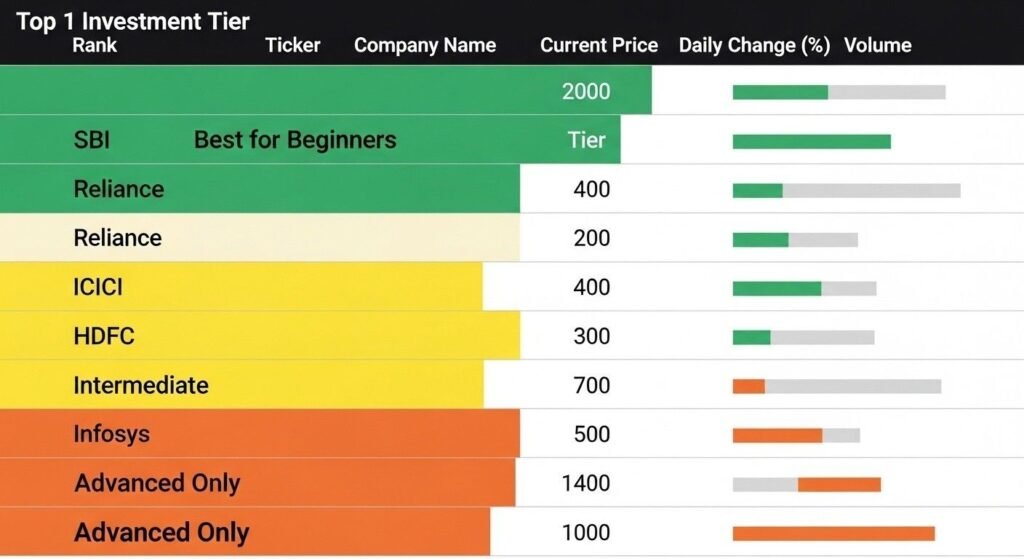
Tier 1: Ultra-Liquid Blue Chips (Best for Beginners)
| Stock | Price Range | 20-Day Avg Volume | Market Cap | Why Good for Intraday |
|---|---|---|---|---|
| State Bank of India (SBI) | ₹1,200-1,220 | 136.5 lakh shares | ₹10.8L Cr | Highest bank volume, RBI policy sensitive, near ATH momentum |
| Reliance Industries | ₹1,420-1,430 | 120+ lakh | ₹19.4L Cr | Blue-chip liquidity, oil price correlation, institutional favorite |
| ICICI Bank | ₹1,250-1,260 | 115.8 lakh | ₹9L Cr | Banking sector leader, high beta to Bank Nifty, tight spreads |
| HDFC Bank | ₹1,570-1,580 | 100+ lakh | ₹12L Cr | Most liquid private bank, consistent 2-3% daily range |
| Infosys | ₹2,080-2,100 | 90+ lakh | ₹8.5L Cr | Dollar-sensitive, IT sector proxy, technical respect |
Why Tier 1 is Best for Beginners: These five stocks offer the tightest spreads (₹0.05-0.15), instant execution even on 5,000-10,000 share orders, and most predictable intraday patterns. A beginner can focus exclusively on SBI and Reliance for first 3-6 months and master intraday trading before expanding.
Tier 2: High-Volume Large Caps (Intermediate Traders)
| Stock | Price Range | 20-Day Avg Volume | Key Characteristics |
|---|---|---|---|
| Axis Bank | ₹1,080-1,090 | 85+ lakh | Third-largest private bank, strong intraday swings |
| Bharti Airtel | ₹1,605-1,615 | 57.1 lakh | Telecom leader, responds to sector news, high market cap |
| Tata Consultancy Services | ₹2,680-2,700 | 70+ lakh | IT heavyweight, Dollar correlation, down 31% from peak creates volatility |
| Tata Steel | ₹155-160 | 65+ lakh | Metal sector proxy, commodity price sensitive, high beta |
| Larsen & Toubro | ₹3,600-3,650 | 55+ lakh | Infrastructure play, responds to capex news, good volume |
Tier 3: Volatile Mid-Tier Stocks (Advanced Traders)
| Stock | Price Range | 20-Day Avg Volume | Risk-Reward Profile |
|---|---|---|---|
| Hindustan Copper | ₹560-575 | 2.78 Cr (27.8 million) | Extreme volatility, metal price sensitive, 4-7% daily swings |
| NMDC | ₹78-80 | High | Iron ore play, government mining policies impact, volatile |
| Havells India | ₹1,510-1,520 | 76.5 lakh | Consumer electrical, moderate volatility, technical respect |
| Hindustan Zinc | ₹725-730 | 2.58 Cr | Commodity play, zinc/silver price driven, high volume |
| Adani Ports | ₹1,250-1,270 | 50+ lakh | Port traffic data sensitive, infrastructure theme |
Critical Warning on Tier 3: These stocks offer 4-7% daily ranges (vs 2-3% in Tier 1) but have significantly higher risk. Hindustan Copper can move ±5% in 30 minutes, triggering stop-losses before reversing direction. Only trade these after 6-12 months of consistent profitability in Tier 1-2 stocks.
Technical Indicators Essential for Daily Trading These Stocks
Selecting the right stock is only 50% of success. The other 50% is using proper technical indicators to time entries and exits.
Indicator #1: VWAP (Volume Weighted Average Price) — The Intraday King
VWAP calculates the average price weighted by volume throughout the day. It’s the single most important intraday indicator.
How to Use:
- Price above VWAP: Bullish bias — look for long entries on pullbacks to VWAP
- Price below VWAP: Bearish bias — look for short entries on bounces to VWAP
- Price crosses VWAP: Potential trend change — wait for confirmation
Example: SBI opens at ₹1,210, VWAP at ₹1,208. Price dips to ₹1,205 (below VWAP) at 10:00 AM = short signal. Covers at ₹1,202 = ₹3 profit per share = ₹6,000 profit on 2,000 shares.
Indicator #2: RSI (Relative Strength Index) — Overbought/Oversold Detection
RSI measures momentum on 0-100 scale:
- RSI >70: Overbought — consider booking profits/shorting
- RSI <30: Oversold — consider buying
- RSI 40-60: Neutral — no clear signal
Intraday RSI Settings: Use 9-period or 14-period RSI on 5-minute or 15-minute charts.
Indicator #3: Moving Averages (9 EMA + 21 EMA) — Trend Identification
Plot 9 EMA (Exponential Moving Average) and 21 EMA on 5-minute chart:
- 9 EMA crosses above 21 EMA: Buy signal
- 9 EMA crosses below 21 EMA: Sell signal
- Price above both EMAs: Strong uptrend — only take long trades
- Price below both EMAs: Strong downtrend — only take short trades
Indicator #4: Volume Analysis — Confirmation Tool
High volume confirms price moves; low volume suggests false moves.
Rules:
- Breakout above resistance with 2x normal volume: Valid breakout, go long
- Breakout above resistance with low volume: False breakout, avoid or short
- Sharp price drop with high volume: Panic selling, potential reversal opportunity
Indicator #5: Support & Resistance Levels
Mark previous day’s high/low and opening price. These act as magnets for intraday price action.
Example: Reliance previous close: ₹1,423. Opens at ₹1,425. Previous day high: ₹1,435.
- If breaks ₹1,435 with volume → Target ₹1,445-1,450
- If rejects at ₹1,434 → Short to ₹1,425-1,420
Intraday Trading Strategy: Step-by-Step Daily Trading Plan
Pre-Market Preparation (8:30 AM – 9:15 AM):
- Check Gift Nifty: Indicates market opening direction
- Scan global markets: US close, Asian opening — determines risk-on or risk-off sentiment
- Identify 3-5 stocks from Top 15 list showing news catalysts or technical setups
- Mark key levels: Previous day high/low, VWAP from previous session
- Set alerts: For breakout/breakdown levels
Opening Session (9:15 AM – 10:00 AM) — The Most Volatile Hour
Rules:
- DO NOT trade in first 15 minutes (9:15-9:30 AM): Extreme volatility, wide spreads, false breakouts
- Observe 9:15-9:30 AM: Let the opening chaos settle, identify true direction
- Enter trades 9:30-10:00 AM: Once direction confirmed
Example Setup: SBI opens at ₹1,212 (gap-up from ₹1,205 previous close). Wait until 9:30 AM. If holds above ₹1,210 with increasing volume, buy at ₹1,211 targeting ₹1,218 with ₹1,207 stop-loss.
Mid-Day Session (10:00 AM – 2:00 PM) — Range-Bound Consolidation
Characteristics:
- Lower volume (institutional lunch hour)
- Narrow ranges, choppy movement
- Difficult to trade — many false signals
Strategy:
- If already in profitable position: Trail stop-loss, let it run
- If no position: Wait for 2:00 PM power hour, avoid overtrading
- Scalpers only: Can trade small 0.3-0.5% moves but high risk-reward ratio poor
Power Hour (2:00 PM – 3:30 PM) — Trend Continuation or Reversal
Characteristics:
- Volume picks up as institutions position for next day
- Clear directional moves
- Best time for new entries if you missed morning
Strategy:
- If market trending up from morning: Look for continuation trades
- If market choppy all day: Expect breakout in power hour direction
- Exit all positions by 3:20 PM: Never hold intraday trades past 3:25 PM
Post-Market Analysis (After 3:30 PM):
- Review trades: What worked, what didn’t
- Calculate P&L: Track win rate (aim for >55%)
- Prepare watchlist for tomorrow: Stocks showing setups
- Journal lessons learned: Critical for improvement
The 7 Deadly Mistakes That Destroy Intraday Traders
Mistake #1: Trading Low-Volume Stocks
The Trap: Stock tip on WhatsApp: “XYZ penny stock will move 10% today!” You buy 5,000 shares. Want to exit — but no buyers. Stock gaps down 5% before you can sell.
Solution: ONLY trade stocks with 50 lakh+ daily volume from the Top 15 list above.
Mistake #2: Not Using Stop-Losses
The Trap: Buy SBI at ₹1,210 expecting move to ₹1,218. It falls to ₹1,205. You think “it will recover.” Falls to ₹1,200. You’re now -₹10 per share = -₹20,000 on 2,000 shares.
Solution: Set stop-loss BEFORE entering trade. Risk maximum 0.5-0.8% per trade. ₹1,210 entry → ₹1,206 stop = ₹4 risk per share.
Mistake #3: Overtrading (More Than 3-4 Trades Per Day)
The Trap: Make ₹2,000 profit on first trade. Excited, take 8 more trades. Win 3, lose 5. End day with -₹1,500 despite starting +₹2,000.
Solution: Limit to 2-3 high-conviction trades daily. Quality over quantity.
Mistake #4: Revenge Trading After Loss
The Trap: Lose ₹3,000 on morning trade. Emotional, take bigger position to “make it back.” Lose another ₹5,000. Day ends -₹8,000.
Solution: After 2 consecutive losses in one day, STOP TRADING. Come back tomorrow with clear mind.
Mistake #5: Using Excessive Leverage
The Trap: Broker offers 5x intraday margin. You have ₹1 lakh, trade ₹5 lakh position. Stock moves 1% against you = -₹5,000 = 5% of capital gone in one trade.
Solution: Use maximum 2-3x leverage initially, 1x leverage (no margin) ideal for beginners.
Mistake #6: Holding Losing Positions Overnight
The Trap: Bought Reliance at ₹1,430 for intraday. Falls to ₹1,420. Instead of booking -₹10 loss, you hold thinking “tomorrow it will recover.” Opens ₹1,410 next day due to negative news.
Solution: NEVER convert intraday losing trade to delivery position. Square off all positions by 3:20 PM without exception.
Mistake #7: Trading During News Events (Budget, RBI Policy, Results)
The Trap: RBI policy announcement at 10:00 AM. You’re in trade. Market gaps up 200 points then reverses 300 points down in 5 minutes. Stop-loss slippage huge.
Solution: Exit all positions 15 minutes before major scheduled events. Re-enter after volatility settles.
Key Takeaways
→ Best stocks for daily trading must have 50 lakh+ daily volume (SBI 136L, ICICI 115L, Reliance 120L+), 2-5% intraday volatility, and <0.05% bid-ask spread — only 15-20 stocks in NSE meet all criteria consistently.
→ Tier 1 stocks (SBI, Reliance, ICICI Bank, HDFC Bank, Infosys) offer tightest spreads ₹0.05-0.15, instant execution, and most predictable patterns — beginners should trade ONLY these for first 3-6 months before expanding.
→ VWAP is the most critical intraday indicator — price above VWAP = bullish bias (buy dips), price below VWAP = bearish bias (short bounces), price crossing VWAP = potential trend change requiring confirmation.
→ Avoid trading first 15 minutes (9:15-9:30 AM) when spreads are wide and false breakouts common — best entry windows are 9:30-10:00 AM after direction confirms and 2:00-3:20 PM power hour.
→ Seven deadly mistakes destroy 89% of intraday traders: trading low-volume stocks, no stop-losses (risk max 0.5-0.8% per trade), overtrading (limit to 2-3 trades/day), revenge trading after losses, excessive leverage (use max 2-3x), holding losers overnight, trading during news events.
→ Ideal intraday trade risks ₹4,000 to make ₹8,000-12,000 on ₹1 lakh capital (4% risk for 8-12% return) — not achievable with low-volume stocks where slippage alone costs 2-3%, requires Top 15 high-liquidity stocks only.
This article is for educational purposes only and does not constitute trading advice. Intraday trading involves substantial risk of loss. Past performance does not guarantee future results. Consult a SEBI-registered advisor before trading.
Data sourced from publicly available information as of February 2026. Sources include: NSE India, Smallcase, Samco Securities, 5paisa, Dhan, Tickertape Stock Screener, Analytics Insight, various technical analysis platforms.