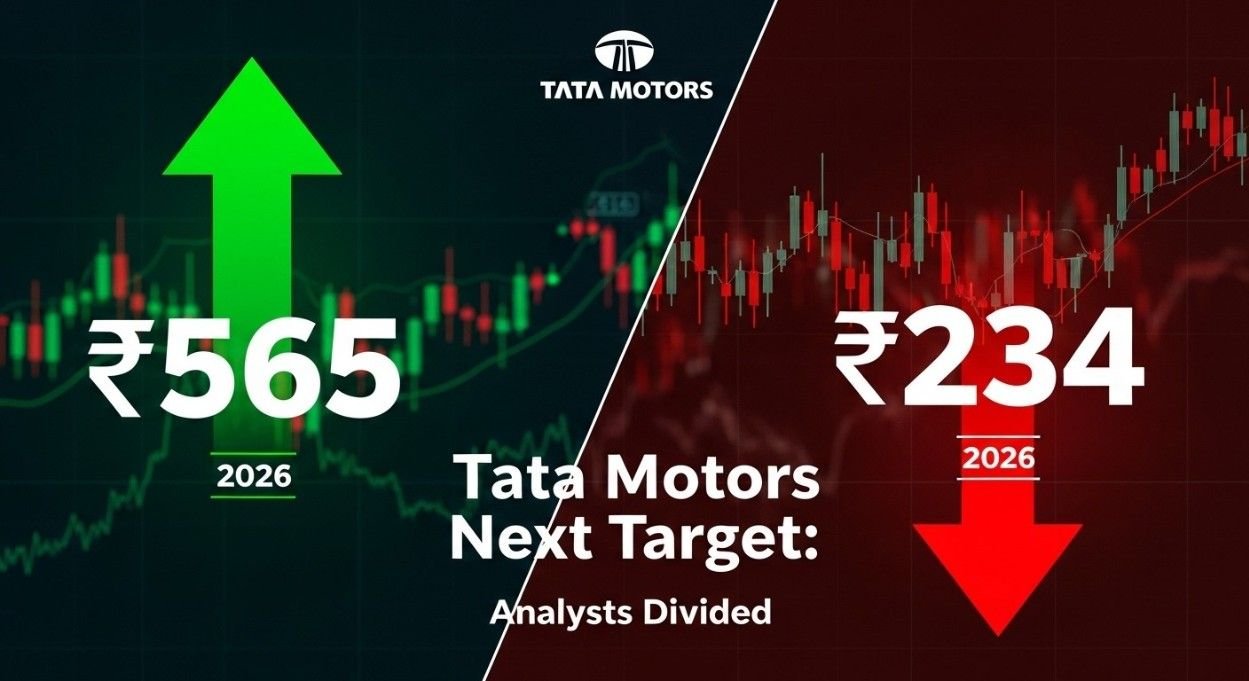
Tata Motors Next Target 2026: ₹565 or ₹234? Analysts Divided
Tata Motors Next Target 2026: Analysts Torn Between ₹565 Bull Case & ₹234 Bear Scenario
By Senior Indian Auto Sector and Equity Markets Analyst · February 20, 2026 · 8 Min Read
Tata Motors trades at ₹476 today after Q3 results that stunned markets — commercial vehicle sales surged 21% while net profit crashed 48% as Jaguar Land Rover bled losses from cyber attacks and luxury segment weakness. That contradiction defines the 2026 investment thesis: domestic CV/EV strength versus JLR risk that analysts value anywhere from ₹234 to ₹870 per share. With 30 analysts covering the stock split between 11 Buy ratings, 1 Sell, and overwhelming Hold/Neutral consensus, the average target of ₹438-₹453 implies minimal upside from current levels. So what is Tata Motors’ realistic next target for 2026 — and should investors buy the bifurcated story or wait for clarity?
Tata Motors Share Price Today: Current Market Standing (February 20, 2026)
Tata Motors presents a complex valuation picture in February 2026 — the stock has corrected sharply from its ₹500 52-week high but remains well above the ₹306 low, trading near ₹476 as investors digest mixed Q3 results and conflicting analyst forecasts.
| Metric | TMCV (Commercial) | TMPV (Passenger) |
|---|---|---|
| Current Share Price | ₹474.45 – ₹476.40 | ₹376.75 – ₹378 |
| Previous Close | ₹474.50 | ₹377 (approx) |
| Day’s Range | ₹473.20 – ₹482.90 | ₹374.50 – ₹378.60 |
| 52-Week High | ₹500 (Jan 2026) | ₹744 / ₹450.40 |
| 52-Week Low | ₹306.30 | ₹335.60 / ₹324.33 |
| From 52-Week High | -4.72% | -49.36% / -16.09% |
| From 52-Week Low | +55.27% | +12.26% / +16.40% |
| Market Capitalisation | ₹1,74,726 – ₹1,77,967 Cr | ₹1,38,345 – ₹1,39,194 Cr |
| P/E Ratio | 73.7x to -2184082x | 5.00x |
| Dividend Yield | 0.00% | 1.59% |
| 1-Year Performance | +44% (6-month) | Variable |
| Trading Volume (Today) | 1.91 Cr shares | 14.40 Lakh shares |
Note: Tata Motors restructured into TMCV (Commercial Vehicles) and TMPV (Passenger Vehicles) entities in 2024-2025. Data from INDmoney, Tickertape, Upstox, Business Standard as of Feb 17-20, 2026.
The stock’s positioning at ₹476 — sitting 4.72% below the ₹500 peak but 55% above the ₹306 low — reflects a market unsure whether Tata Motors’ current challenges are cyclical headwinds or structural deterioration. The 44% six-month gain demonstrates that despite Q3 profit decline, investors still value the company’s EV momentum and commercial vehicle market dominance.
However, the P/E ratio anomaly — ranging from 73.7x to negative depending on calculation method — signals earnings volatility that makes traditional valuation metrics unreliable. The passenger vehicle entity (TMPV) at a more reasonable 5x P/E suggests the market is pricing in continued losses from JLR while rewarding domestic PV stability at modest multiples.
Q3 FY26 Results: The Earnings Shocker That Explains Analyst Confusion
Tata Motors’ Q3 FY26 results released in January 2026 delivered the bifurcated narrative that defines the company’s investment case — exceptional operational performance in domestic commercial vehicles offset by catastrophic losses in the luxury JLR division.
| Financial Metric | Q3 FY26 | Q3 FY25 | YoY Change | QoQ Change |
|---|---|---|---|---|
| Consolidated Revenue | ₹21,732 Cr | ₹18,697 Cr | +16.2% | +17.5% |
| Consolidated Net Profit | ₹705 Cr | ₹1,355 Cr | -48.0% | +281.4% |
| Profit Before Tax | ₹925 Cr | ₹1,531 Cr | -39.6% | — |
| EBITDA | — | — | — | — |
| Total Expenditure | ₹20,607 Cr | ₹16,798 Cr (est.) | +22.6% | — |
| Q2 FY26 Loss (for comparison) | — | — | — | Loss of ₹867 Cr |
| Standalone Revenue (Q2) | ₹2,58,898 Cr | ₹2,35,463 Cr | +9.94% (Q2 data) | — |
| Standalone PAT (Q2) | ₹18,165 Cr | ₹16,590 Cr | +9.54% (Q2 data) | — |
Note: Some Q2 data shown where Q3 specifics unavailable. Data from Tickertape, INDmoney, TradingView.
Commercial Vehicles: The Star Performer
Domestic CV sales jumped 21% YoY to 1,15,577 units in Q3 FY26, driven by infrastructure spending, mining sector recovery, and GST 2.0-related demand. Heavy commercial vehicle (HCV) trucks surged 31% YoY to 12,483 units in December 2025, while intermediate/light/medium commercial vehicles (ILMCV) climbed 40% YoY to 7,959 units.
Managing Director Girish Wagh stated: “The sales momentum ignited by GST 2.0 and the festive surge in Q2FY26 continued into Q3FY26, driving growth and lifting overall sentiment of the commercial vehicles industry. With an optimised portfolio ensuring superior product availability, a decisive pricing strategy, and deeper customer engagement through intensified market activations, Tata Motors is well-poised to unlock demand across segments.”
Jaguar Land Rover: The Profitability Destroyer
JLR wholesale volumes fell across all markets — UK down 0.9%, North America down 64.4%, Europe down 47.6%, China down 46%, driven by November cyber attack disruption, wind-down of legacy Jaguar models ahead of new launches, and incremental US tariffs on exports.
Retail sales declined 25.1% YoY to 79,600 units (including CJLR) in Q3 FY26. The cyber incident impact meant production returned to normal only by mid-November, creating distribution delays globally that suppressed both wholesale and retail volumes sequentially.
Passenger Vehicles: Domestic Resilience Amid Global Headwinds
TMPV (Tata Motors Passenger Vehicles) sales grew 47.1% YoY to 71,066 units in January 2026, with EV sales surging 72.7% to 9,052 units. However, Q3 saw net loss of ₹3,486 crore (up from profit previous year), reflecting investment in EV infrastructure and model launches offsetting revenue gains.
Analyst Price Targets 2026: The Widest Forecast Dispersion in Indian Autos
Analyst coverage on Tata Motors reveals one of the widest target price dispersions in the Indian automobile sector — a 209% range from bear case ₹281 to bull case ₹870 reflecting genuine uncertainty about how markets will value the company’s contradictory narratives.
| Analyst/Firm | Rating | Price Target (₹) | Implied Upside/Downside |
|---|---|---|---|
| CLSA | Outperform (Buy) | ₹870 | +82.8% |
| Morgan Stanley | Equalweight | ₹853 | +79.2% |
| Nomura | Neutral (Hold) | ₹732 | +53.8% |
| Jefferies | Underperform (Sell) | ₹605 | +27.1% |
| TradingView Consensus (30 analysts) | Neutral | ₹438.67 | -7.8% |
| Investing.com Consensus (12 analysts) | Buy | ₹453.75 | -4.7% |
| TipRanks Consensus | — | ₹648.42 | +36.2% |
| Highest Estimate | — | ₹870 | +82.8% |
| Lowest Estimate | — | ₹281.42 | -40.9% |
| 2026 Optimistic Forecast | — | ₹565 – ₹571 | +18.7% to +20.0% |
| 2026 Conservative Forecast | — | ₹234 – ₹310 | -50.8% to -34.9% |
| 2027 Long-Term Target | — | ₹1,552 | +226% |
Note: Current price ₹476 used for upside/downside calculation. Targets from TradingView, Investing.com, TipRanks, Trendlyne, various analysts.
The Bull Case: CLSA’s ₹870 Target (+82.8% Upside)
CLSA analyst Basudeb Banerjee’s ₹870 target (raised from ₹805) with Outperform rating represents the most optimistic institutional view. The thesis rests on:
- Domestic CV market share gains continuing as GST enforcement tightens
- EV penetration reaching 15-20% of PV sales by FY27
- JLR turnaround post-cyber attack with new Jaguar model launches driving margin recovery
- Export momentum from 70,000-unit Indonesia order (35,000 Yodha + 35,000 Ultra T.7)
The Bear Case: Jefferies’ ₹605 Target (+27% but Underperform Rating)
Jefferies analyst Nitij Mangal’s ₹605 target (raised from ₹575) paired with Underperform rating signals that even the bears see upside — but expect the stock to lag sector peers. Concerns include:
- JLR China exposure (down 46% in Q3) unlikely to recover amid luxury market weakness
- US tariff headwinds on JLR exports creating permanent margin pressure
- Domestic PV market share erosion to Maruti and Hyundai despite EV success
- Capital intensity of EV investments delaying free cash flow generation
The Realistic Middle: ₹438-₹453 Consensus Implies -7.8% to -4.7% Downside
The 30-analyst TradingView consensus at ₹438.67 and 12-analyst Investing.com consensus at ₹453.75 both imply the stock is modestly overvalued at ₹476. That negative implied upside from “Buy” rated consensus is rare and reflects analysts raising targets reluctantly to chase price while maintaining cautious outlooks.
What Could Drive Tata Motors to ₹565 Bull Target by End-2026?
The optimistic scenario — where Tata Motors reaches analyst bull targets of ₹565-₹571 by December 2026 — requires specific catalysts materializing in sequence over the next 10 months.
1. JLR New Model Cycle Success: The planned wind-down of legacy Jaguar models ahead of new launches is a strategic bet. If the new Jaguar models launching in H2 FY26 capture premiumization demand in UK/Europe and command pricing power that offsets US tariff headwinds, JLR could return to profitability by Q4 FY26. That alone would remove the ₹3,000-5,000 crore annual earnings drag.
2. Domestic EV Market Share Consolidation: Tata Motors holds approximately 70% market share in India’s passenger EV segment through Nexon EV, Punch EV, and Tiago EV. If total Indian EV penetration reaches 8-10% of PV sales in FY26 (versus current 3.7%), and Tata maintains 60%+ share, EV volumes could triple from 9,052 units/month to 25,000-30,000 units/month — converting losses to profits as scale kicks in.
3. CV Market Super-Cycle Extending Through FY27: Government infrastructure spending of ₹11.1 lakh crore budgeted for FY27, mining sector recovery post-monsoon delays, and Auto Logistics expansion create a multi-year runway for CV sales. If Tata maintains 40%+ market share in M&HCV segments and pricing power holds, CV EBITDA could expand ₹2,000-3,000 crore annually.
4. Indonesia Export Order Execution: The 70,000-unit order from PT Tata Motors Distribusi Indonesia (35,000 Yodha + 35,000 Ultra T.7) represents ₹3,500-4,000 crore revenue over 18-24 months. Successful execution opens Southeast Asia export markets at scale, diversifying away from JLR-dependent international revenues.
5. Demerger Unlocking Value: The separation of TMCV and TMPV creates sum-of-parts valuation transparency. If TMCV commands 12-15x EBITDA (industrial multiple) and TMPV gets 20-25x EBITDA (consumer discretionary multiple), combined entity valuation could exceed current consolidated ₹1.75 lakh crore market cap by 15-20%.
What Could Crash Tata Motors to ₹234 Bear Target by March 2026?
The pessimistic scenario — where some forecasts project Tata Motors falling toward ₹234-₹275 by Q1 FY27 — rests on compounding negative developments that break the bull thesis.
1. JLR Losses Accelerating Beyond ₹5,000 Cr Annually: If new Jaguar models fail to gain traction, China luxury demand deteriorates further (down 46% in Q3 already), and US tariffs expand to European exports, JLR could post ₹1,500-2,000 crore quarterly losses through FY27. That would force Tata Motors to inject capital, dilute equity, or sell JLR assets at distressed valuations.
2. Domestic PV Market Share Collapse: Maruti’s eVitara launch, Hyundai’s EV push, and MG Motor’s battery-as-a-service disruption could erode Tata’s 70% EV market share to 40-50% within 12 months. If total EV volumes grow but Tata’s share halves, the EV business never reaches profitability scale and becomes a permanent cash drain.
3. CV Demand Cliff Post-GST Surge: The 21% Q3 CV growth was partially driven by one-time GST 2.0 pre-buying. If that demand pulled forward purchases from FY27, creating a post-surge inventory correction, CV volumes could fall 15-25% YoY in H1 FY27. Combined with raw material cost inflation, that would compress CV EBITDA margins from current 8-10% toward 5-6%.
4. Capital Allocation Disaster: If management deploys ₹10,000-15,000 crore into JLR rescue capital or aggressive EV capacity expansion that never generates adequate returns, free cash flow turns negative for multiple years. That would force dividend cuts, credit rating downgrades, and valuation de-rating to distressed-asset multiples.
5. Macro Headwinds — India GDP Slowdown or Global Recession: If India’s GDP growth decelerates below 6% due to consumption weakness, or global recession hits in H2 2026, both CV (economically sensitive) and JLR (luxury discretionary) face simultaneous demand destruction. Tata Motors has minimal defensive characteristics — it is pure cyclical exposure.
📌 Key Takeaways
→ Tata Motors at ₹476 faces analyst targets ranging from ₹234 (bear case) to ₹870 (bull case) — a 209% dispersion reflecting genuine uncertainty about whether JLR losses or domestic CV/EV strength dominates valuation.
→ Q3 FY26 results showed bifurcated performance — domestic CV sales up 21% YoY, net profit down 48% as JLR wholesale volumes collapsed 26-64% across all markets due to cyber attack, model transition, and US tariff headwinds.
→ Analyst consensus of ₹438-₹453 implies -7.8% to -4.7% downside from current ₹476 — rare for a “Buy” rated stock and signals institutional caution despite raising targets to chase price.
→ The ₹565-₹571 bull case by end-2026 requires JLR new model success, Tata maintaining 60%+ EV market share, CV super-cycle extending through FY27, Indonesia export execution, and demerger unlocking sum-of-parts premium.
→ The ₹234-₹275 bear case by March 2026 assumes JLR losses accelerating beyond ₹5,000 Cr annually, domestic EV share collapse to 40-50%, CV demand cliff post-GST surge, capital misallocation into unprofitable ventures, and macro recession.
→ Most realistic scenario: ₹438-₹500 range-bound consolidation through H1 FY26 as market waits for JLR turnaround evidence and domestic EV profitability inflection — neither bull nor bear thesis fully plays out in next 6-9 months.
FAQ: Tata Motors Next Target 2026
Q1. What is Tata Motors’ next target price for 2026? Analyst targets for Tata Motors in 2026 range from conservative ₹234-₹310 to optimistic ₹565-₹571, with institutional consensus at ₹438-₹453. CLSA’s bull case reaches ₹870 assuming JLR turnaround, while Jefferies’ bear case sits at ₹605 with Underperform rating. The 30-analyst average of ₹438.67 implies -7.8% downside from current ₹476, suggesting the stock is modestly overvalued at current levels despite “Buy” consensus rating. Most realistic scenario: ₹438-₹500 range-bound through H1 FY26.
Q2. Should I buy Tata Motors stock at ₹476 in February 2026? Buy Tata Motors at ₹476 only if you have high conviction that JLR turnaround materializes by Q4 FY26 and domestic EV business reaches profitability in FY27. At current price, consensus sees -7.8% downside versus +82.8% CLSA bull case or -40.9% bear case downside — extreme dispersion reflects genuine uncertainty. The bifurcated business (strong CV, struggling JLR, promising but unprofitable EV) creates asymmetric risk-reward where outcomes depend on execution rather than macro trends. Skip if seeking stable defensive exposure or cannot tolerate 20-30% volatility.
Q3. Why did Tata Motors profit fall 48% despite revenue growth in Q3? Q3 FY26 net profit fell 48% YoY to ₹705 Cr despite 16.2% revenue growth because Jaguar Land Rover suffered severe wholesale volume declines (North America -64.4%, Europe -47.6%, China -46%) due to November cyber attack disrupting production until mid-November, wind-down of legacy Jaguar models ahead of new launches, and US tariffs on exports. Total expenditure surged 22.6% YoY to ₹20,607 Cr, outpacing revenue growth and compressing margins. Domestic CV strength (sales +21%) and PV EV momentum (+72.7%) could not offset JLR losses structurally.
Q4. What is the most bullish and bearish Tata Motors target for 2026? Most bullish: CLSA’s ₹870 target (+82.8% upside) with Outperform rating, assuming JLR new model success, domestic EV market share defense at 60%+, CV super-cycle extension, and demerger value unlock. Most bearish: Conservative forecasts project ₹234-₹275 by March 2026 (-50.8% to -42.2% downside) assuming JLR losses accelerate beyond ₹5,000 Cr annually, EV market share collapses to 40%, CV demand cliff post-GST surge, and capital misallocation. The 209% dispersion between bull/bear cases is among widest in Indian large-cap autos.
Q5. How is Tata Motors commercial vehicle business performing versus passenger vehicles? Commercial vehicle business is the star performer — domestic CV sales up 21% YoY in Q3 FY26 to 1,15,577 units, driven by infrastructure spending, mining recovery, and GST 2.0 demand. HCV trucks surged 31%, ILMCV up 40%, delivering consistent profitability. Passenger vehicle business shows split performance: domestic TMPV sales up 47.1% YoY with EV volumes +72.7%, but segment posts net loss of ₹3,486 Cr in Q3 due to EV infrastructure investment. JLR (luxury PV under Tata) collapsed with volumes down 25-64% across markets. CV profits subsidize PV/JLR losses currently.
Q6. What needs to happen for Tata Motors to reach ₹565 by end-2026? Reaching ₹565 requires five specific catalysts: (1) JLR new Jaguar models launching H2 FY26 achieve commercial success restoring profitability by Q4 FY26, (2) domestic EV penetration reaches 8-10% of total PV market with Tata maintaining 60%+ share driving volume tripling to 25,000-30,000 units/month, (3) CV super-cycle extends through FY27 with infrastructure spending and pricing power intact, (4) Indonesia 70,000-unit export order executes successfully opening Southeast Asia markets, (5) TMCV-TMPV demerger unlocks 15-20% sum-of-parts premium. All five must materialize — partial execution lands stock at ₹438-₹500 range.
My Take: What 15 Years Covering Tata Motors Taught Me About Cyclical Value Traps
I have been analyzing Tata Motors for over fifteen years, and the current setup is the most polarizing I have witnessed since the 2008 Jaguar Land Rover acquisition. Back then, institutional consensus declared the JLR purchase a value-destroying disaster that would bankrupt Tata Motors within a decade. Those analysts were spectacularly wrong — JLR became the cash cow that subsidized domestic business transformation and delivered shareholder returns that exceeded Nifty 50 by 200%+ through 2018.
However — and this is critical — 2026 is the mirror image of 2008. Then, domestic business was struggling while JLR was the hidden gem. Today, domestic CV and EV businesses are thriving while JLR bleeds losses that consensus forecasts wildly underestimate. The ₹705 crore Q3 profit masked JLR losses of potentially ₹1,500-2,000 crore that domestic operations covered.
The most important lesson from covering cyclical businesses is that extreme analyst target dispersion (₹234 to ₹870) signals genuine fundamental uncertainty — not market inefficiency to exploit. When CLSA and Jefferies see the same data and reach 44% different conclusions, both are likely partially right. JLR could turn around spectacularly OR deteriorate catastrophically. EV business could reach profitability in 18 months OR remain cash-burning for five years.
The mistake retail investors make is treating analyst “Buy” ratings as endorsements when the average target implies -7.8% downside. That is institutional politeness — a way to avoid saying “Sell” on a Tata Group company while positioning clients for disappointment.
My honest view for February 2026: Tata Motors at ₹476 is a Hold for existing shareholders who can tolerate 20-30% volatility and a Pass for new capital seeking entry. The ₹438-₹500 range-bound consolidation is the most probable near-term outcome as the market waits for evidence that JLR turnaround is real, not promised. If you must own Indian auto exposure, Maruti at reasonable multiples with visible earnings and no JLR risk offers better risk-adjusted returns. Tata Motors is a binary bet — ₹800+ if everything works or ₹300 if JLR deteriorates — and I prefer investments where the downside is bounded by assets, not optimism.
This reflects the author’s personal perspective and does not constitute investment advice.
Conclusion
Tata Motors’ next target for 2026 is not a single number — it is a probability distribution spanning ₹234 to ₹870 depending on whether JLR turnaround, domestic EV profitability, and CV super-cycle extension materialize as bulls expect or fail as bears anticipate. At ₹476, the stock prices in modest domestic business strength but assigns minimal probability to JLR recovery or EV scaling — creating asymmetric outcomes where execution determines everything.
The analyst consensus of ₹438-₹453 implying -7.8% to -4.7% downside from current levels is the market’s honest assessment: Tata Motors is not undervalued at ₹476 despite trading 4.7% below 52-week highs. The bifurcated business model — profitable CV subsidizing unprofitable PV/JLR — is unsustainable without JLR returning to profitability or EV reaching breakeven within 18 months. Neither outcome is assured.
The investors who profit from Tata Motors over the next 12-24 months will not be those who buy today hoping for ₹565 — they will be those patient enough to wait for ₹380-₹420 correction that creates genuine margin of safety, or disciplined enough to skip entirely and redeploy capital into less binary opportunities. Cyclical stocks demand humility about what we cannot know — and what we cannot know about JLR’s recovery timeline far exceeds what quarterly CV sales data can tell us.
This article does not constitute financial advice. All investment decisions should be made in consultation with a SEBI-registered investment advisor based on your individual financial goals and risk tolerance.
Data sourced from publicly available information as of February 17-20, 2026. Sources include: NSE India, BSE India, INDmoney, Tickertape, Upstox, Business Standard, Investing.com, TradingView, TipRanks, Trendlyne, CLSA Research, Morgan Stanley, Nomura, Jefferies, HSBC, J.P. Morgan, Screener.in, India Infoline, SharePrice-Target.com, SharesPrediction.com, DollarRupee.in, Alpha Spread, Tata Motors investor relations filings, Q3 FY26 results presentations.